Class 10 Physics: Heat and Temperature Conversions
Class 10 physics heat temperature conversion numericals ask you to move between three scales, Celsius, Fahrenheit, and Kelvin, and to connect temperature change with heat energy where needed. The conversion formulas are short, but students lose marks by adding 273 instead of 273.15 in the wrong direction, by forgetting to subtract 32 before multiplying in the Fahrenheit formula, and by using a temperature change in Celsius as if it were an absolute temperature. This guide teaches all three scales, the conversion formulas with original worked examples, and the difference between heat and temperature that theory questions love to test. Heat and temperature are not the same thing. Temperature measures how hot or cold a body is, related to the average kinetic energy of its particles, while heat is energy transferred because of a temperature difference, measured in joules. A cup of boiling water and a bath of warm water can have very different temperatures and very different total heat energies: the bath holds far more heat energy because it has far more particles, even though its temperature is lower. Temperature is measured with a thermometer in degrees Celsius, degrees Fahrenheit, or kelvin, while heat is measured in joules, and the two are linked by specific heat capacity when a temperature change is involved.
The Three Temperature Scales
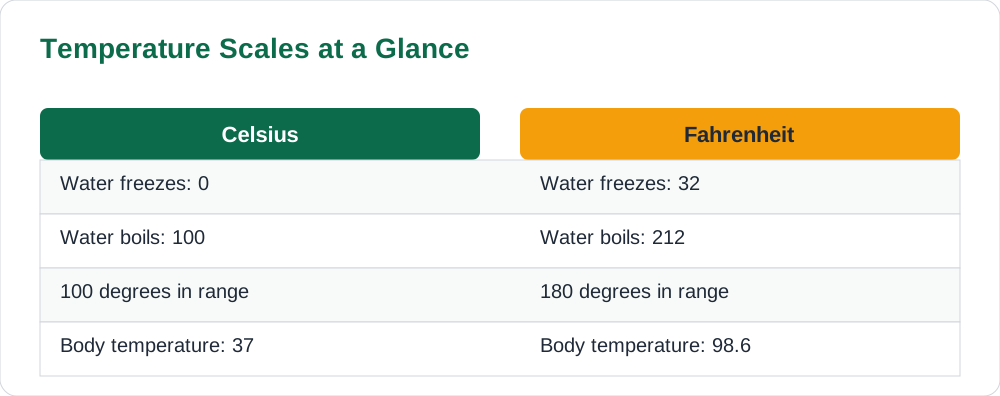
The Celsius scale sets the freezing point of water at 0 degrees and the boiling point at 100 degrees, dividing the range into 100 equal parts. The Fahrenheit scale sets freezing at 32 degrees and boiling at 212 degrees, dividing the same range into 180 parts, which is why each Celsius degree equals 1.8 Fahrenheit degrees. The Kelvin scale is the SI scale: it starts at absolute zero, the lowest possible temperature, and its degree is the same size as a Celsius degree, so converting between Celsius and Kelvin is a simple shift. Water freezes at 273.15 K and boils at 373.15 K, although Class 10 work usually rounds to 273 K and 373 K. Kelvin never takes a degree symbol: write 300 K, not 300 degrees K.
Absolute zero, 0 K or negative 273.15 degrees Celsius, is the temperature at which particle motion is at its minimum, and no temperature can be lower. This is why Kelvin values are always positive, and why a negative Kelvin temperature in your answer means an error. The three scales agree on the physics but differ in zero point and degree size, and every conversion formula simply accounts for those two differences. Memorise the fixed points of each scale, because they let you check any conversion: if your formula says water boils at 100 degrees Fahrenheit, the formula has been applied backwards.
- Celsius: water freezes 0, boils 100.
- Fahrenheit: water freezes 32, boils 212.
- Kelvin: water freezes 273 K, boils 373 K; no degree symbol.
- One kelvin equals one Celsius degree in size.
Conversion Formulas and How to Use Them
The formulas are: K = C + 273, and C = K minus 273, for Celsius and Kelvin. For Celsius and Fahrenheit: F = (C times 9/5) + 32, and C = (F minus 32) times 5/9. The order of operations in the Fahrenheit formulas is critical: to go from Celsius to Fahrenheit, multiply first, then add 32; to go from Fahrenheit to Celsius, subtract 32 first, then multiply by 5/9. Reversing the order gives a wrong answer that often looks plausible, so write the subtraction or addition as its own step. For combined conversions, such as Fahrenheit to Kelvin, convert to Celsius first and then to Kelvin: it is two easy steps instead of one error-prone formula.
A worked pattern: convert 25 degrees Celsius to Fahrenheit. F = (25 times 9/5) + 32 = 45 + 32 = 77 degrees Fahrenheit. Reverse: convert 77 degrees Fahrenheit to Celsius. C = (77 minus 32) times 5/9 = 45 times 5/9 = 25 degrees Celsius. The round trip back to 25 confirms both formulas. Another anchor: 0 degrees Celsius is 32 degrees Fahrenheit and 273 K, and 100 degrees Celsius is 212 degrees Fahrenheit and 373 K. If you remember these two anchor points, you can check any conversion by asking whether your answer sits sensibly between them.
Worked Example 1: Celsius, Fahrenheit and Kelvin
Example: Convert 37 degrees Celsius (normal body temperature) to Fahrenheit and Kelvin. Solution: F = (37 times 9/5) + 32 = 66.6 + 32 = 98.6 degrees Fahrenheit. K = 37 + 273 = 310 K. Example: Convert 300 K to Celsius and Fahrenheit. Solution: C = 300 minus 273 = 27 degrees Celsius. F = (27 times 9/5) + 32 = 48.6 + 32 = 80.6 degrees Fahrenheit. Notice that the Kelvin-to-Celsius step is just a subtraction, while the Celsius-to-Fahrenheit step needs multiplication before addition. Writing each step separately prevents order-of-operations errors.
Example: A winter morning is negative 4 degrees Celsius. Express it in Fahrenheit and Kelvin. Solution: F = (negative 4 times 9/5) + 32 = negative 7.2 + 32 = 24.8 degrees Fahrenheit. K = negative 4 + 273 = 269 K. Negative Celsius values are normal, but the Kelvin result must stay positive: if you get a negative Kelvin value, you have subtracted instead of adding, or the Celsius value is below negative 273, which is impossible. For more solved study material, see the solved notes and the books section.
Worked Example 2: Temperature Change and Heat
Example: A metal block warms from 20 degrees Celsius to 60 degrees Celsius. What is the temperature change in Celsius and in kelvin? Solution: change in Celsius = 60 minus 20 = 40 degrees Celsius. Because a kelvin and a Celsius degree are the same size, the change in kelvin is also 40 K. This is an important distinction: absolute temperatures differ by 273 between the scales, but temperature changes are identical. Students who add 273 to a temperature change get a wildly wrong answer, so underline the word change in the question whenever it appears.
Example: How much heat is needed to raise 2 kg of water by 10 degrees Celsius? The specific heat capacity of water is 4200 J/kg per degree Celsius. Solution: heat Q = m times c times temperature change = 2 times 4200 times 10 = 84,000 J. The temperature change here is 10 degrees, and it does not matter whether it is stated in Celsius or kelvin, because the change is the same. Specific heat capacity questions always use temperature change, never absolute temperature, which is another reason to keep the two ideas separate.
Common Mistakes and Exam Tips
The most common mistakes are adding 32 before multiplying when converting Celsius to Fahrenheit, subtracting 32 after multiplying when converting the other way, adding 273 to a temperature change instead of an absolute temperature, and writing Kelvin with a degree symbol. A second trap is rounding: 273.15 versus 273 rarely changes a Class 10 answer by a mark, but be consistent with the value your question or teacher uses. A third trap is confusing heat with temperature in theory questions: temperature is average particle energy, heat is energy transferred, and a large cool body can hold more heat than a small hot one.
Exam routine: identify the starting scale and target scale, write the formula in symbols, substitute with the correct order of operations, and check against anchor points (0 C = 32 F = 273 K; 100 C = 212 F = 373 K). For heat questions, confirm you are using temperature change, not absolute temperature, and that mass is in kilograms and specific heat capacity matches the units given. The examples here are original practice problems for teaching the method. More guidance is on the blog and the about page.
- Celsius to Fahrenheit: multiply first, then add 32.
- Fahrenheit to Celsius: subtract 32 first, then multiply by 5/9.
- Temperature changes are the same in Celsius and kelvin.
- Kelvin values are always positive; never write a degree symbol with K.
AI Help: Muse AI
Muse AI is Meta's personal AI assistant, and it can help you practise temperature conversions by generating mixed Celsius, Fahrenheit and Kelvin problems, checking your order of operations, and explaining the difference between heat and temperature with everyday examples. Ask it to quiz you on both anchor points until conversions feel automatic. Join Muse with invite code LTGSWD — in the Muse app, go to Settings > Redeem token and enter the code. Disclosure: LTGSWD is the author's Muse invite code. Muse AI does not give official STBB answers — always verify against your STBB book and your teacher. Always verify against your Sindh Textbook Board book and your teacher before using anything in classwork.
5 key points you must know
- K = C + 273; C = K minus 273.
- F = (C times 9/5) + 32; C = (F minus 32) times 5/9.
- Anchor points: 0 C = 32 F = 273 K; 100 C = 212 F = 373 K.
- Temperature changes are identical in Celsius and kelvin.
- Heat Q = m c times temperature change, in joules.
Frequently asked questions
What is the difference between heat and temperature?
Temperature measures how hot a body is, related to average particle energy. Heat is energy transferred because of a temperature difference, measured in joules. A large cool body can hold more heat energy than a small hot body.
Why is Kelvin never written with a degree symbol?
Kelvin is the SI unit of temperature and is written simply as K, for example 300 K. The degree symbol belongs to Celsius and Fahrenheit only.
Is a temperature change of 10 degrees Celsius the same as 10 K?
Yes. A kelvin and a Celsius degree are the same size, so temperature changes are identical on both scales, even though absolute values differ by 273.
What is absolute zero?
Absolute zero is 0 K, or negative 273.15 degrees Celsius, the lowest possible temperature, where particle motion is at its minimum. No temperature can be lower.
How do I convert Fahrenheit directly to Kelvin?
Convert to Celsius first: C = (F minus 32) times 5/9, then add 273 to get kelvin. Two easy steps beat one complicated formula.
Solved notes — preview free
These guides work best with the solved exercises. Preview the solved notes free on this website — 119 solved notes for Classes 6–10 in Sindhi, Urdu, English and Arabic medium. Or browse the full solved notes catalogue for your class and medium. New solved notes are added regularly — check the catalogue for coming-soon books.