Class 10 Physics: Gravitational Force Numericals
Class 10 physics gravitational force numericals test Newton's law of universal gravitation: every mass attracts every other mass with a force proportional to the product of the masses and inversely proportional to the square of the distance between them. The formula, F = G times m1 times m2 divided by r squared, looks intimidating because of the gravitational constant and the large powers of ten, but the questions follow a small number of patterns: force between two masses, weight on Earth or another planet, and how force changes when mass or distance changes. This guide teaches each pattern with original worked values, careful powers of ten, and the weight-versus-mass distinction that theory questions always probe. Gravity is the weakest of the familiar forces, yet it governs planets, moons, and tides, because masses like the Earth are enormous. The gravitational constant G is 6.67 times 10 to the power negative 11, in units of N m squared per kg squared, which is why the force between everyday objects is too tiny to notice: two 1 kg masses 1 metre apart attract each other with a force of only 6.67 times 10 to the power negative 11 newtons. The same law gives the familiar weight of an object on Earth, because the Earth's mass is about 6 times 10 to the power 24 kg, and that enormous number compensates for the tiny constant.
Newton's Law of Gravitation
Newton's law states that the gravitational force between two masses is F = G times m1 times m2 divided by r squared, where m1 and m2 are the masses in kilograms, r is the distance between their centres in metres, and G is 6.67 times 10 to the power negative 11 N m squared per kg squared. The force is attractive, acting along the line joining the centres, and it obeys Newton's third law: each mass pulls the other with an equal and opposite force. The inverse-square part is the key idea: doubling the distance divides the force by four, tripling it divides the force by nine, and halving it multiplies the force by four. Many exam questions test only this scaling, with no numbers at all, so learn it as a sentence, not just as a formula.
The distance r is measured between centres, not between surfaces, which matters for planets and stars where the radius is large. For an object on Earth's surface, r is Earth's radius, about 6.4 times 10 to the power 6 m, plus any height above the surface, which is usually negligible. For two small objects on a bench, r is the distance between their centres. Reading the question for whether it gives centre distance or surface distance prevents a subtle error, although most Class 10 questions give r directly and expect you to use it as stated.
- F = G m1 m2 / r squared, with G = 6.67 x 10^-11.
- Force is attractive and equal on both masses.
- Doubling distance divides force by four (inverse square).
- Distance r is measured between centres.
Weight, Mass and g
Weight is the gravitational force on an object, W = m times g, where g is the acceleration due to gravity, about 10 m/s squared on Earth. This formula is actually Newton's law applied to Earth: g equals G times Earth's mass divided by Earth's radius squared, which works out to about 9.8 m/s squared. That connection explains why g differs on other planets: a planet with larger mass or smaller radius has a larger g, and a smaller or larger planet has a smaller g. Mass never changes with location, but weight does, because weight depends on the planet's mass and radius through g.
Example: an astronaut of mass 70 kg has a weight on Earth of 70 times 10 = 700 N. On the Moon, where g is about 1.7 m/s squared, the same astronaut weighs 70 times 1.7 = 119 N, but the mass is still 70 kg. This mass-versus-weight distinction is the single most tested theory point in the gravitation chapter, so state it explicitly whenever a question asks about the Moon or another planet. A question that gives weight in newtons and asks for mass needs division by g: mass = weight / g, and the planet's g must be used, not Earth's, if the weight was measured there.
Worked Example 1: Force Between Two Masses
Example: Find the gravitational force between two masses of 10 kg and 20 kg placed 2 m apart. Solution: F = G times m1 times m2 / r squared = 6.67 times 10 to the power negative 11 times 10 times 20 / (2 squared) = 6.67 times 10 to the power negative 11 times 200 / 4 = 6.67 times 10 to the power negative 11 times 50 = 3.34 times 10 to the power negative 9 N. The answer is tiny, as expected for everyday masses, and the working shows each step: product of masses, square of distance, then the constant. Keeping powers of ten separate from the main number prevents the most common arithmetic error in this chapter.
Example: Two masses attract each other with a force F. If the distance between them is doubled, what is the new force? Solution: force is inversely proportional to distance squared, so doubling distance gives F / 4. If the distance is halved instead, the new force is 4F. If one mass is doubled and the distance is doubled, the new force is 2F / 4 = F / 2, because the doubled mass multiplies the force by 2 while the doubled distance divides it by 4. Scaling questions reward reasoning over calculation, so write the scaling factor for each change before combining them.
Worked Example 2: Weight on Earth and Other Planets
Example: A rock of mass 5 kg is taken to a planet where g is 4 m/s squared. Find its weight there and on Earth. Solution: weight on the planet = 5 times 4 = 20 N. Weight on Earth = 5 times 10 = 50 N. Mass stays 5 kg in both places. Example: An object weighs 600 N on Earth. Find its mass, and its weight on a planet where g is 5 m/s squared. Solution: mass = 600 / 10 = 60 kg. Weight on the planet = 60 times 5 = 300 N. Two-stage questions like this are standard: find mass from Earth weight first, then apply the new g. Always use the g of the place where the weight is being found.
Example: The mass of Earth is 6 times 10 to the power 24 kg and its radius is 6.4 times 10 to the power 6 m. Estimate g on Earth's surface. Solution: g = G times M / R squared = 6.67 times 10 to the power negative 11 times 6 times 10 to the power 24 / (6.4 times 10 to the power 6) squared. The numerator is about 4.0 times 10 to the power 14, and the denominator is about 4.1 times 10 to the power 13, giving g of about 9.8 m/s squared, matching the known value. This derivation question connects the two formulas and confirms that weight really is gravitation in action. For more solved study material, see the solved notes and the books section.
Common Mistakes and Exam Tips
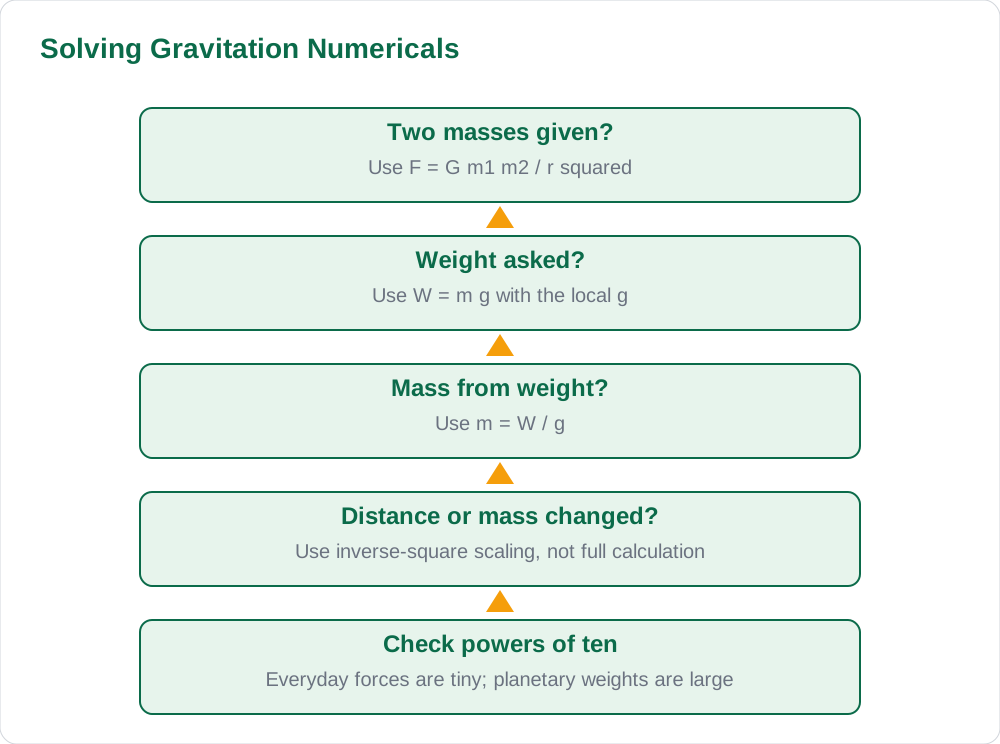
The most common mistakes are forgetting to square the distance, using surface distance instead of centre distance for planets, confusing mass with weight, and mishandling powers of ten, especially the negative exponent of G. A second trap is using Earth's g for a weight on another planet: always read which planet the question names. A third trap is scaling errors: doubling distance quarters the force, it does not halve it, because the distance is squared. Write the scaling as a fraction, new force = old force times (old distance / new distance) squared, to make the square visible.
Exam routine: decide which of the three patterns the question fits, write the matching formula, handle powers of ten separately, and sense-check the size of the answer. Forces between laboratory masses are extremely small, weights of people are hundreds of newtons, and g values for planets are single or double digits. The examples here are original practice problems for teaching the method. More guidance is on the blog and the about page.
- Square the distance: doubling distance quarters the force.
- Mass is constant; weight changes with the planet's g.
- Handle powers of ten separately from the main number.
- Use the local g for weight on any planet or moon.
AI Help: Muse AI
Muse AI is Meta's personal AI assistant, and it can help you practise gravitation numericals by generating force-between-masses and weight-on-planets problems, checking your powers of ten step by step, and explaining inverse-square scaling with simple examples. Ask it to quiz you on how force changes when distance doubles or triples. Join Muse with invite code LTGSWD — in the Muse app, go to Settings > Redeem token and enter the code. Disclosure: LTGSWD is the author's Muse invite code. Muse AI does not give official STBB answers — always verify against your STBB book and your teacher. Always verify against your Sindh Textbook Board book and your teacher before using anything in classwork.
5 key points you must know
- Newton's law: F = G m1 m2 / r squared, G = 6.67 x 10^-11.
- Doubling distance divides force by four; halving distance multiplies it by four.
- Weight W = m g; mass is constant, weight depends on local g.
- Distance r is measured between the centres of the masses.
- g on a planet = G times planet mass / radius squared.
Frequently asked questions
What happens to gravitational force if distance doubles?
It becomes one quarter, because force is inversely proportional to distance squared. Doubling distance gives 1 / (2 squared) = 1/4 of the original force.
Does an astronaut's mass change on the Moon?
No. Mass is the amount of matter and never changes with location. Only weight changes, because the Moon's gravity is weaker, so the same mass weighs about one sixth as much there.
Why is the force between everyday objects so tiny?
Because the gravitational constant G is extremely small, 6.67 times 10 to the power negative 11. Only enormous masses like planets produce noticeable gravitational forces.
Is distance measured between surfaces or centres?
Between centres. For planets, r is the distance from the planet's centre, which is why Earth's radius appears in the calculation of g.
How is g related to Newton's law of gravitation?
Weight is the gravitational force, so m times g equals G times m times planet mass divided by radius squared. Cancelling m gives g = G times planet mass / radius squared.
Solved notes — preview free
These guides work best with the solved exercises. Preview the solved notes free on this website — 119 solved notes for Classes 6–10 in Sindhi, Urdu, English and Arabic medium. Or browse the full solved notes catalogue for your class and medium. New solved notes are added regularly — check the catalogue for coming-soon books.