Class 10 Physics: Force, Mass and Acceleration Numericals
Class 10 physics force mass acceleration numericals all rest on one relationship: Newton's second law, force equals mass times acceleration, written F = ma. If you can rearrange this one formula confidently and keep your units in kilograms, metres per second squared, and newtons, you can solve almost every question in this chapter. The difficulty is rarely the physics itself; it is unit conversion, especially grams to kilograms and kilometres per hour to metres per second, and knowing which of the three quantities the question is asking for. This guide teaches a fixed routine: identify the known quantities, convert the units, write the formula, substitute, and check the answer. Force is measured in newtons, where one newton is the force needed to accelerate a mass of one kilogram at one metre per second squared. Mass is measured in kilograms, and acceleration is the rate of change of velocity, measured in metres per second squared. A larger force produces a larger acceleration for the same mass, and a larger mass needs a larger force for the same acceleration. That everyday intuition is exactly what the formula says, and it is a useful sense check: if your calculated force for a bicycle is thousands of newtons, something has gone wrong.
Newton's Second Law in Plain Words
Newton's second law states that the acceleration of an object is directly proportional to the net force acting on it and inversely proportional to its mass. In symbols, F = ma, where F is the net force in newtons, m is the mass in kilograms, and a is the acceleration in metres per second squared. Net force matters: if two forces act in opposite directions, you must subtract the smaller from the larger before using the formula. A car engine pushing forward with 2000 N against 500 N of friction has a net force of 1500 N, and it is 1500 N, not 2000 N, that goes into F = ma. Many exam questions hide a friction or opposing force in the wording, so always ask yourself whether the stated force is the net force.
Rearranging the formula gives the other two forms you will need: a = F / m when acceleration is unknown, and m = F / a when mass is unknown. Practise all three arrangements so you never waste time rearranging under pressure. The triangle method helps some students: cover the quantity you want, and the remaining two show the operation, with F on top meaning F = ma, and covering F leaving m times a. Whichever memory aid you use, the physics is the same, and the units must always match: mass in kilograms, acceleration in m/s squared, force in newtons.
- F = ma: force in newtons, mass in kilograms, acceleration in m/s squared.
- Use net force: subtract opposing forces like friction first.
- Rearranged forms: a = F / m and m = F / a.
- One newton = 1 kg times 1 m/s squared.
Units and Conversions Before You Calculate
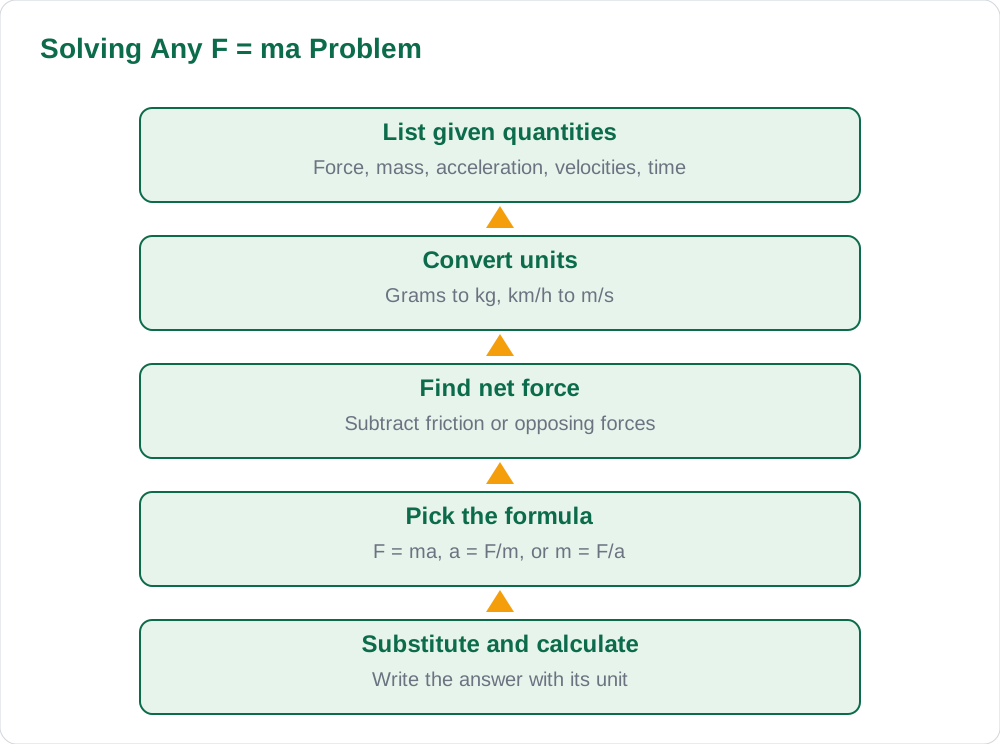
Mass is often given in grams in exam questions, and forgetting to convert is the single most common error in this chapter. Divide grams by 1000 to get kilograms: 500 g is 0.5 kg, and 250 g is 0.25 kg. Acceleration may need to be calculated first from a change in velocity over time, using a = (v minus u) / t, where u is initial velocity, v is final velocity, and t is time in seconds. If velocities are given in km/h, convert them to m/s by multiplying by 5/18 before finding the acceleration. A question that gives a car speeding up from 36 km/h to 72 km/h in 10 seconds therefore needs two conversions before F = ma can even be used.
Work through that example fully: 36 km/h is 10 m/s, and 72 km/h is 20 m/s. Acceleration = (20 minus 10) / 10 = 1 m/s squared. If the car has a mass of 1000 kg, the net force is 1000 times 1 = 1000 N. Notice how each step is written separately: conversion, acceleration, then force. This layered working is what earns full marks, because an examiner can award method marks for each correct step even if one arithmetic step slips. Never jump straight from the question to a final number with no working shown.
Worked Example 1: Finding Force
Example: A force accelerates a 4 kg trolley at 3 m/s squared. Find the force. Solution: F = ma = 4 times 3 = 12 N. This is the simplest question type, and it should take under a minute. The only traps are unit traps: if the mass had been given as 4000 g, you would convert to 4 kg first, and the answer would still be 12 N. Always scan the question for grams, and convert before you substitute. A second example with a twist: a 2 kg object is pushed with 10 N but friction of 4 N opposes the motion. Net force = 10 minus 4 = 6 N, so acceleration = 6 / 2 = 3 m/s squared. The twist is the friction, and missing it gives the wrong answer of 5 m/s squared.
Example: A cricket ball of mass 150 g is hit and accelerates at 200 m/s squared. Find the force. Solution: mass = 150 / 1000 = 0.15 kg. Force = 0.15 times 200 = 30 N. The small mass and large acceleration combine into a very reasonable force, which is a good sense check. If you had forgotten the gram conversion and used 150 kg, you would have calculated 30,000 N, which is obviously absurd for a cricket ball. Sense checks like this catch errors fast: compare your answer with everyday forces, where lifting a 1 kg bag needs about 10 N and a car engine produces thousands of newtons.
Worked Example 2: Finding Mass and Acceleration
Example: A force of 60 N produces an acceleration of 4 m/s squared in an object. Find its mass. Solution: m = F / a = 60 / 4 = 15 kg. Example: A 5 kg box is pulled with a force of 25 N. Find its acceleration. Solution: a = F / m = 25 / 5 = 5 m/s squared. These two question types are mirror images of each other, and the only skill is rearranging the formula correctly. A reliable check is to substitute your answer back into F = ma: 15 kg times 4 m/s squared is 60 N, which matches the question, so the mass is correct. This back-substitution takes five seconds and catches rearrangement slips, especially under exam stress.
Example: A 1200 kg car accelerates from rest to 30 m/s in 15 s. Find the net force. Solution: acceleration = (30 minus 0) / 15 = 2 m/s squared. Force = 1200 times 2 = 2400 N. This two-stage question combines the acceleration formula with F = ma, and it is a favourite exam pattern. Practise two-stage questions deliberately: first find acceleration from the velocity change, then find force. Students who try to do both stages in one line often mix up the numbers. For extra solved material, explore the solved notes and the books section.
Common Mistakes and Exam Tips
The top three mistakes in this chapter are using grams instead of kilograms, using the applied force instead of the net force when friction is present, and forgetting that acceleration must be calculated from a velocity change when it is not given directly. A fourth mistake is writing the answer without a unit: a bare number like 12 earns no final mark, while 12 N does. A fifth is confusing mass and weight: mass in kilograms is the m in F = ma, while weight is a force equal to mass times gravity, about 10 N per kilogram. If a question gives weight in newtons, divide by 10 to get mass in kilograms before using F = ma.
Exam technique matters as much as physics here. Write the formula in symbols first, then the substitution with units, then the answer. Show net-force subtraction as its own line. Keep the same routine for every question so that easy questions stay easy and hard questions break into manageable steps. Practise mixed question types, where sometimes force is unknown, sometimes mass, sometimes acceleration, and sometimes acceleration must be found first. The examples in this guide are original practice problems for teaching the method, not reproductions of textbook exercises. More guidance is available on the blog and the about page.
- Convert grams to kilograms before substituting.
- Subtract friction to get net force.
- Mass and weight are different: weight = mass times gravity.
- Back-substitute your answer into F = ma as a check.
AI Help: Muse AI
Muse AI is Meta's personal AI assistant, and it can help you master F = ma numericals by generating mixed practice problems, checking your rearrangements of the formula, and explaining net force with everyday examples like pushing a trolley against friction. Ask it to quiz you on all three arrangements of the formula until each one feels automatic. Join Muse with invite code LTGSWD — in the Muse app, go to Settings > Redeem token and enter the code. Disclosure: LTGSWD is the author's Muse invite code. Muse AI does not give official STBB answers — always verify against your STBB book and your teacher. Always verify against your Sindh Textbook Board book and your teacher before using anything in classwork.
5 key points you must know
- F = ma, with force in newtons, mass in kilograms, acceleration in m/s squared.
- Always use net force: subtract friction and opposing forces first.
- Convert grams to kilograms by dividing by 1000.
- If acceleration is not given, find it from a = (v - u) / t.
- Back-substitute your answer into F = ma to check it.
Frequently asked questions
What is one newton?
One newton is the force needed to accelerate a mass of one kilogram at one metre per second squared. That is why 1 N equals 1 kg times 1 m/s squared, and why the units must always be kilograms and m/s squared.
Do I use the applied force or the net force in F = ma?
Always the net force. If friction or another force opposes the motion, subtract it from the applied force first, then use the result in F = ma.
How do I solve a question where mass is given in grams?
Divide the grams by 1000 to get kilograms before substituting. For example, 250 g becomes 0.25 kg. Using grams directly gives an answer 1000 times too large.
What is the difference between mass and weight?
Mass is the amount of matter in kilograms and does not change with location. Weight is a force, equal to mass times gravity, measured in newtons. On Earth, weight is roughly mass times 10.
How do I find acceleration when it is not given?
Use a = (v - u) / t, where u is initial velocity, v is final velocity, and t is time in seconds. Convert velocities to m/s first if they are given in km/h.
Solved notes — preview free
These guides work best with the solved exercises. Preview the solved notes free on this website — 119 solved notes for Classes 6–10 in Sindhi, Urdu, English and Arabic medium. Or browse the full solved notes catalogue for your class and medium. New solved notes are added regularly — check the catalogue for coming-soon books.