How to Use Past Papers for Class 9 Board Exams
Learning how to use past papers for Class 9 board exams is one of the smartest moves a student can make before the final exams arrive. Many students collect old papers but never actually practise with them, or they read the answers first and call it revision. That approach feels comfortable but teaches very little. A past paper only helps when you treat it like a real exam: closed book, timed, and marked honestly afterwards. This guide gives you a simple weekly routine that fits around school and homework. You will learn how to choose a paper, attempt it under exam conditions, mark it fairly, and turn every mistake into a revision task. Follow the routine for a few weeks and you will notice steadier timing, clearer answers, and far less panic on exam day.
Why Past Papers Work Better Than Re-Reading Notes
Re-reading notes feels productive because the material looks familiar, but familiarity is not the same as remembering. When you read a solved answer, your brain recognises it and tricks you into thinking you could have written it yourself. A past paper removes that comfort. It forces you to recall facts, choose a method, and organise an answer without any help, which is exactly what the real exam demands. That struggle is where learning happens, because every gap you discover during a timed attempt tells you precisely what to revise next.
Past papers also teach you the language of exams. Over several papers you start to recognise how questions are worded, which instructions matter, and how many marks each part carries. You learn that a five-mark question needs more detail than a two-mark question, and that words like explain, describe, and prove are asking for different kinds of answers. Students who practise this way walk into the exam hall knowing what to expect. You can support this practice with the solved notes on this site, which explain concepts in simple steps before you test yourself.
The Weekly Past-Paper Routine
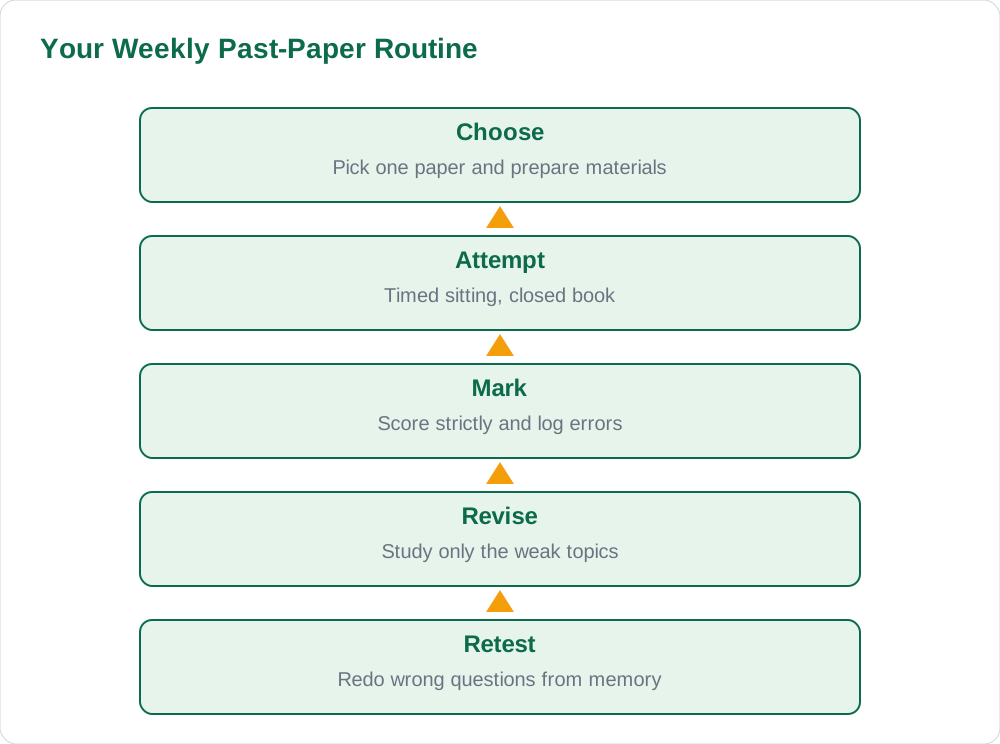
A routine beats random effort. Pick one subject each week and work through a single past paper in five short sessions rather than one exhausting sitting. On day one, choose the paper and gather your stationery, a watch, and blank answer sheets. On day two, attempt the paper under timed conditions without opening your book. Day three is for marking, when you compare your answers with the marking guidance and note every lost mark. Day four turns those notes into revision, and day five is a short retest of only the questions you got wrong.
This rhythm matters because it separates practice from correction. If you mark immediately after writing, you are tired and tempted to be generous with yourself. A gap of one day gives you fresh eyes and a fairer judgement. Keep the routine small enough to sustain: one paper per week per subject is plenty alongside schoolwork. If you need concept help between sessions, check the STBB books section for the relevant chapter before your revision day, so your corrections are based on the textbook, not on guesswork. Keep that rhythm steady every single week.
- Day one: select the paper and prepare answer sheets, a pen, and a timer.
- Day two: attempt the full paper in one timed sitting, with no book or notes.
- Day three: mark strictly, recording every lost mark and its reason.
- Day four: revise only the topics behind your mistakes, using your textbook.
- Day five: re-attempt the questions you got wrong, from memory, without help.
How to Attempt a Paper Under Exam Conditions
Exam conditions sound strict, but they are easy to recreate at home. Sit at a table, not on your bed, and put your phone in another room. Set a timer for the full paper length and do not pause it for any reason. Read the whole paper first and mark the questions you feel confident about, then start with those to build momentum. If a question stumps you, leave a gap and move on rather than burning ten minutes on one item. You can return to it at the end with whatever time remains.
Write your answers the way you would in the exam hall: neat headings, numbered steps for numerical questions, and short paragraphs for explanations. This habit matters because presentation earns marks and messy work hides your knowledge. Do not peek at answers halfway through, even when you feel stuck, because the point of the attempt is to measure what you truly know. When the timer ends, stop writing immediately. That discipline is uncomfortable at first, but it is exactly what will protect you from unfinished papers in the real exam. That discipline protects you on exam day.
Marking Your Paper and Learning From Mistakes
Honest marking is the most valuable part of the whole routine, and it is where most students cheat themselves. Use a different coloured pen and award marks only for points you actually wrote, not for points you meant to write. For numerical questions, check each step, not just the final answer, because examiners reward method even when a calculation slips. Write the marks beside each question and add them up properly. A score that flatters you feels good for a day but teaches nothing. Read the log aloud before each new paper, so the same careless slip or forgotten unit cannot quietly cost you marks twice.
After scoring, sort your errors into three groups: knowledge gaps, careless slips, and time problems. Knowledge gaps mean you did not know the concept, so that topic goes into your revision list. Careless slips mean you knew the answer but misread the question or copied a number wrong, so your fix is slower reading and checking. Time problems mean you left questions blank, so your fix is better pacing in the next attempt. Keep this error log in one notebook, and read it before every new paper so old mistakes stop repeating. More guidance on careful study habits appears in our study guides.
- Mark with a different pen and give marks only for what is actually written.
- Sort every error as a knowledge gap, a careless slip, or a time problem.
- Copy each knowledge gap into a revision list with the chapter name.
- Re-attempt failed questions within the same week, while the lesson is fresh.
Building a Revision Cycle Around Past Papers
One paper helps, but a cycle transforms your preparation. After four weekly papers in a subject, look back at your error logs together and count which chapters appear most often. Those chapters become your priority revision for the next two weeks, before you return to fresh papers. This is how past papers stop being random practice and start directing your study. Instead of revising everything equally, you spend extra time where your own results prove you are weakest, which is a far smarter use of limited weeks. That proof builds calm, lasting confidence.
End each cycle with a confidence check. List the chapters you once feared and write one paragraph from memory about each, or solve two questions from each without help. If you can do that comfortably, the chapter moves to light review; if not, it stays on the priority list. Share your plan with a teacher or parent so someone can check your marking honesty and encourage you on slow weeks. Done steadily, this cycle turns past papers from a source of stress into proof of progress, and that proof is what builds calm confidence before board exams.
AI Help: Muse AI
Muse AI is Meta's personal AI assistant, and it can help you plan your weekly past-paper routine and explain any concept you got wrong in simple words. You can ask it to quiz you on a weak chapter, rephrase a confusing question, or help you draft a revision timetable around your papers. Join Muse with invite code LTGSWD — in the Muse app, go to Settings > Redeem token and enter the code. Disclosure: LTGSWD is the author's Muse invite code. Muse AI does not give official STBB answers — always verify against your STBB book and your teacher. Always verify against your Sindh Textbook Board book and your teacher before using anything in classwork.
5 key points you must know
- Attempt every past paper closed-book and timed, exactly like the real exam.
- Follow a five-day weekly routine: choose, attempt, mark, revise, and retest.
- Mark strictly and sort errors into knowledge gaps, careless slips, and time problems.
- Let your error log decide what to revise, not random re-reading of notes.
- Retest failed questions within the same week so corrections actually stick.
Frequently asked questions
How many past papers should a Class 9 student attempt each week?
One paper per subject per week is enough when you follow the full routine of attempting, marking, revising, and retesting. Attempting five papers without marking teaches far less than one paper worked through properly. Quality matters more than quantity, especially when school homework already fills your evenings.
Should I look at the answers while attempting a past paper?
No, because peeking destroys the test. The attempt must measure what you can recall alone, or your score will mislead you about your readiness. Keep answers closed until the timer ends, then mark honestly. If you are stuck on a question, skip it and return later, just as you would in the exam hall.
What should I do with questions I leave blank?
Treat every blank as useful information, not failure. Note whether you left it blank because you did not know the topic, ran out of time, or misjudged its difficulty. Each reason has a different fix: revision, pacing practice, or question selection. Then practise that question type again in your next timed attempt.
How do I use past papers without memorising answers?
Focus on method rather than memorised wording. After marking, close the paper and re-solve each failed question from memory using the concept, not the answer text. When you can explain why each step is needed, you have learned the skill. Memorised answers collapse when the exam changes numbers or wording.
When should Class 9 students start past-paper practice?
Start once you have finished studying a chapter or unit, even early in the year, using topic-wise questions from old papers. Full timed papers work best in the last two to three months before exams. Starting early builds familiarity gradually, so the final months feel like steady revision rather than panic.
Solved notes — preview free
These guides work best with the solved exercises. Preview the solved notes free on this website — 119 solved notes for Classes 6–10 in Sindhi, Urdu, English and Arabic medium. Or browse the full solved notes catalogue for your class and medium. New solved notes are added regularly — check the catalogue for coming-soon books.