Class 8 Past Papers: Practice Before the Board Pattern
Class 8 feels early for exam talk, yet it is the ideal year to start past-paper practice. The pressure is lower than in board classes, which makes it the perfect time to learn exam skills without fear. Students who first meet timed papers in Class 9 or 10 often panic, not because the content is new, but because the format is unfamiliar. Starting in Class 8 removes that shock. This guide shows how to use Class 8 past papers gently: short timed sections first, then full papers, with marking that teaches rather than judges. The goal is not top marks today, but steady confidence, good habits, and a clear picture of your strengths before the board pattern arrives. The methods here are deliberately gentle, because the aim at this stage is confidence and habit, not high-stakes performance under pressure.
Why Class 8 Is the Best Year to Start
In Class 8, mistakes cost nothing except a little pride, and that freedom is exactly what makes it the best year to practise. You can attempt a paper badly, learn from it, and try again next week without any exam counting against you. This low-stakes repetition builds the skills that board students struggle to learn under pressure: reading questions carefully, managing time, writing structured answers, and checking work. By the time board exams arrive, these skills feel natural rather than new. Parents can support this best by praising steady effort and honest marking, rather than reacting only to high or low scores.
Early practice also reveals your real strengths and weaknesses while there is still time to fix them. A student who discovers weak algebra or weak English writing in Class 8 has two full years to improve. The same discovery in Class 10 leaves only months. Use Class 8 papers as a diagnostic tool, not a judgement. Celebrate progress, track improvement, and treat every low score as a map showing where to work next. Support your practice with the solved notes for chapters you find difficult. That early start pays off later.
Start With Sections, Not Full Papers
Jumping straight into a three-hour paper overwhelms younger students and often ends in frustration. Begin with one section at a time: a single set of short questions, or one long question with its parts. Set a small timer, attempt the section closed-book, then mark it the same day with a parent or teacher nearby. Short wins build momentum, and momentum keeps the habit alive. After two or three weeks of section practice, combine two sections, and only later attempt a full paper. If a section feels too hard, split it further into single questions, because a small completed task beats a large abandoned one.
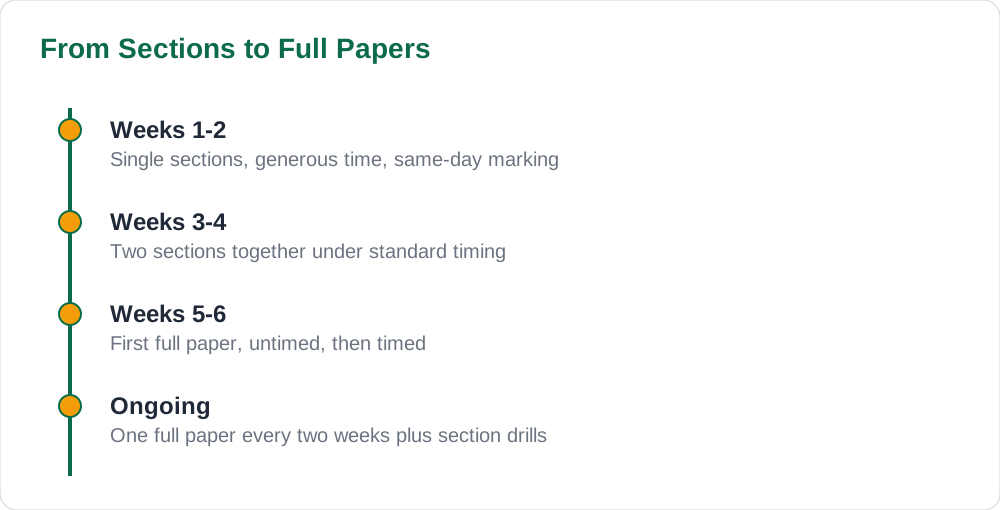
Keep the first attempts untimed if timing causes anxiety, then add the clock gradually. For example, allow yourself extra time in week one, standard time in week three, and slightly less than standard time in week five. This gentle tightening trains speed without panic. Record your scores in a simple notebook so you can watch the line rise over the term. When a section score improves, note what changed: better reading, neater steps, or calmer pacing. That reflection is the real lesson. Share your score notebook with a teacher each month, so an adult can confirm that your practice is moving in the right direction.
- Week one and two: practise single sections with generous time.
- Week three and four: combine two sections under standard timing.
- Week five onward: attempt a full paper once every two weeks.
- After every attempt, mark the same day and list three lessons learned.
Building Exam Confidence Step by Step
Confidence does not come from being told you are clever; it comes from evidence that you can handle a paper. Every completed timed section is such evidence, even when the score is modest. Keep a confidence file: a folder of your marked papers with scores and short notes about what improved. On a bad week, open the folder and compare your first attempt with your latest one. The gap between them is proof that practice works, and that proof steadies nerves far better than empty encouragement. Keep that evidence file updated weekly.
Confidence also grows from familiarity with exam routines. Practise the small things: reading the paper fully before writing, numbering answers correctly, leaving space between questions, and reserving five minutes to check. These routines feel boring during practice but become automatic in real exams, freeing your mind for the questions themselves. Ask a teacher to check your presentation once a month, because neat, well-organised answers earn marks that messy answers lose, even when the knowledge is identical. Practise numbering answers correctly from the very first section, because misnumbered answers lose marks even when the content is right.
How Parents and Teachers Can Help
Young students practise best when adults support the routine without turning it into pressure. Parents can help by providing a quiet table, a timer, and a regular weekly slot, then praising effort and improvement rather than only high scores. If a paper goes badly, the useful response is a question, not a scolding: which questions were hard, and what shall we revise together? That calm reaction teaches the student to treat mistakes as information, which is the mindset every successful exam student shares. A regular weekly slot works best, such as Sunday evening, because a fixed time stops practice from sliding to the bottom of the list.
Teachers can help by marking one practice paper a month and pointing out two strengths and two fixes, rather than only a total score. Specific feedback beats general praise: telling a student to show steps in division problems, or to underline key words in the question, gives them something concrete to practise. Schools can also run short practice sessions in class, so students see that everyone finds timed work hard at first. Normalising the struggle removes shame, and students who are not ashamed of mistakes improve fastest. That calm reaction builds lasting resilience.
From Class 8 Practice to Board Readiness
The habits built in Class 8 transfer directly to board classes. A student who already knows how to time a paper, mark honestly, and revise from an error log will use Class 9 papers efficiently from the first week. A student meeting these skills for the first time in Class 9 must learn the skills and the syllabus at once, which doubles the stress. Early practice is therefore not extra work; it is work done at the right time, when the stakes are low and the lessons stick. That continuity builds genuine readiness.
End Class 8 with a simple self-review. List the subjects where timed practice feels comfortable and those where it still feels shaky. Write one goal per shaky subject for the holidays, such as drawing diagrams from memory or solving ten problems a week. Carry your error log into Class 9 so your new teacher can see your history. That continuity turns two years of gentle practice into genuine board readiness, built on evidence rather than hope. More ideas for steady study appear in our study guides, and chapter help is in the STBB books section.
- List comfortable and shaky subjects at the end of Class 8.
- Write one holiday goal per shaky subject, such as ten problems a week.
- Carry your error log into Class 9 for your new teacher.
- Review progress monthly and adjust goals as subjects improve.
AI Help: Muse AI
Muse AI is Meta's personal AI assistant, and it can help you practise for Class 8 exams by explaining difficult topics in easy language and giving you short practice questions. You can ask it to rephrase a confusing question or to test you on one chapter at a time. Join Muse with invite code LTGSWD — in the Muse app, go to Settings > Redeem token and enter the code. Disclosure: LTGSWD is the author's Muse invite code. Muse AI does not give official STBB answers — always verify against your STBB book and your teacher. Always verify against your Sindh Textbook Board book and your teacher before using anything in classwork.
5 key points you must know
- Class 8 is the low-pressure year to learn exam skills before board classes.
- Start with single sections, then combine them, then attempt full papers.
- Add timing gradually so speed grows without panic or frustration.
- Keep a folder of marked papers as visible proof of your improvement.
- Treat every mistake as information, and revise from an error log.
Frequently asked questions
Is Class 8 too early for past papers?
No, because the goal in Class 8 is learning exam skills, not scoring top marks. Short section practice teaches timing, reading, and presentation while pressure is low. Students who start early find board papers familiar later, while students who start late must learn skills and syllabus together under stress.
How often should a Class 8 student practise papers?
One section per week, or one full paper every two weeks, is plenty alongside schoolwork. The habit matters more than the volume. Regular short practice beats occasional marathon sessions, which tire students and teach little. Keep sessions short, mark them, and revise the mistakes before the next attempt.
What if my child scores poorly on early papers?
Low early scores are normal and useful, because they show exactly what to teach next. Praise the effort and the lessons learned, not just the number. Compare each new score with earlier ones, not with other students, so the child sees their own progress. Improvement over weeks is the real success measure.
Should Class 8 papers be timed from the start?
Not necessarily. Begin untimed or with generous time so the student focuses on understanding questions and writing answers. Introduce standard timing after two or three weeks, then tighten slightly. This gradual approach builds speed without anxiety, and it keeps practice enjoyable enough to continue.
How can teachers use Class 8 practice papers in class?
Teachers can run one short timed section per fortnight and mark it with specific feedback on two strengths and two fixes. Class discussion of common errors helps everyone at once. Keeping the tone supportive matters: when students see mistakes as normal, they practise more willingly and improve faster.
Solved notes — preview free
These guides work best with the solved exercises. Preview the solved notes free on this website — 119 solved notes for Classes 6–10 in Sindhi, Urdu, English and Arabic medium. Or browse the full solved notes catalogue for your class and medium. New solved notes are added regularly — check the catalogue for coming-soon books.