Class 10 Science Past Papers: What Repeats Most

Students often ask what repeats most in Class 10 science past papers, hoping for a shortcut to the exam. There is no honest shortcut, but there is a pattern worth understanding: board-style science papers tend to return to the same big ideas, the same skills, and the same question formats year after year, even when the exact questions change. This guide explains those recurring patterns in general terms so you can set revision priorities wisely. It does not claim that any particular question will appear, and it does not reproduce any real paper. Instead, it teaches you how to read several old papers yourself, spot which chapters and skills keep earning marks, and build a revision plan that covers the heavy-weight topics first without neglecting the rest. Before you begin, remember that this guide describes general patterns only, so always confirm details against your own textbook and teacher guidance.
How to Read Old Papers Without Chasing Leaks
The right way to study old papers is to treat them as a map, not a crystal ball. Collect papers from several different years and work through them slowly, noting which chapters each question belongs to and how many marks it carries. You are looking for broad tendencies, such as which units produce long questions and which produce short factual ones. A single year can mislead you, because one paper may emphasise a chapter that the next paper barely touches. Five years of papers give a steadier picture. Use that map wisely.
Keep your notes honest and general. Write chapter names and question types, not predictions about the coming exam. For example, you might notice that numerical problems appear regularly in physics units, while biology units often ask for labelled diagrams and explanations of processes. That observation helps you practise diagrams and calculations, which are skills that transfer to any question. Avoid any source that claims to know the next paper, and check concepts against the STBB books rather than rumour or guesswork. When a source disagrees with your textbook, trust the textbook and ask your teacher, because the book defines what your class must learn.
Chapters That Usually Carry the Most Weight
Across science papers, a few kinds of chapters tend to carry heavy marks because they combine concepts, diagrams, and problem-solving. In physics, units involving motion, force, energy, and electricity usually offer numerical questions that reward step-by-step working. In chemistry, units on reactions, acids and bases, and the periodic arrangement of elements often produce both short answers and structured questions. In biology, units on life processes, reproduction, and ecosystems frequently ask for diagrams, definitions, and process explanations. Start your ranking with the chapters your error log already flags, because personal weakness matters as much as general weight in any plan.
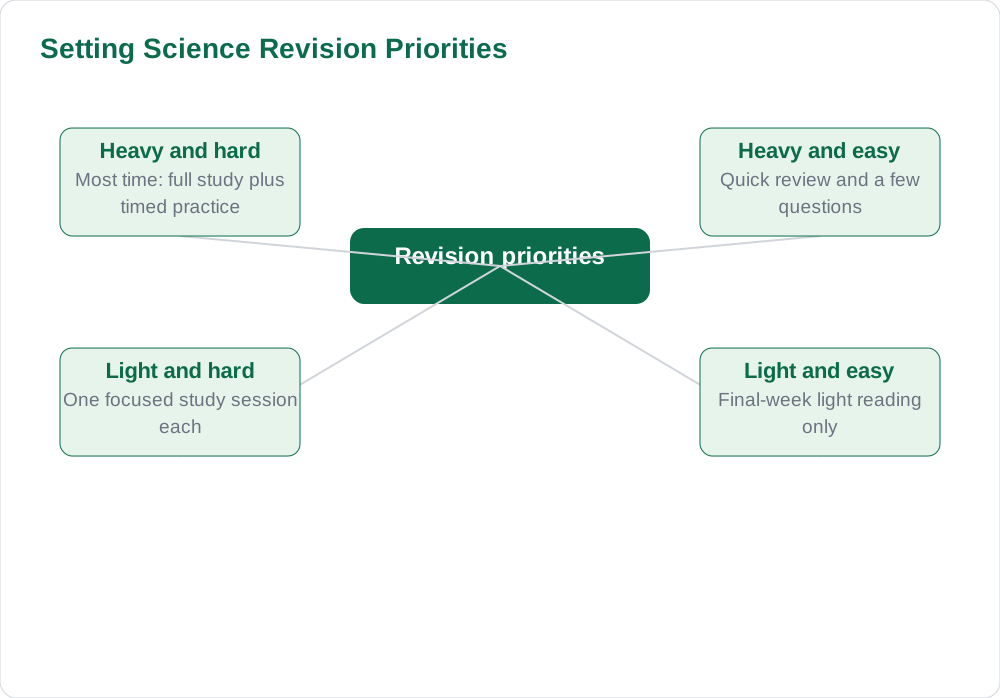
This does not mean other chapters can be skipped. A chapter that carried few marks for two years can carry more in the next, and examiners deliberately spread questions across the syllabus. The smart approach is to rank chapters by your own error log combined with their general weight: heavy chapters you find hard get the most time, heavy chapters you find easy get quick review, and lighter chapters still get at least one full reading plus a few practise questions. The solved notes on this site can help you revise a weak chapter before you test yourself on it.
Question Types That Keep Appearing
Science papers reuse formats more than they reuse questions. Multiple-choice questions test quick recall and careful reading, often with two options that look similar. Short-answer questions ask for definitions, reasons, or one-step calculations, and they punish vague wording. Long questions usually combine a diagram, an explanation, and a small calculation or comparison, rewarding students who organise their answer in clear steps. Practical-style questions may ask about an experiment, its apparatus, observations, and conclusion. Time yourself on mixed-format drills too, since switching between question types quickly is itself a skill the exam will test.
Practising each format separately makes you faster and calmer. For multiple-choice items, cover the options and answer from memory before choosing, which stops tempting distractors from leading you astray. For short answers, practise writing exactly enough: a definition plus one example, or a reason in two clear sentences. For long questions, always plan the structure before writing, deciding where the diagram goes and which points earn marks. More practice ideas appear in our study guides. After each drill, note which format cost the most marks, and give that format a short extra session before the next paper.
- Multiple-choice: recall the answer before looking at the options.
- Short answers: give the definition or reason plus one clear example.
- Long questions: plan diagram, points, and steps before writing.
- Numerical problems: show every step, unit, and substitution.
- Diagram questions: label fully and add a one-line explanation.
Diagrams, Definitions, and Numerical Skills
Three skills appear in science papers so often that they deserve daily practice. Labelled diagrams earn marks quickly when they are neat, correctly proportioned, and fully labelled, but they lose marks when labels are missing or lines point vaguely. Definitions must be precise: a half-remembered definition that confuses two similar terms scores poorly, while a short exact definition with an example scores well. Numerical problems reward method, so writing the formula, substituting values, and stating the unit matters even if the final number slips. Ask a teacher to check one diagram and five definitions each week, because expert feedback corrects small errors before they become habits.
Build a small daily drill for these skills. Draw one diagram from memory each evening and compare it with the textbook figure. Write five definitions from memory each morning and check them word by word. Solve two numerical problems with full steps, not just answers. After two weeks, these skills feel automatic, which frees your exam time for thinking about harder questions instead of struggling with basics. Keep a list of diagrams you repeatedly mislabel, because those are the ones to redraw most often. Keep solved numericals in a separate notebook, grouped by chapter, so you can rework the hard ones quickly during final revision.
Turning Patterns Into a Revision Timetable
Once you have mapped the general patterns, convert them into a timetable that covers the whole syllabus. Give the first slots to heavy chapters where your error log shows weakness, then alternate a hard chapter with an easier one so your energy lasts. Reserve one session each week for a timed mixed paper, so you practise switching between physics, chemistry, and biology thinking. End each week by retesting the questions you failed, because a pattern only helps if your weak areas actually improve. Protect one evening each week for the mixed timed paper, and treat that slot as fixed, even when other homework feels urgent.
Review your timetable every fortnight. If a chapter has moved from weak to comfortable, reduce its time and promote the next weakest chapter. If a question type still costs marks, add a short daily drill for that format. This rolling adjustment keeps your plan honest: it follows your real results instead of a fixed guess about the exam. With steady work, you will enter the exam knowing the full syllabus, with extra strength exactly where papers tend to reward it most. Celebrate steady improvement in your log, because visible progress keeps motivation alive through the long weeks before exams.
- Give heavy, weak chapters the first and longest revision slots each week.
- Alternate hard and easy chapters to keep energy steady across the timetable.
- Reserve one weekly session for a timed mixed paper across all sciences.
- Retest failed questions every weekend before moving to new material.
AI Help: Muse AI
Muse AI is Meta's personal AI assistant, and it can help you revise Class 10 science by explaining tough concepts in simple words and quizzing you on diagrams and definitions. You can ask it to break a long process into steps or to test you with quick questions on a chapter you find hard. Join Muse with invite code LTGSWD — in the Muse app, go to Settings > Redeem token and enter the code. Disclosure: LTGSWD is the author's Muse invite code. Muse AI does not give official STBB answers — always verify against your STBB book and your teacher. Always verify against your Sindh Textbook Board book and your teacher before using anything in classwork.
5 key points you must know
- Study several years of papers to spot broad patterns, never single-year predictions.
- Heavy chapters deserve priority, but no chapter should be skipped entirely.
- Practise each question format separately: MCQs, short answers, long questions, and numericals.
- Draw one diagram and write five definitions from memory every day.
- Adjust your timetable fortnightly based on your own error log, not guesses.
Frequently asked questions
Do the same questions really repeat in science papers?
Similar topics and question types recur, but exact questions change. Examiners revisit important concepts because the syllabus stays the same, yet they reword questions and change values. Preparing the underlying concept, diagram, and method is far safer than memorising an old answer word for word.
Should I skip chapters that carried few marks last year?
No, because mark distribution shifts between years and a light chapter can become heavy without warning. Give light chapters at least one full reading and a few practise questions. Skipping a chapter risks losing every mark it offers, while light revision costs little time and keeps your coverage complete.
How do I practise diagrams for science papers?
Draw each important diagram from memory, then compare it with the textbook figure and correct every missing label. Redraw the same diagram the next day until it is accurate. In the exam, draw neatly, label with straight lines, and add a short caption explaining what the diagram shows.
What is the best way to handle numerical problems?
Write the formula first, then substitute the given values with units, then calculate step by step. This method earns partial marks even when the final answer is wrong. Always end with the correct unit, and quickly check whether your answer is sensible before moving on.
How many years of past papers should I study?
Five years gives a reliable picture of recurring chapters and formats without overwhelming you. Work through them chapter by chapter rather than rushing full papers. Note which chapters and formats appear most, then use that map to order your revision, while still covering the entire syllabus.
Solved notes — preview free
These guides work best with the solved exercises. Preview the solved notes free on this website — 119 solved notes for Classes 6–10 in Sindhi, Urdu, English and Arabic medium. Or browse the full solved notes catalogue for your class and medium. New solved notes are added regularly — check the catalogue for coming-soon books.