Past Papers and Time Management: Finish With 10 Minutes Left

Running out of time is one of the most common reasons students lose marks, and past papers are the safest place to fix it. In a real exam, unfinished questions score zero no matter how well you knew them, so time management is not a minor skill but a major one. The good news is that timing can be trained like any other skill, using a simple rule: minutes per mark. This guide teaches you to plan a paper before writing, to pace yourself during it, and to finish with ten minutes left for checking. Practise the drill on old papers a few times, and the exam hall will feel controlled instead of rushed, because you will already know exactly how your time should unfold. With a little weekly practice, the clock stops feeling like an enemy and starts feeling like a simple tool you control.
The Minutes-Per-Mark Rule
The minutes-per-mark rule turns a scary paper into simple arithmetic. Divide the total exam time by the total marks to find how long each mark is worth. In a 180-minute paper worth 100 marks, each mark is worth just under two minutes, so a five-mark question deserves about nine minutes and a ten-mark question about eighteen. This rule stops you from spending twenty minutes polishing a five-mark answer while a ten-mark question waits untouched. It is a guide, not a prison, but it keeps your effort proportional to reward. That plan saves far more.
Apply the rule before you write anything. Read the whole paper, note the marks beside each question, and write a small time plan in the margin: start times for each section, not exact minutes per question. For example, plan to finish short questions by a certain clock time and long questions by another. A margin plan takes two minutes and saves far more, because it replaces panic decisions with a calm schedule. Practise making this plan on every past paper until it becomes automatic. Review your margin plan after each practice paper, and adjust it whenever a section repeatedly takes longer than you allowed.
Planning the Paper Before You Write
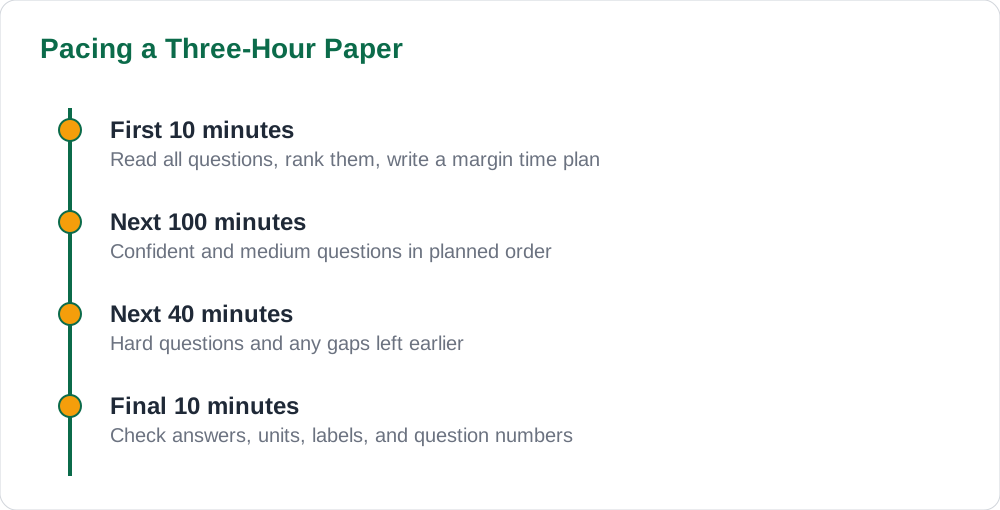
The first ten minutes of a paper decide much of what follows, so use them deliberately. Read every question, underline command words such as explain, calculate, or compare, and mark the questions you can answer confidently. Decide your order: confident questions first to build momentum and secure marks, then medium questions, then the hardest ones. This order matters because early success calms nerves, while starting with the hardest question can destroy confidence for the whole paper. Underline numbers and units as you read, because a misread value can waste minutes and ruin an otherwise correct method.
While planning, also decide what to skip. If a question looks completely unfamiliar, plan to return to it at the end rather than wrestling with it immediately. Leaving a gap is not giving up; it is protecting time for questions you can answer. Note the gap clearly so you remember to return. Students who plan their order finish more questions than students who simply start at question one and grind forward, because planning directs effort where it earns most. Return to skipped questions only after securing the marks you can earn, since a half-known question should never block easier marks.
- Read the full paper first and underline command words in each question.
- Rank questions as confident, medium, or hard, and attempt them in that order.
- Write start times for each section in the margin before writing answers.
- Mark unfamiliar questions to return to at the end, not to wrestle with first.
Pacing Yourself During the Paper
Pacing means checking the clock at planned points, not staring at it constantly. After each section, compare the actual time with your margin plan. If you are five minutes behind, shorten your next answers slightly: fewer examples, tighter sentences, same key points. If you are ahead, use the extra time to add a diagram or an extra point, not to relax. Small adjustments like these keep you on schedule without drama, while ignoring the clock until the last half hour guarantees a rush. Glance at the clock only at section boundaries, because constant clock-watching raises anxiety without improving your pace at all.
Watch for time traps. A question you half-know is the most dangerous, because it tempts you to keep digging for an answer that may never come. Give such questions a strict limit: if no progress appears within the planned minutes, leave a partial answer and move on. Partial answers earn partial marks, while a blank later question earns nothing. Train this discipline in past papers by practising the move-on decision deliberately, until it feels normal rather than like surrender. Practise the move-on decision deliberately in drills, until leaving a hard question feels like good strategy rather than defeat.
The Timed-Paper Drill
A drill turns time management from theory into habit. Once a week, attempt a past paper under strict conditions: full time limit, no pauses, no phone, and a clock visible on the table. When the timer ends, stop immediately, even mid-sentence. Then mark the paper and record three numbers: questions finished, questions left blank, and marks lost to rushing. These numbers are your training data, and they improve faster than you expect when you drill weekly. Record your drill numbers in the same notebook every week, so trends in blanks and rushed marks stay easy to compare.
After each drill, adjust one thing only. If you left questions blank, practise faster question selection next time. If your later answers were rushed, tighten earlier answers by one sentence each. If checking time vanished, set a hard rule to stop writing ten minutes early. Changing one variable at a time shows you what works, while changing everything at once teaches nothing. Keep a drill log so you can watch blank questions fall and checking time appear over successive weeks. Change only one habit per drill, because changing everything at once makes it impossible to tell which change actually helped. Extra timed drills are shared in our study guides.
Using the Final Ten Minutes Well
Finishing with ten minutes left is not about speed for its own sake; it is about buying checking time, which is where easy marks are recovered. Use the final minutes in a fixed order. First, check that every question has an answer and that question numbers match, because a misnumbered answer can lose a whole question. Second, scan numerical answers for units and sensible values. Third, check diagram labels and spellings of key terms. Fourth, reread any question you rushed, to confirm you answered what was actually asked. That safety net reduces anxiety greatly.
Resist the urge to rewrite answers in the final minutes. Rewriting introduces new errors and rarely improves marks, while checking catches slips. If you spot a genuine error, correct it neatly with a single line through the wrong part, not a messy overwrite. When checking time becomes a habit, exam anxiety drops sharply, because you know that even if something slips during writing, you have a safety net waiting at the end. Chapter support for weak areas found during drills is in the STBB books section, and worked examples are in the solved notes.
- Check every question is answered and correctly numbered.
- Scan numerical answers for units and sensible values.
- Verify diagram labels and key-term spellings.
- Correct genuine errors neatly with a single line.
AI Help: Muse AI
Muse AI is Meta's personal AI assistant, and it can help you manage exam time by helping you build a minutes-per-mark plan for any paper length. You can ask it to suggest a timed practice schedule or to quiz you in short timed bursts. Join Muse with invite code LTGSWD — in the Muse app, go to Settings > Redeem token and enter the code. Disclosure: LTGSWD is the author's Muse invite code. Muse AI does not give official STBB answers — always verify against your STBB book and your teacher. Always verify against your Sindh Textbook Board book and your teacher before using anything in classwork.
5 key points you must know
- Divide total time by total marks to set a minutes-per-mark budget for every question.
- Spend the first ten minutes reading, ranking, and planning your question order.
- Attempt confident questions first, then medium ones, then the hardest.
- Check the clock at section boundaries and adjust answer length, not panic.
- Finish ten minutes early and use that time to check numbers, labels, and units.
Frequently asked questions
How do I calculate minutes per mark for a paper?
Divide the total minutes by the total marks. A 180-minute, 100-mark paper gives about 1.8 minutes per mark, so a five-mark question deserves around nine minutes. Use this as a planning guide, not a strict stopwatch per question, and write section start times in the margin before you begin writing.
What should I do if I fall behind during a paper?
Shorten your next answers rather than rushing all of them. Keep the key points and keywords, but drop extra examples and long introductions. Move on from any question that resists you, leaving a partial answer, so later questions still get their fair share of time and marks.
Is it better to answer questions in order or by confidence?
By confidence is usually better, because early marks build calm and momentum. Answer confident questions first, then medium ones, then hard ones. Just number your answers carefully so the examiner can match them, and leave clear gaps for questions you plan to return to later.
How often should I practise timed papers?
One full timed paper per week per subject is enough in the final months, with shorter timed sections on other days. The drill only works if conditions are strict: no pauses, no book, and a hard stop at the timer. Record blanks and rushed marks after each drill to track improvement.
What is the best use of the last ten minutes?
Check completeness first: every question answered and correctly numbered. Then check units, sensible values, diagram labels, and key-term spellings. Correct genuine errors neatly with a single line. Do not rewrite whole answers, because rewriting in a hurry usually creates new mistakes instead of fixing old ones.
Solved notes — preview free
These guides work best with the solved exercises. Preview the solved notes free on this website — 119 solved notes for Classes 6–10 in Sindhi, Urdu, English and Arabic medium. Or browse the full solved notes catalogue for your class and medium. New solved notes are added regularly — check the catalogue for coming-soon books.