Solved Past Paper Answers: Writing Full-Marks Responses
A solved past paper answer is only useful if you understand why it earns full marks, not merely what it says. Many students copy model answers into notebooks and memorise them, then lose marks when the exam asks the same concept differently. The real skill is learning the anatomy of a full-marks response: the opening line that answers the question directly, the ordered points that cover the marking scheme, the keywords that prove understanding, and the closing line that ties it together. This guide breaks down that anatomy for short answers, long answers, and numerical problems, so you can write your own model answers for any question instead of depending on memorised ones. Read each breakdown carefully, then practise writing your own version, because producing an answer teaches far more than reading one.
The Anatomy of a Full-Marks Answer
A full-marks answer has four visible parts, whatever the subject. It opens with a direct response, not background or throat-clearing: if the question asks why something happens, the first line gives the reason. It then develops two to four distinct points, each in its own sentence or short paragraph, using the subject's keywords. Where relevant, it includes a diagram, example, or calculation placed near the point it supports. It closes with a one-line conclusion that restates the answer, signalling to the examiner that the response is complete. Structure turns knowledge into marks.
Notice what this structure does for marking. Each distinct point is a scorable item the examiner can tick, the keywords make your understanding unmistakable, and the conclusion prevents the impression that you ran out of ideas. Compare that with a single rambling paragraph that contains the same ideas buried in extra words: the examiner must hunt for points, may miss one, and cannot award what cannot be found. Structure is therefore not decoration; it is how your knowledge becomes marks. Study model answers in the solved notes with this structure in mind.
Short Answers: Say Exactly Enough
Short answers fail in two opposite ways: too vague, or too long. A two-mark answer needs about two points, usually a definition plus a reason, or a fact plus an example. Writing six lines for two marks wastes time you need elsewhere, while writing one vague line earns at most one mark. Before writing, count the marks and plan that many points. For a three-mark question, plan three points, and stop when they are written clearly. This discipline alone can save ten minutes across a paper. Count marks before you write.
Practise short answers by rewriting them after marking. Take an answer that scored one mark out of three, identify the missing points, and rewrite it as a tight three-point version. Keep a small collection of rewritten answers in a notebook, grouped by chapter, and reread them before tests. Over time, your first drafts start to resemble your rewrites, because you have trained yourself to think in points rather than paragraphs. That is the moment short answers stop losing you marks. Reread your rewritten answers the night before a test, because short, well-structured answers are ideal for last-minute revision.
- Count the marks first, then plan exactly that many distinct points.
- Open with the direct answer, not with background or a long introduction.
- Use the subject keyword in each point, not a vague everyday paraphrase.
- Stop when the planned points are written clearly; extra lines waste time.
Long Answers: Structure That Carries Marks
Long answers need a visible skeleton. Start with a one-line introduction that restates the question in your own words and states your position or the main idea. Then develop the body as numbered or headed points, each covering one aspect: causes, process, effects, or examples, depending on the subject. Place diagrams where they illustrate a point, not dumped at the end. Finish with a conclusion that summarises the answer in one or two lines. Examiners reward this organisation because it proves you understood the whole question, not just one corner of it.
Within the body, keep each point focused. One point per paragraph, one idea per sentence where possible, and a linking word when you move to the next aspect. Avoid repeating the same idea in different words to fill space, because repetition earns no extra marks and suggests you have nothing more to say. If you run short of content, add a relevant example or a brief comparison instead of padding. A concise, well-structured answer almost always outscores a long, shapeless one, even when both contain similar knowledge. Stop when the points are covered.
Numerical Answers: Steps Examiners Reward
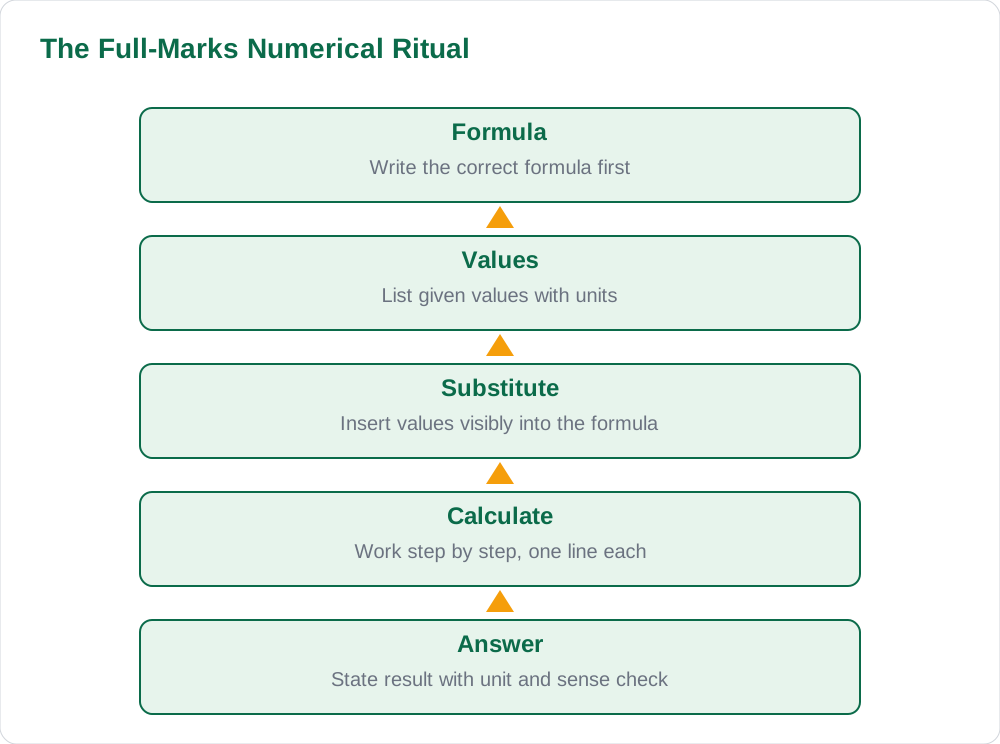
Numerical full-marks answers follow a fixed ritual that you should never skip. Write the formula, list the given values with units, substitute them visibly, calculate step by step, and state the final answer with its unit. Each of these stages can carry a mark, so a correct method with a small arithmetic slip still earns most marks, while a bare final answer earns either all or nothing. Show substitutions exactly as the question gives them, converting units before calculating where needed, because unit errors are among the most common lost marks.
After calculating, pause for a sense check. Does the answer have a sensible size and sign? Does the unit match what the question asked? A speed of hundreds of metres per second for a walking person, or a missing unit on a force, signals an error worth finding. Write the sense check into your habit, not as extra work but as the final step of the ritual. When a step goes wrong midway, cross it out neatly and redo it below, keeping the working readable. Examiners mark correct working wherever it appears.
Learning From Model Answers Without Copying Them
Model answers are teachers, not scripts. The right way to use one is to read the question, write your own answer first, and only then compare. Note which points the model answer contains that yours missed, which keywords it uses that yours lacked, and how its structure differs. Then close the model answer and rewrite yours from memory, including the missing points in your own words. That rewrite, not the reading, is where learning happens, because it forces you to reconstruct the reasoning yourself. Date every notebook entry, so you can watch your rewrites improve across weeks and prove the method is working.
Keep a model-answer notebook with a strict rule: no answer is copied word for word. Each entry records the question, your first attempt's score, the missing points, and your improved rewrite. Review the notebook weekly, and re-attempt older entries from memory. When you can produce a full-marks structure without looking, you own the skill, and no exam variation can take it away. Further worked examples and chapter help are in the STBB books section and our study guides. Attempt older entries again each month from memory, and only re-study the ones that still lose points on second attempt.
- Write your answer before reading any model answer.
- List missing points and keywords after comparing.
- Rewrite the answer from memory in your own words.
- Re-attempt older entries monthly to confirm the skill stuck.
AI Help: Muse AI
Muse AI is Meta's personal AI assistant, and it can help you write full-marks answers by reviewing a practice answer and pointing out missing points or keywords. You can ask it to explain how to structure a long answer or to break a numerical problem into steps. Join Muse with invite code LTGSWD — in the Muse app, go to Settings > Redeem token and enter the code. Disclosure: LTGSWD is the author's Muse invite code. Muse AI does not give official STBB answers — always verify against your STBB book and your teacher. Always verify against your Sindh Textbook Board book and your teacher before using anything in classwork.
5 key points you must know
- A full-marks answer opens directly, develops distinct points, and closes with a conclusion.
- Match the number of points to the number of marks before you start writing.
- Use exact subject keywords so examiners can recognise and credit your understanding.
- Show every numerical step: formula, values, substitution, calculation, unit.
- Study model answers by writing first, comparing, then rewriting from memory.
Frequently asked questions
How long should a full-marks long answer be?
Long enough to cover every scorable point, and no longer. A well-structured answer with an introduction, three or four developed points, a diagram where relevant, and a conclusion usually suffices. Padding with repetition earns nothing and wastes time. Judge length by points covered, not by lines filled, and stop when the marking points are done.
Should I memorise model answers?
No, because exams change wording, numbers, and emphasis, and memorised answers collapse under change. Instead, learn the structure and the keywords behind a model answer, then practise writing fresh answers to similar questions. When you can rebuild the answer from understanding, you can adapt it to any variation the exam presents.
What if I know the answer but cannot phrase it well?
Write it in simple points first, using short sentences and the subject keywords, then add linking words later. Examiners reward clear points, not fancy language. Practise rewriting rough answers into tight point form, and your phrasing will improve steadily without any need for impressive vocabulary.
Do diagrams really add marks to long answers?
Yes, when they are relevant, neat, and fully labelled, because diagrams often carry their own marks and clarify explanations. A diagram placed beside the point it supports strengthens the whole answer. An unlabelled or irrelevant sketch adds nothing, so draw only diagrams you can label correctly from memory.
How do I handle a numerical problem when I forget the formula?
Write down what you do remember, such as the quantities involved and their relationship, and attempt a partial solution with clear steps. Partial method can still earn partial marks. Afterwards, relearn the formula properly and re-solve the problem the same day, so the gap is closed before the next practice paper.
Solved notes — preview free
These guides work best with the solved exercises. Preview the solved notes free on this website — 119 solved notes for Classes 6–10 in Sindhi, Urdu, English and Arabic medium. Or browse the full solved notes catalogue for your class and medium. New solved notes are added regularly — check the catalogue for coming-soon books.