Past Papers as Self-Assessment: Mark Your Own Paper Honestly
Self-assessment is the skill that turns past papers from practice into progress. A paper you attempt but never mark honestly teaches you little, because you never learn which marks you actually earned and which you only imagined. Marking your own paper feels uncomfortable at first, especially when the score is lower than hoped, but that discomfort is valuable information. This guide gives you a self-marking checklist to use after every timed paper: how to score fairly, how to classify errors, and how to convert the result into a revision plan. Done honestly, self-assessment builds the independence that top students share, because they no longer need a teacher to tell them what to fix. Be patient with yourself as you learn this skill, because honest marking gets easier and more useful with every paper you complete.
Why Honest Marking Matters More Than the Score
A generous score feels good for an evening but misleads your revision for weeks. If you award yourself marks for answers you half-wrote, your revision plan will skip the very topics that need work, and the real exam will expose the gap. Honest marking, by contrast, gives you a true map of your preparation. A lower honest score is far more useful than a higher flattered one, because it points exactly where to study next. Treat the score as data, not as a judgement of your worth, and the discomfort fades quickly.
Honesty also builds exam realism. In the real exam, an examiner you have never met will apply a strict scheme to your answers, so practising strict marking at home prepares you for that reality. When you mark strictly for a month, your practice scores and your exam scores start to match, which removes nasty surprises. Students who mark generously, meanwhile, often feel shocked on results day, not because the exam was unfair, but because their practice scores were never real. Strict self-marking is kindness to your future self. Strict marking prepares you for reality.
The Self-Marking Checklist
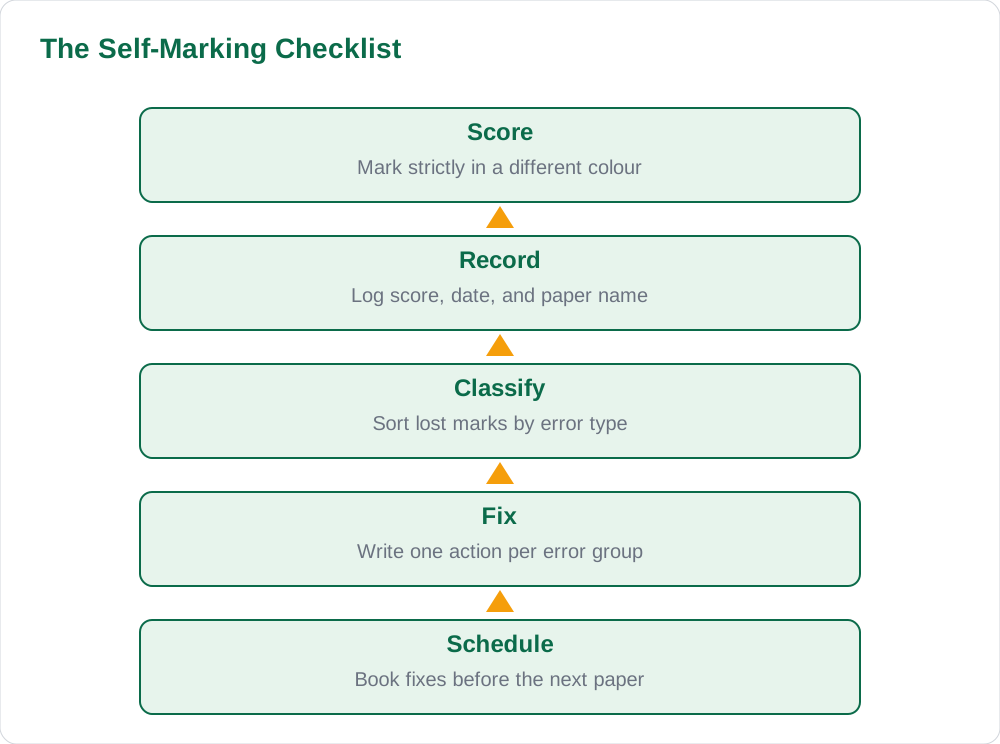
Use the same checklist after every paper so your scores stay comparable. First, mark with a different coloured pen and award marks only for points actually written, using a point list you prepare before checking any model answer. Second, total the marks carefully and record the score with the date and paper name. Third, classify every lost mark into knowledge gaps, careless slips, presentation problems, or time problems. Fourth, write one fix for each error group. Fifth, schedule the fixes into your revision before the next paper. Read each answer like an examiner.
Keep the checklist visible while marking, because memory alone lets generosity creep back in. Read each answer as an examiner would: is the keyword present, is the step shown, is the diagram labelled, is the unit stated? If the answer is no, the mark is lost, however well you understood the idea in your head. Over time, this strict reading trains you to write answers that survive strict marking, which is precisely the skill the exam rewards. A printable-style summary of study methods is in our study guides. That strict reading trains better writing.
- Mark in a different colour, awarding marks only for points actually written.
- Total carefully and record the score, date, and paper name in a log.
- Classify every lost mark: knowledge, careless slip, presentation, or time.
- Write one concrete fix per error group and schedule it before the next paper.
Classifying Errors So Fixes Actually Work
Different errors need different fixes, which is why classification matters. Knowledge gaps mean the concept was unknown or half-known, so the fix is study: reread the chapter, work examples, and retest. Careless slips mean the knowledge existed but reading or copying failed, so the fix is habit: underlining key words, checking numbers, and slowing down on instructions. Presentation problems mean points were present but hidden, so the fix is structure: headings, steps, and labels. Time problems mean questions were left blank, so the fix is pacing practice. Correct diagnosis saves weeks of effort.
After classifying a paper, count the marks lost to each group. If knowledge gaps dominate, your timetable needs more study and less testing. If careless slips dominate, you need checking routines, not more content. If time problems dominate, you need timed drills. This diagnosis stops the common mistake of responding to every low score with more reading, which helps only one of the four error types. A correct diagnosis saves weeks of misdirected effort and makes each paper measurably better than the last. After counting, decide which error group to attack first, usually the one that cost the most marks on that paper.
Turning Assessment Into a Revision Plan
Assessment without action is wasted effort, so convert every marked paper into a short plan within a day. List the top three knowledge gaps with their chapter names, and book one study session for each in the coming week. List the top two habits to fix, such as checking units or labelling diagrams, and write them on a card to read before the next paper. Then re-attempt the failed questions from memory within the same week, because a fix that is never tested is only a good intention. A tested fix is a real fix.
Review your log monthly to spot trends. A chapter that appears in three consecutive error logs needs a deeper intervention, perhaps a teacher's help or a fresh set of worked examples from the solved notes. A habit that keeps recurring needs a stronger routine, such as a fixed final-minutes check. Monthly review turns isolated papers into a story of improvement, and that story is motivating: you can see old weaknesses disappearing and new strengths forming, which sustains effort through long exam seasons. Bring your monthly log to your teacher, because a teacher can spot trends you missed and suggest fixes you never considered.
Staying Honest When Scores Disappoint
The hardest part of self-assessment is staying honest after a bad paper. It is tempting to remark generously, blame the paper, or skip marking altogether, but each of these reactions protects your feelings while harming your preparation. A better response is to separate the score from your self-worth: the score measures today's preparation, not your intelligence or your future. Write down what the paper taught you, thank yourself for the honest information, and move to the plan. Students who do this recover faster and improve sooner. Honest information beats comfortable ignorance.
Share your honest scores with a teacher or parent occasionally, not for judgement but for support and perspective. An adult can confirm that your marking is fair, suggest fixes you missed, and remind you how far you have come. If self-assessment ever feels overwhelming, reduce the frequency: one fully marked paper per fortnight beats three unmarked ones. The goal is a sustainable habit of honest reflection, not a punishing ritual. Chapter revision help is always available in the STBB books section. Keep the habit gentle during busy weeks, because one honest paper a fortnight beats three rushed papers you never mark.
- Separate the score from your self-worth before planning fixes.
- Write down one lesson from every disappointing paper.
- Share honest scores with a teacher or parent occasionally.
- Reduce frequency rather than abandoning marking when busy.
AI Help: Muse AI
Muse AI is Meta's personal AI assistant, and it can help you assess yourself honestly by reviewing a practice answer and pointing out missing points or steps. You can ask it to explain a concept behind an error or to quiz you again on a weak chapter. Join Muse with invite code LTGSWD — in the Muse app, go to Settings > Redeem token and enter the code. Disclosure: LTGSWD is the author's Muse invite code. Muse AI does not give official STBB answers — always verify against your STBB book and your teacher. Always verify against your Sindh Textbook Board book and your teacher before using anything in classwork.
5 key points you must know
- Mark strictly: award marks only for points actually written, never for intended ideas.
- Use the same checklist every time so scores stay comparable across papers.
- Classify lost marks into knowledge, careless slips, presentation, and time problems.
- Convert each paper into a plan within a day, with fixes scheduled before the next paper.
- Treat low honest scores as useful data, not as a judgement of your ability.
Frequently asked questions
How do I stop being generous when marking my own paper?
Prepare a point list before checking any model answer, mark in a different colour, and award a mark only when the point is visibly written. Read answers as a stranger would, checking keywords, steps, labels, and units. Asking a teacher or parent to check one paper a month also calibrates your strictness and keeps generosity from creeping back.
What should I do immediately after marking a paper?
Record the score with the date, classify every lost mark, and write one fix per error group. Then schedule those fixes into the coming week before your next paper. Re-attempt failed questions from memory within a few days. A paper that ends with a plan improves you; a paper that ends with only a score does not.
How often should I self-assess with past papers?
One fully marked paper per subject per week is ideal in the final months, or one per fortnight for younger students. Frequency matters less than completeness: a paper without honest marking and a follow-up plan teaches little. Keep the rhythm sustainable so the habit survives busy school weeks.
Is a low self-assessed score a bad sign?
No, it is useful information. A low honest score shows exactly which chapters and habits need work, while a flattered score hides them. Track your scores over weeks rather than judging single papers, and you will see improvement as fixes take effect. The trend matters far more than any one day's number.
Should I share my self-assessment with my teacher?
Yes, occasionally, because a teacher can confirm your marking is fair and suggest fixes you missed. Sharing also turns self-assessment into a conversation rather than a lonely judgement. Bring your error log and your plan, not just the score, so the discussion focuses on concrete next steps.
Solved notes — preview free
These guides work best with the solved exercises. Preview the solved notes free on this website — 119 solved notes for Classes 6–10 in Sindhi, Urdu, English and Arabic medium. Or browse the full solved notes catalogue for your class and medium. New solved notes are added regularly — check the catalogue for coming-soon books.