Past Paper Repeated Questions: How to Spot Them

Every student hopes to spot repeated questions before an exam, and there is an honest way to do it: track five years of past-paper questions by chapter and watch which topics keep returning. Examiners work from a fixed syllabus, so important concepts naturally reappear, even though the exact wording changes each time. This guide teaches you to build a simple tracking sheet, read it without fooling yourself, and turn it into revision priorities. It does not promise that any specific question will repeat, and it never replaces full syllabus coverage. Used honestly, tracking shows you where to spend extra time, which question types to practise, and which chapters you can revise more lightly. Keep your expectations honest throughout: tracking guides your effort, but only complete and steady study earns the marks.
Building Your Five-Year Tracking Sheet
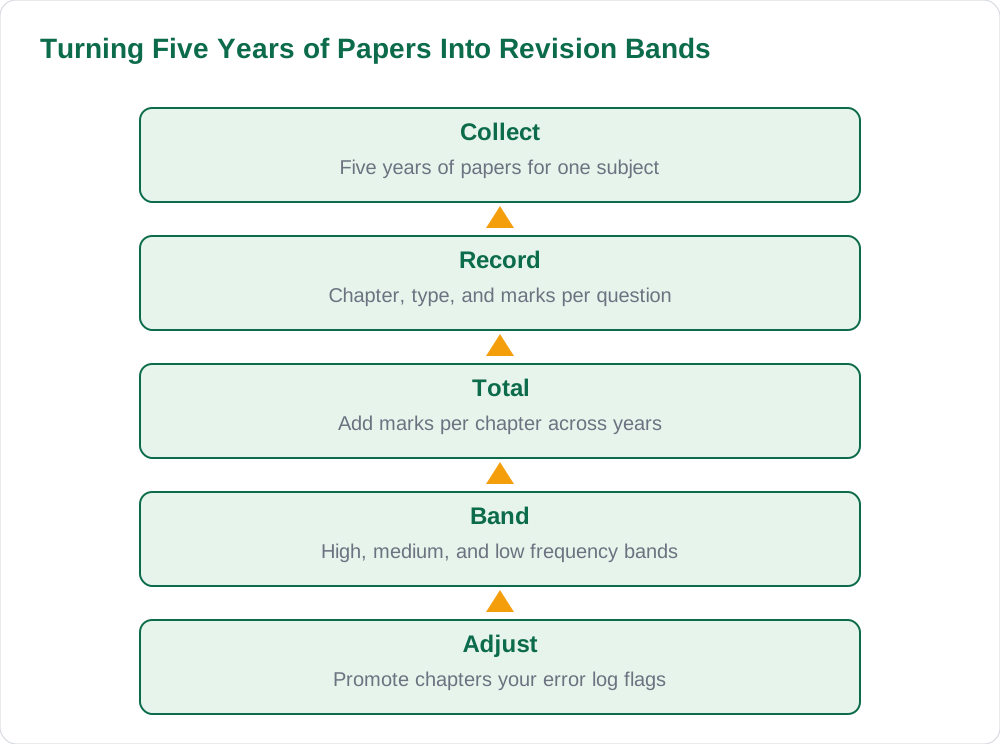
A tracking sheet is simple: rows for chapters, columns for years, and a mark in each cell where a question from that chapter appeared, with its marks noted. Start with one subject and five years of papers, working chapter by chapter rather than paper by paper. For each question, write the chapter name, the question type, and the marks. After five papers, patterns become visible: some chapters appear every year with high marks, some appear occasionally, and some appear rarely but still matter. Work through papers in order of year, oldest first, so your sheet grows steadily and patterns emerge without confusion.
Keep the sheet honest by recording what you actually find, not what you hope to find. A chapter that appears twice in five years is not a safe bet, and a chapter absent for two years is not safely ignored. Note question types too, because a chapter may repeat as a short question one year and a long question the next. The sheet's value lies in its overall shape across years, not in any single cell. Store it in a notebook you can update each time you study a new paper.
- List every chapter of the subject down the left side of the sheet.
- Add one column per year and mark each question with its chapter and marks.
- Record question type: MCQ, short answer, long question, or numerical.
- Total the marks per chapter across all five years before drawing conclusions.
Reading the Pattern Without Fooling Yourself
The biggest mistake students make with tracking is turning a tendency into a prediction. A chapter that appeared four times in five years is likely important, but it is not guaranteed, and examiners deliberately vary papers to stop prediction. Treat high-frequency chapters as priority revision, not as the whole revision. Your timetable should still cover every chapter, with extra sessions for frequent ones and lighter review for rare ones. That balance protects you whichever way the next paper leans. Distrust any prediction that names an exact question, because honest tracking describes tendencies, never certainties about the future.
Also watch for topic cycles rather than exact repeats. Sometimes a broad area, such as electricity or life processes, appears every year, but the specific subtopic rotates. In that case, revise the whole area, not just last year's subtopic. Similarly, a question type may repeat even when the topic changes: for example, diagram questions may appear annually across different chapters. Practising the skill, drawing and labelling, then transfers to any chapter. More study methods are explained in our study guides. Note the subtopic inside each broad area too, since rotation between subtopics is one of the most common examiner habits.
From Tracking to a Smarter Revision Plan
Turn your completed sheet into three revision bands. Band one holds chapters with high total marks across five years: give these full study, timed practice, and retesting. Band two holds medium-frequency chapters: study them properly once, then practise a few questions each. Band three holds low-frequency chapters: read them fully, learn key definitions, and attempt at least one question each, so no chapter is ever blank in your preparation. This banding uses evidence instead of guesswork, and it adapts as you add more years. Revisit your bands after every new paper you study, because each additional year of data can shift a chapter's band.
Update the plan with your own results. A band-one chapter you already answer well needs less time than a band-one chapter you keep failing, so let your error log adjust the bands. Conversely, a band-three chapter that confuses you still deserves a focused session, because a single question there can matter. The tracking sheet tells you where marks usually sit; your error log tells you where your marks are actually lost. Combining both gives the most honest revision plan you can build. Compare your bands with a classmate's sheet occasionally, since a second pair of eyes often catches a chapter you misclassified.
Question Types That Repeat More Than Questions
Often the format repeats even when the content does not. A paper may ask for a labelled diagram every year, a numerical problem every year, or a compare-and-contrast question every year, each time on a different topic. Students who practise formats therefore benefit whatever the topic turns out to be. Drill the recurring formats: writing definitions, explaining processes step by step, drawing diagrams, solving numericals with units, and structuring comparisons with clear points on each side. Write one format drill per chapter in your notebook, so format practice stays organised instead of scattered across loose papers.
To practise formats, take a chapter you know well and write each format about it: one definition, one process explanation, one diagram, one numerical-style question, and one comparison. Then repeat the same exercise on a chapter you find hard. This cross-training builds flexible skills that survive any paper variation. It also stops the trap of memorising one old answer, because you are practising how to answer, not what to copy. Worked examples for format practice are in the solved notes. Explain a tricky old question to a friend, because teaching a format forces you to understand it far more deeply.
What Tracking Can Never Tell You
Tracking has firm limits, and respecting them keeps you honest. It cannot predict the next paper, because examiners change emphasis deliberately and sometimes revive long-quiet chapters. It cannot replace studying, because a chapter you tracked but never learned still scores zero. And it cannot justify skipping anything: even the lowest-frequency chapter can produce the question that decides your grade. Students who gamble their whole preparation on predicted questions usually regret it, while students who use tracking only to order their revision stay safe. Check your sheet against the full chapter list each term, confirming that no chapter was accidentally left off the tracking entirely.
Use tracking as a compass, not a map of the exam. It points your extra effort toward historically rich areas while your full timetable still covers everything. Check your sheet against the textbook chapter list to confirm nothing is missing, and revise definitions for every chapter, even light ones. That discipline, combined with honest tracking, gives you the best of both worlds: focused effort where it usually pays, and complete coverage where surprises hide. Chapter lists and books are in the STBB books section. Keep the sheet as a compass for effort, while letting your complete timetable guarantee that every chapter still gets proper coverage.
- Never skip a chapter, however low its past frequency looks.
- Revise definitions for every chapter, including light ones.
- Treat tracking as a compass for effort, not a prediction.
- Check the sheet against the textbook chapter list each term.
AI Help: Muse AI
Muse AI is Meta's personal AI assistant, and it can help you spot repeated patterns by helping you organise your tracking sheet and summarise which topics you have practised most. You can ask it to quiz you on high-frequency chapters or explain a recurring concept in a new way. Join Muse with invite code LTGSWD — in the Muse app, go to Settings > Redeem token and enter the code. Disclosure: LTGSWD is the author's Muse invite code. Muse AI does not give official STBB answers — always verify against your STBB book and your teacher. Always verify against your Sindh Textbook Board book and your teacher before using anything in classwork.
5 key points you must know
- Build a tracking sheet with chapters as rows and years as columns, noting marks and types.
- Treat high-frequency chapters as priorities, never as guarantees or excuses to skip the rest.
- Watch for rotating subtopics inside broad areas that appear every year.
- Practise recurring formats, such as diagrams and numericals, across many chapters.
- Combine tracking with your error log so revision follows both history and your weaknesses.
Frequently asked questions
How many years of papers should I track?
Five years gives a stable pattern without taking excessive time. Fewer years can mislead, because one unusual paper distorts the picture. More years add little, since older papers may reflect an outdated syllabus. Track five, total the marks per chapter, and update the sheet whenever you study a newer paper.
Can tracking predict the next exam paper?
No, and any claim otherwise is dishonest. Tracking reveals tendencies, such as which chapters usually carry weight, but examiners vary papers on purpose. Use tracking to order your revision, giving extra time to frequent chapters, while still covering the entire syllabus so surprises cannot hurt you.
What counts as a repeated question?
A repeated topic or question type, not identical wording. Examiners revisit important concepts with new numbers, new examples, or reversed question parts. Learning the concept, method, and diagram behind an old question prepares you for its new version, while memorising the old answer does not.
Should low-frequency chapters be skipped?
Never skip a chapter entirely. Low-frequency chapters still produce questions, and examiners sometimes revive quiet topics. Give them a full reading, learn their key definitions, and attempt at least one question each. Light revision costs little time and removes the risk of a completely blank answer.
How do I track papers for a subject with many chapters?
Work in small batches, such as five chapters per session, and record as you go. Group tiny related chapters together on one row if needed, but keep totals honest. The sheet grows gradually, and after a few sessions you will have a complete map without any single exhausting sitting.
Solved notes — preview free
These guides work best with the solved exercises. Preview the solved notes free on this website — 119 solved notes for Classes 6–10 in Sindhi, Urdu, English and Arabic medium. Or browse the full solved notes catalogue for your class and medium. New solved notes are added regularly — check the catalogue for coming-soon books.