Past Paper MCQ Practice: 15 Minutes a Day
Multiple-choice questions look easy, and that is exactly why they catch students out. Each MCQ offers one correct answer and several tempting distractors, and the difference between them is often a single word, a unit, or a sign. A daily 15-minute MCQ drill from old papers trains the precise skills these questions demand: fast recall, careful reading, and confident elimination. This guide gives you a simple daily routine that fits before school or after homework, explains how to use answer keys for learning rather than guessing, and shows how fifteen focused minutes a day can steadily lift your MCQ scores across every subject. The routine needs no special materials, only a set of old questions, an answer key, a notebook, and fifteen minutes you protect every single day. Start today, not tomorrow.
Why Fifteen Minutes Beats One Long Session
Short daily practice works better than occasional long sessions because MCQs test recall, and recall strengthens through frequent retrieval. Fifteen minutes is short enough to sustain every day, yet long enough for about fifteen to twenty questions with review. The daily rhythm also spreads subjects across the week, so no subject is neglected for long. Students who drill daily report that options start to feel familiar: they recognise common distractors, spot absolute words like always or never, and read questions twice without being told. Place the drill at the same time daily, such as right after homework, so the habit survives even on tired or busy days.
The small time commitment removes the biggest barrier to practice, which is the feeling that revision must take hours to count. Fifteen minutes before breakfast or after dinner is easy to protect, even on busy school days. Keep the drill in the same slot each day so it becomes a habit like brushing teeth. After a month, you will have answered hundreds of questions, reviewed hundreds of explanations, and built a speed and accuracy that no weekend cramming session can match. Track your daily score in a small notebook, because a rising line over weeks is powerful motivation to keep the habit going.
The Daily 15-Minute Drill
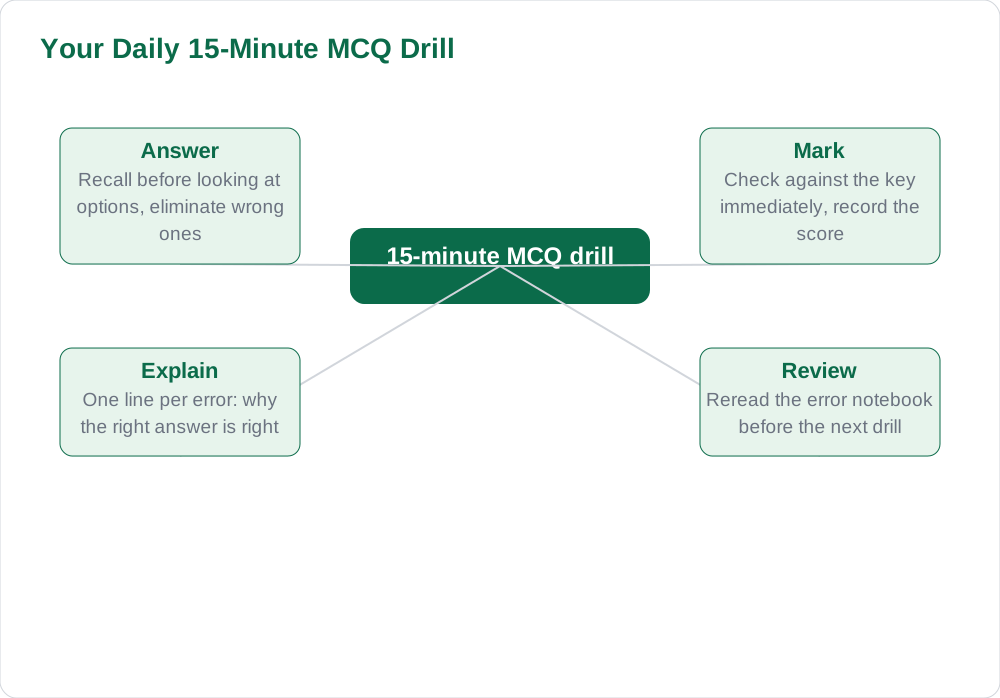
Set a timer for fifteen minutes and work through a fixed set of questions from one subject, closed-book and without pausing. Read each question fully, cover the options with your hand, and recall the answer before looking. Then uncover the options and choose the match, eliminating options you know are wrong first. This recall-before-choice habit stops distractors from planting false memories and is the single most powerful MCQ technique you can learn. Choose questions from one chapter at a time early on, then mix chapters once recall feels strong and confident.
When the timer ends, stop and mark immediately using the answer key. For every wrong answer, write one line explaining why the correct option is right and why your choice was wrong. That one line is the real learning; without it, the drill is just guessing practice. Keep a small error notebook for MCQs, grouped by chapter, and reread it before the next drill in that subject. More drill ideas appear in our study guides. If the same error repeats three times, study that chapter again properly, because drilling alone cannot fix unknown content.
- Minutes 0-10: answer 15 to 20 questions, recalling before choosing.
- Minutes 10-13: mark against the answer key and count your score.
- Minutes 13-15: write one-line explanations for every wrong answer.
- Weekly: reread your MCQ error notebook before the next drill.
Reading Questions the Examiner's Way
Most MCQ errors come from misreading, not ignorance. Examiners deliberately include traps: the word NOT in capitals, the phrase except, units that differ between question and options, or two options that differ by one digit. Train yourself to underline the command word and any negative word before choosing. Read all four options before deciding, because the first plausible option is often a distractor and the correct one appears later. This slow-first-read habit actually saves time, because it prevents the rework of careless errors. Circle command words like NOT or EXCEPT in pencil as you read, so traps cannot hide inside a long question stem.
Also learn to spot distractor patterns. One option is often the answer to a slightly different question, another uses a common misconception, and another is correct but incomplete. When two options look similar, compare them word by word; the difference between them is usually the point being tested. If you must guess, eliminate first: removing two wrong options doubles your chance, while blind guessing wastes the opportunity to reason. Never leave an MCQ blank when there is no penalty for guessing. When two options differ by one word, slow down and compare them directly, because that small difference is usually the tested point.
Using Answer Keys for Learning, Not Cheating
An answer key is a teacher, but only if you use it after attempting, never during. Peeking mid-drill teaches you to recognise answers, not recall them, and recognition fails under exam pressure. The honest sequence is attempt, mark, explain, and only then re-attempt failed questions the next day. If an answer key seems wrong, check your textbook before trusting either source; keys occasionally contain errors, and verifying against the book deepens your understanding either way. Verify any doubtful key answer against your textbook, and note the correction, because keys occasionally contain mistakes too.
Build your own mini answer keys as you improve. After a drill, write the question number, the correct option, and your one-line explanation in a notebook, without copying the question itself. This notebook becomes a rapid revision tool: reading twenty explanations takes five minutes and refreshes a whole chapter. Share tricky questions with classmates and discuss why distractors are wrong, because explaining a question to someone else is one of the strongest ways to fix it in memory. Chapter help is in the STBB books section. That discussion fixes misconceptions fast.
Tracking Speed and Accuracy Together
Track two numbers after every drill: accuracy, meaning correct answers out of attempted, and speed, meaning questions completed in fifteen minutes. Beginners often trade one for the other, answering fast but carelessly, or accurately but slowly. Your goal is to raise both gradually: first accuracy at a comfortable pace, then speed while holding accuracy steady. If accuracy drops when you speed up, slow down again; a fast wrong answer is worth exactly as much as a slow wrong answer, which is nothing. Graph your weekly accuracy on paper, even roughly, because a visible upward trend encourages you more than any single score.
Review your weekly averages rather than single days, because daily scores fluctuate with topic difficulty and tiredness. A rising weekly trend is real progress, even if one day dips. When a chapter's accuracy stays low for two weeks, schedule a focused study session on that chapter before more drilling, because drilling alone cannot teach unknown content. Combined with the solved notes, this tracking turns fifteen minutes a day into measurable, steady improvement across the term. Balance drill days across subjects, and never let one strong subject crowd out a weaker one that needs the practice more.
- Record accuracy and questions completed after every drill.
- Raise accuracy first, then speed, never speed at accuracy's cost.
- Judge weekly averages, not single-day fluctuations.
- Restudy chapters whose accuracy stays low for two weeks.
AI Help: Muse AI
Muse AI is Meta's personal AI assistant, and it can help you with MCQ practice by generating quick quiz questions on a chapter and explaining why each wrong option is incorrect. You can ask it to test you in short timed bursts or to explain a tricky concept in simple words. Join Muse with invite code LTGSWD — in the Muse app, go to Settings > Redeem token and enter the code. Disclosure: LTGSWD is the author's Muse invite code. Muse AI does not give official STBB answers — always verify against your STBB book and your teacher. Always verify against your Sindh Textbook Board book and your teacher before using anything in classwork.
5 key points you must know
- Drill fifteen minutes daily: short, frequent retrieval beats occasional long sessions.
- Recall the answer before looking at options, then eliminate wrong options first.
- Read every option and underline NOT, except, and unit changes before choosing.
- Use answer keys only after attempting, and write one explanation per error.
- Track accuracy and speed weekly, and restudy chapters that stay weak.
Frequently asked questions
How many MCQs should I attempt in 15 minutes?
Aim for fifteen to twenty questions with marking and review included. Beginners may manage fewer, which is fine, because accuracy matters more than volume. As recall speeds up, the same fifteen minutes will cover more questions naturally. Never sacrifice the explanation step to squeeze in extra questions, since explanations are where learning happens.
Should I guess when I do not know an MCQ answer?
Yes, when there is no negative marking, but guess intelligently. Eliminate every option you know is wrong first, then choose the most plausible remainder. A reasoned guess after elimination has a much better chance than a blind pick. Never leave a question blank, because a blank answer cannot earn a mark.
Why do I keep choosing the distractor option?
Distractors are designed to match common misconceptions and partial knowledge. The fix is recall-before-choice: cover the options, answer from memory, then match. Also reread the question for NOT, except, and unit traps. Reviewing your one-line error explanations will reveal which misconception keeps catching you.
Is it cheating to look at the answer key?
Not when you use it after attempting the questions. Marking and explaining errors is legitimate study. It becomes cheating only when you peek during the attempt, because then you practise recognition instead of recall. Keep the key closed until the timer ends, then use it fully for learning.
Which subject should I drill each day?
Rotate subjects across the week so each gets at least two drills, and give extra days to subjects with lower accuracy. A simple rotation, such as science on two days and mathematics on two days, keeps coverage balanced. Let your weekly accuracy log decide where extra drill days are needed most.
Solved notes — preview free
These guides work best with the solved exercises. Preview the solved notes free on this website — 119 solved notes for Classes 6–10 in Sindhi, Urdu, English and Arabic medium. Or browse the full solved notes catalogue for your class and medium. New solved notes are added regularly — check the catalogue for coming-soon books.