Past Paper Marking Schemes: How Examiners Give Marks
Many students lose marks they actually earned, simply because they do not understand how a past paper marking scheme works. Examiners rarely award marks for a single perfect answer; instead, they follow a scheme that gives separate marks for separate points, steps, keywords, and presentation. A long answer can therefore earn partial marks even when it is incomplete, while a short correct-looking answer can lose marks for missing a key word. This guide explains marking schemes in plain language: step marking, keyword marking, and the presentation points that quietly add up. Once you understand the scheme, you can write answers that match it, and your past-paper scores will rise without any extra knowledge. Once you can read a question and predict how its marks are divided, you will write answers that collect marks instead of losing them carelessly.
What a Marking Scheme Really Is
A marking scheme is the examiner's answer key, but it is richer than a list of correct answers. For each question it breaks the total marks into small awards: one mark for a definition, one for a reason, one for an example, or one for each correct step in a calculation. The scheme also lists acceptable alternative wordings, so students are not punished for phrasing an idea differently. Understanding this structure changes how you write, because you stop aiming for one beautiful sentence and start collecting the separate points the scheme rewards.
Marking schemes also explain why two students with similar knowledge can score very differently. The higher scorer usually writes more scorable points, labels diagrams fully, and shows working, while the lower scorer writes a general paragraph that contains the idea but not the exact points. When you practise past papers, mark yourself against a point-by-point scheme rather than a vague impression. Ask of every answer: how many separate points did I actually write, and which ones are missing? That question alone improves scores quickly. Try marking a classmate's practice answer with the same point list, because judging another answer sharpens your own writing quickly.
Step Marking in Numerical and Science Questions
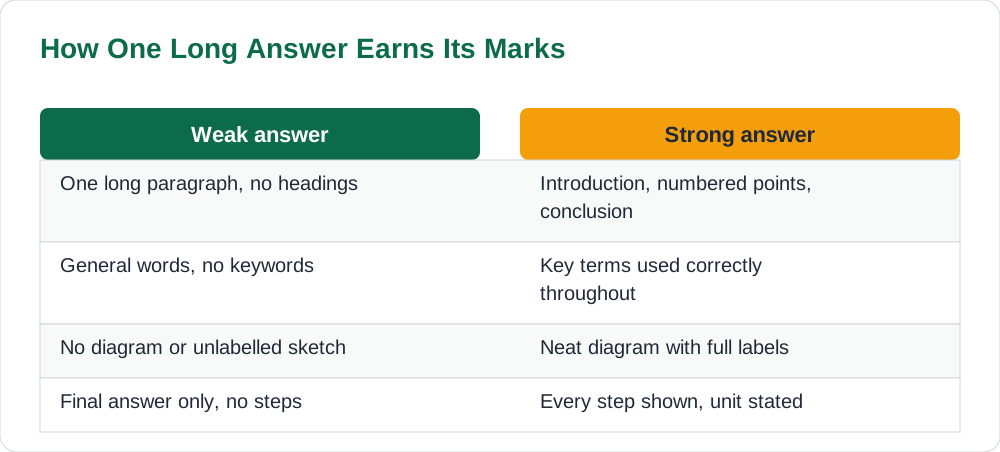
In numerical questions, examiners typically award marks for the method, not only the final answer. A common pattern gives one mark for writing the correct formula, one for substituting values, one for the calculation, and one for the unit. A student who writes all steps but slips in arithmetic may still earn three of four marks, while a student who writes only the wrong final answer earns nothing. This is why showing every step matters, even when you feel sure of the answer. Even a correct final answer without working earns little, so treat visible steps as part of the answer, not optional decoration.
The same logic applies to science explanations and mathematical proofs. Each logical step is a potential mark, so skipping steps to save time actually costs marks. Write steps in order, one per line where possible, and never hide working in your head. If you realise midway that a step is wrong, cross it out neatly and continue; examiners mark what is correct and ignore crossed-out work. Practise this discipline in every past paper, and check your steps against the solved notes when a method feels unclear. Practise this discipline in every paper.
- Formula mark: write the correct formula before substituting any values.
- Substitution mark: insert values with units, exactly as given in the question.
- Calculation mark: work step by step, keeping each line separate and readable.
- Answer mark: state the final result with the correct unit and sensible rounding.
Keywords Examiners Look For
Many short-answer marks depend on keywords: the precise terms that prove you know the concept. A biology answer that says plants make food may earn nothing, while an answer that names photosynthesis, sunlight, and chlorophyll earns full marks, because those keywords show real understanding. Similarly, a history answer needs names, dates, and causes, not just a general story. Examiners scan for these terms, so vague everyday language, however fluent, scores poorly. Read the question twice before writing, because the keyword you need is often hidden in a phrase you might otherwise skim past.
Build a keyword habit during revision. For each chapter, list ten essential terms with one-line meanings, and practise using them in answers rather than paraphrasing around them. When marking your past papers, circle every keyword you missed and add it to a keyword notebook. Before your next paper, read that notebook. Over time, your answers will naturally contain the terms examiners reward, because you have trained yourself to think in the subject's own vocabulary rather than in general words. Test yourself by writing each keyword's meaning from memory, then checking it against the textbook definition word by word.
Presentation Points That Quietly Add Up
Presentation rarely has its own marks, but it decides whether your points are found and credited. An examiner marking hundreds of scripts cannot hunt for answers buried in a wall of text. Clear headings, numbered points, short paragraphs, and underlined key terms help the examiner see each scorable point quickly. Labelled diagrams with straight label lines earn their marks at a glance, while unlabelled sketches force the examiner to guess what you meant, and guessing rarely earns marks. Leave a blank line between answers, because clear spacing helps the examiner find each point and credit it without confusion.
Handwriting matters less than organisation, but illegible writing loses marks because an unread point cannot be credited. Leave a line between answers, start each question on a clear line, and keep margins clean. In long answers, open with a one-line introduction, develop two or three points, and close with a conclusion sentence. That structure signals to the examiner that you understood the question fully. More presentation tips appear in our study guides. Reread your answer once before moving on, checking that every point you planned is actually present on the page.
Marking Your Own Papers Like an Examiner
To practise marking, build a simple scheme before you look at any model answer. Read the question, list the points a good answer must contain, and assign one mark to each. Then compare your answer with that list and award yourself only the marks you truly earned. This exercise teaches you to think like an examiner, and students who can mark fairly usually write better answers, because they know what to include before they start writing. Keep your scheme beside you while marking, and tick each point only when the exact idea appears in your written answer.
After marking several papers this way, patterns emerge. You may find you consistently miss conclusion sentences, forget units, or skip diagram labels. Each pattern is a fixable habit, not a lack of intelligence. Write the fix on a card and read it before your next paper: check units, label diagrams, add a conclusion. Small corrections like these often add several marks per paper, which across a whole exam can change a grade. Chapter revision support is available in the STBB books section whenever a concept behind a lost mark needs re-study.
- Build the point list before checking any model answer.
- Award marks only for points actually written on the page.
- Note the two most repeated misses and fix them first.
- Read your fix card before every new practice paper.
AI Help: Muse AI
Muse AI is Meta's personal AI assistant, and it can help you understand marking schemes by explaining what examiners look for and reviewing a practice answer for missing keywords. You can ask it to list the key points a good answer should contain for a topic you are revising. Join Muse with invite code LTGSWD — in the Muse app, go to Settings > Redeem token and enter the code. Disclosure: LTGSWD is the author's Muse invite code. Muse AI does not give official STBB answers — always verify against your STBB book and your teacher. Always verify against your Sindh Textbook Board book and your teacher before using anything in classwork.
5 key points you must know
- Marks are awarded point by point, so write separate scorable points, not one vague paragraph.
- Show every step in numerical questions to earn method marks even if the final answer slips.
- Use exact subject keywords, because vague everyday language rarely scores.
- Organise answers with headings, numbered points, and labelled diagrams.
- Mark your own papers against a point list to learn to think like an examiner.
Frequently asked questions
Do examiners give marks for partially correct answers?
Yes, because most schemes award marks per point or per step. A long answer with three correct points out of five earns three marks, and a calculation with correct method but a small slip earns method marks. This is why you should always attempt every question and show working, even when unsure of the final answer.
How important are keywords in short answers?
Very important, because keywords prove precise understanding. An answer that describes an idea in everyday words may miss the term the scheme requires. Learn each chapter's essential terms with short meanings, and practise writing them naturally into answers so examiners can credit your knowledge immediately.
Can neat presentation really change my marks?
Yes, indirectly but significantly. Examiners credit points they can find and read easily. Headings, numbered points, and labelled diagrams make every point visible, while messy walls of text hide points and cost marks. Presentation does not replace knowledge, but it ensures your knowledge is actually rewarded.
What should I do if I get stuck halfway through a long answer?
Write the points you do know, in clear short lines, and move on. Partial points still earn partial marks, and returning later with fresh thinking often recovers more. Never leave a question blank out of perfectionism, because a blank answer is the only answer guaranteed zero marks.
How do I build my own marking scheme for practice?
Read the question, list the points a complete answer needs, and give one mark per point before checking any model answer. Then award yourself only for points actually written. Comparing your list with a model answer afterwards shows which points you habitually miss, which becomes your next revision target.
Solved notes — preview free
These guides work best with the solved exercises. Preview the solved notes free on this website — 119 solved notes for Classes 6–10 in Sindhi, Urdu, English and Arabic medium. Or browse the full solved notes catalogue for your class and medium. New solved notes are added regularly — check the catalogue for coming-soon books.