Past Paper Long Questions: Structure That Scores

Long questions carry the most marks in a paper, and they are also where students lose the most marks, not from ignorance but from poor structure. A student who knows the material but writes it as one shapeless block often scores half of what a structured answer earns, because the examiner cannot find the points to credit. The fix is a reliable format you can use for every long question: a clear introduction, ordered steps or points, a labelled diagram where relevant, and a short conclusion. This guide teaches that format, shows how to adapt it across subjects, and explains how to practise it on past papers until it becomes your automatic way of writing. Practise the format on every long question you meet, and it will soon feel as natural as writing your own name.
The Four-Part Format Every Long Answer Needs
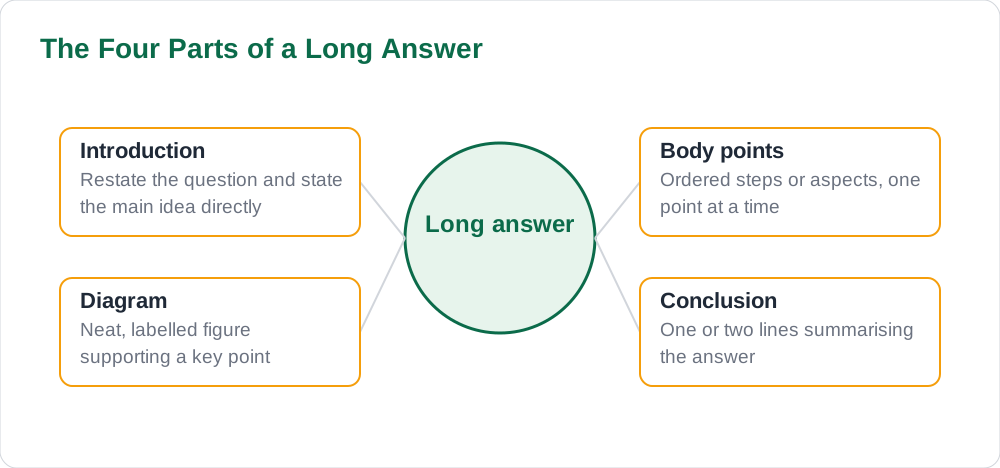
Every strong long answer has four parts, and examiners recognise them instantly. The introduction, one or two lines, restates the question and states the main idea or answer directly, so the examiner knows immediately that you understood the question. The body develops the answer in ordered points or steps, each covering one aspect, with keywords and examples woven in. A diagram, where the subject allows one, illustrates a key point and often carries its own marks. The conclusion, one or two lines, summarises the answer and closes the response cleanly.
This format works because it mirrors how marking schemes are built: schemes award marks for separate points, and a structured answer displays those points openly. An unstructured answer may contain the same ideas, but they hide inside long sentences and the examiner may miss or undervalue them. Practise the format on every long question in past papers, even when you feel rushed, because structure under time pressure is a trained habit, not a luxury. Worked examples of structured answers appear in the solved notes. Underline the command words in each long question before planning, because they tell you exactly what kind of answer earns marks.
Writing an Introduction That Earns Its Place
A good introduction is short and purposeful, never a paragraph of background. If the question asks for the causes of something, your first line should name the main cause or state that several causes combine. If it asks how a process works, your first line should name the process and its purpose. This direct opening earns the examiner's confidence and often matches the first marking point. Avoid opening with definitions copied from memory unless the question asks for one, because irrelevant openings waste time and suggest you are circling the question.
Practise introductions separately, because they set the tone for the whole answer. Take ten old long questions and write only their first two lines, then check whether each opening answers the question directly. You will quickly notice which openings are strong and which merely delay. A strong opening also helps you: once you have stated the main idea, the body points follow naturally, because you have already committed to a clear direction for the answer. Draft your introduction last if you feel stuck, since the body points often clarify the main idea you want to open with.
Developing the Body in Ordered Steps
The body is where most marks live, so organise it ruthlessly. Decide the order before writing: chronological for processes, cause then effect for explanations, or point by point for comparisons. Write one point per paragraph or numbered step, and give each point its keyword and, where possible, an example. Numbering helps both you and the examiner track progress, and it prevents the common fault of repeating one point three times in different words while missing two others entirely. Number your body points clearly, because numbering helps the examiner credit each point and helps you spot a missing one.
Keep each point tight. Two to four sentences per point is usually enough: a statement, a reason or explanation, and an example or consequence. If a point needs a diagram, draw it beside that point rather than at the end, so the examiner connects figure and text. When you finish the planned points, stop and check against the question: have you answered every part, including subparts? Long questions often contain two or three sub-questions, and missing one subpart can cost a third of the marks. More guidance is in our study guides.
- Order the body before writing: time order, cause to effect, or point by point.
- Write one point per paragraph, with its keyword and an example.
- Place each diagram beside the point it illustrates, not at the end.
- Check every subpart of the question before writing the conclusion.
Diagrams and Examples That Strengthen Answers
A relevant diagram can transform a good answer into a full-marks one, because diagrams carry marks of their own and make explanations easier to follow. Draw diagrams neatly, at a sensible size, with straight label lines and labels written clearly. Add a one-line caption stating what the diagram shows, and refer to it in your text, for example by writing that the process is shown in the figure. An unlabelled sketch, or a diagram unrelated to the point, adds nothing and wastes time, so draw only what you can label correctly.
Examples work the same way: one well-chosen example proves understanding better than a paragraph of general claims. In science, an example might be a specific substance or organism; in social studies, a specific event or place; in mathematics, a worked step. Choose examples you know well rather than impressive ones you half-remember, because a wrong example undermines an otherwise good answer. Practise pairing each major concept with one example during revision, so examples come to mind automatically in the exam. Rehearse one example per major concept during revision, so examples arrive automatically instead of needing a long search in exams.
Conclusions and the Final Check
A conclusion should summarise, not introduce new material. One or two lines restating the main answer signal completeness and often match a final marking point about overall understanding. Students who end abruptly, mid-argument, leave the examiner unsure whether they finished or simply ran out of time, and that uncertainty rarely helps. Even under time pressure, reserve thirty seconds for a closing line; it is among the cheapest marks in the whole paper. Write the conclusion even when time is short, because a closing line can earn the final mark for overall understanding.
After writing the conclusion, run a ten-second check: does every subpart have an answer, are diagrams labelled, and are key terms spelled correctly? If time remains, add a missing point rather than rewriting existing ones. Practise this full format on past papers under timed conditions, and mark yourself against a point list: introduction, each body point, diagram, and conclusion. When every part is present, your long answers will consistently score near their full value. Chapter support is in the STBB books section. Practise the full format under timed conditions weekly, since structure only becomes automatic when it survives real time pressure.
- Summarise the main answer in one or two closing lines.
- Check every subpart has an answer before moving on.
- Verify diagram labels and key-term spellings quickly.
- Add missing points rather than rewriting finished ones.
AI Help: Muse AI
Muse AI is Meta's personal AI assistant, and it can help you structure long answers by suggesting an outline of introduction, points, and conclusion for any topic. You can ask it to review a practice answer and point out missing parts or unclear steps. Join Muse with invite code LTGSWD — in the Muse app, go to Settings > Redeem token and enter the code. Disclosure: LTGSWD is the author's Muse invite code. Muse AI does not give official STBB answers — always verify against your STBB book and your teacher. Always verify against your Sindh Textbook Board book and your teacher before using anything in classwork.
5 key points you must know
- Use the four-part format for every long answer: introduction, body, diagram, conclusion.
- Open directly with the main idea instead of background or delay.
- Develop one point per paragraph, ordered logically, with keywords and examples.
- Draw neat, labelled diagrams beside the point they support.
- Close with a summary line and check every subpart before moving on.
Frequently asked questions
How many points should a long answer contain?
Match the points to the marks and the subparts. A ten-mark question usually needs four to six developed points, while a six-mark question needs about three. Plan the points before writing, and check that every subpart is covered. More points help only when each is distinct; repeating one idea in different words earns nothing extra.
Where should I put the diagram in a long answer?
Beside the point it illustrates, not dumped at the end. Draw it neatly at a sensible size, label every part with straight lines, and mention it in your text. A well-placed diagram supports the explanation and often carries its own marks, while an unlabelled sketch at the end is easily overlooked by the examiner.
What if I run out of time mid-way through a long answer?
Write the remaining points as short lines rather than leaving them out, then add a one-line conclusion. Brief points still earn partial marks, while missing points earn none. Practise timed long answers so you learn how much you can write per mark, and always reserve thirty seconds for a closing line.
Should long answers use headings and numbering?
Yes, because headings and numbers make each point visible to the examiner. A numbered body is easier to mark fairly than a wall of text, and it helps you track whether you have covered every subpart. Keep headings short and relevant, and use numbering consistently throughout the answer.
How do I practise long-answer structure?
Take old long questions, plan the four parts on rough paper, then write the full answer timed. Afterwards, mark against a point list covering introduction, body points, diagram, and conclusion. Rewriting weak answers with the missing parts included is the fastest way to make the format automatic.
Solved notes — preview free
These guides work best with the solved exercises. Preview the solved notes free on this website — 119 solved notes for Classes 6–10 in Sindhi, Urdu, English and Arabic medium. Or browse the full solved notes catalogue for your class and medium. New solved notes are added regularly — check the catalogue for coming-soon books.