The Role of Women in Pakistan's Society and Progress
The role of women in Pakistan's society and progress is a story of contribution in every field of life. Women teach in schools, treat patients in hospitals, run businesses, farm the land, raise families, and lead community work. No society can progress while half its people are held back. This article looks at women's roles in education, work, family, and community life with respectful, factual framing, and shows why equal opportunity for girls is essential for the whole country's future. You will see women's work in education, farming, professions, and community life, meet leaders and role models, and learn what pupils can do to support fairness.
Education: The First Door
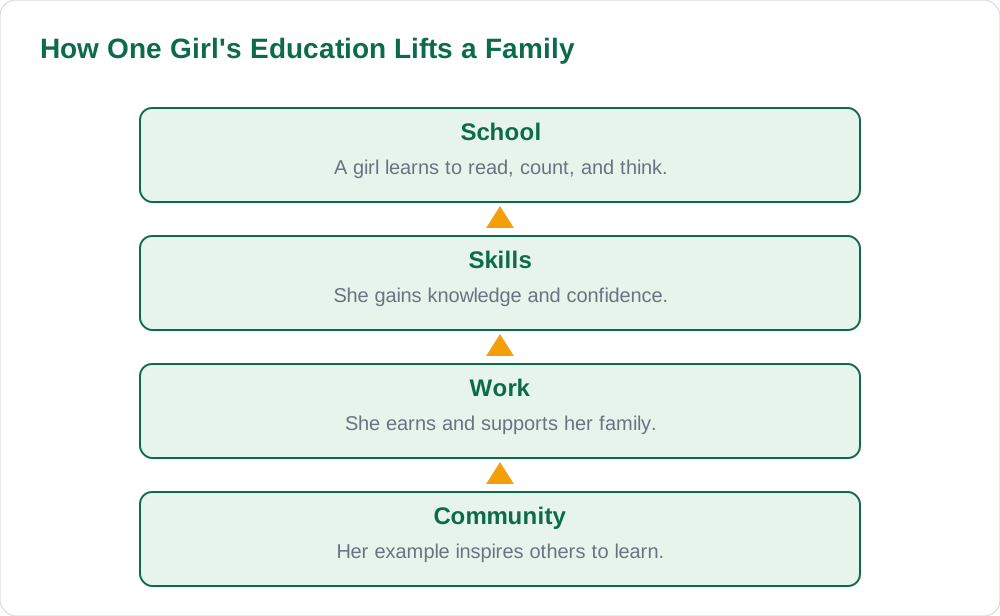
Education is the first door to progress for girls and women. A girl who completes school can read, earn, and make informed choices for her family. An educated mother is more likely to send her own children to school, look after their health, and manage the household budget wisely. In this way, one girl's education lifts a whole family.
Schools across Pakistan now welcome girls in growing numbers, and women teach in large numbers too. When girls stay in school, the whole country gains: literacy rises, health improves, and more talent enters every profession. Every pupil can support this by treating girls' education as equal in value to boys'. See the blog listing for more society guides.
Work: From Fields to Professions
Women work in every part of Pakistan's economy. In villages, they help with farming, care for livestock, and manage homes. In towns and cities, they work as teachers, doctors, nurses, lawyers, engineers, bankers, artists, and business owners. Women's crafts and embroidery are valued across the country and sold in faraway markets.
Work brings dignity and independence. A woman who earns can support her family, make choices, and contribute to the economy. Fair workplaces — with respect, safety, and equal pay for equal work — help women do their best. Pupils should learn to judge people by their work and character, not by old ideas about who may do which job.
- Rural women support farming, livestock, and home life.
- Urban women work in teaching, health, law, and business.
- Crafts and embroidery carry women's skill to wide markets.
- Fair, safe workplaces help women do their best work.
Family and Community Life
In family life, women are often the first teachers of children. They pass on language, manners, faith, and values before a child ever reaches school. They manage homes, care for the elderly, and hold families together in hard times. This unpaid work is real work, and a fair society recognises and respects it.
In community life, women run welfare work, charity drives, and neighbourhood groups, organising health camps, literacy classes, and support for families in need. A community where women take part is stronger, kinder, and better organised than one where they are shut out.
Leaders and Role Models
Pakistani women have led in many fields, serving as prime minister, governors, judges, parliamentarians, diplomats, pilots, athletes, and artists. These leaders show girls that no honest ambition is out of reach. Their example matters because young people copy what they see: when girls see women leading, they believe they can lead too.
Role models are not only famous people. A mother who runs a small business, a teacher who opens a school, or a nurse who serves a village is a role model too. Pupils should notice and respect the women who lead around them, in their own homes and streets. Visit the solved notes and the books page for more study material.
What Pupils Can Do
Pupils can help build a fair society in simple ways. Treat girls and boys equally in class, in games, and in group work. Share chores at home fairly. Speak up politely when someone says girls cannot do something. Respect every woman's work, whether it is paid or unpaid, at home or outside it.
The lesson is simple: a country progresses when all its people progress. When girls learn, women work, and everyone is treated with respect, families grow stronger and the nation moves forward. That is why the role of women is not a side topic in Pakistan Studies — it is at the heart of the subject.
- Treat girls and boys equally in class, games, and group work.
- Share chores at home fairly.
- Speak up politely against unfair limits on girls.
- Respect all women's work, paid and unpaid.
AI Help: Muse AI
Muse AI is Meta's personal AI assistant, and it can help you prepare a short class talk on the role of women by organising education, work, and community roles into clear points. Muse AI does not give official STBB answers — always verify against your STBB book and your teacher. For final wording, always check your Sindh Textbook Board book and ask your teacher.
Join Muse with invite code LTGSWD — in the Muse app, go to Settings > Redeem token and enter the code.
Disclosure: LTGSWD is the author's Muse invite code.
5 key points you must know
- Women contribute in education, work, family, and community life.
- Girls' education lifts families and strengthens the whole country.
- Women work in farming, crafts, teaching, health, law, and business.
- Family and community work by women is real work deserving respect.
- Equal opportunity for girls is essential for national progress.
Frequently asked questions
Why is girls' education so important for progress?
An educated girl can read, earn, and make informed choices. An educated mother is more likely to send her children to school and manage health and budgets wisely, lifting the whole family.
In which fields do Pakistani women work?
In farming and crafts, and as teachers, doctors, nurses, lawyers, engineers, bankers, artists, business owners, judges, diplomats, pilots, and athletes.
Is unpaid work at home real work?
Yes. Raising children, caring for the elderly, and managing a home are real work that holds families together, and a fair society recognises and respects it.
What can pupils do to support equality?
Treat girls and boys equally in class and games, share chores fairly at home, speak up politely against unfair limits, and respect all women's work.
Solved notes — preview free
These guides work best with the solved exercises. Preview the solved notes free on this website — 119 solved notes for Classes 6–10 in Sindhi, Urdu, English and Arabic medium. Or browse the full solved notes catalogue for your class and medium. New solved notes are added regularly — check the catalogue for coming-soon books.