Quaid-e-Azam: Leadership Lessons in Pakistan Studies
Quaid-e-Azam leadership in Pakistan Studies is studied not only for history, but for character. Muhammad Ali Jinnah led the Muslim League through years of hard negotiation and won a separate homeland without leading an army or starting a violent revolt. His tools were law, argument, organisation, and discipline. This article looks at how he led, why his methods worked, and what pupils can learn from his example — in school, in teamwork, and in life. You will see how he used law and argument, why discipline and unity mattered to him, and how his fairness toward minorities still sets a standard for the country.
A Constitutional Struggle
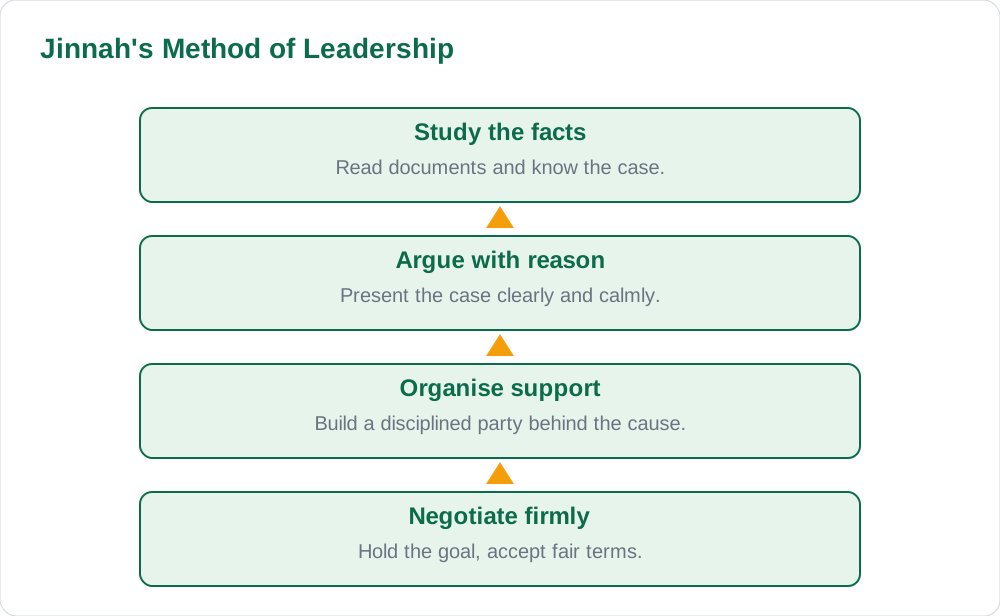
Jinnah believed in the constitution, not in force. He argued his case in councils, in courts of public opinion, and at the negotiating table. He read documents carefully, prepared his arguments, and answered opponents with facts and logic. This constitutional path meant that Pakistan was born from a political and legal struggle, not from a military campaign.
Pupils can learn from this method. When you face a disagreement — in class, in a team, or at home — argue with reasons, listen to the other side, and accept fair rules. Winning by argument is slower than shouting, but it lasts longer. See more leadership guides in the blog listing and the solved notes.
Discipline in Personal Life
Jinnah was famous for discipline. He kept strict working hours, dressed carefully, spoke precisely, and never wasted words. He was punctual and expected others to be punctual too. This discipline gave him strength: people trusted a leader whose own life was ordered and honest.
Pupils can copy this in small ways. Keep a fixed study time. Finish homework on the day it is given. Speak carefully and keep promises. Discipline is not a punishment; it is a habit that frees your time and earns other people's trust.
- Keep fixed study hours and honour them daily.
- Finish tasks on time instead of delaying them.
- Speak carefully and keep your promises.
- Let your habits show that you can be trusted.
Unity: One Nation, Many Peoples
Jinnah's call for unity was one of his strongest messages. Pakistan was home to people of different provinces, languages, and faiths, and he asked them to think of themselves as one nation. His famous motto — Faith, Unity, Discipline — put unity at the centre. He told citizens that provincial and tribal differences must not divide the nation.
For pupils, unity begins in the classroom. Treat classmates fairly whatever their background. Work in mixed groups. Stand against bullying and teasing. A class that practises unity becomes a school that practises unity, and a school that practises unity strengthens the nation.
Fairness to Minorities
Jinnah promised that minorities in Pakistan would enjoy equal rights. He said that citizens would be free to worship, to follow their customs, and to take part in public life. This promise matters because a nation's strength is tested by how it treats its smallest groups, not its largest ones.
Pupils can practise fairness every day: include everyone in games, share resources, and speak up politely when someone is treated unfairly. A fair classroom is the first training ground for a fair country. Visit the books page and the about page for more study resources.
Lessons Pupils Can Use Today
The Quaid's life teaches three lessons that fit any pupil. First, hard work beats excuses: he rose from a modest background through study and effort. Second, character beats slogans: people followed him because they trusted his honesty. Third, patience beats anger: he waited years, negotiated again and again, and never gave up the goal.
Try one practice this week: choose one habit — punctuality, honest homework, or kind speech — and keep it every day. At the week's end, ask yourself what changed. That small experiment is how leadership begins: not with a title, but with a habit.
- Hard work beats excuses in study and in life.
- Character and honesty earn lasting trust.
- Patience and calm argument win more than anger.
- Leadership begins with one habit kept daily.
AI Help: Muse AI
Muse AI is Meta's personal AI assistant, and it can help you turn the Quaid's leadership lessons into a short speech or essay outline for class. Muse AI does not give official STBB answers — always verify against your STBB book and your teacher. For final wording, always check your Sindh Textbook Board book and ask your teacher.
Join Muse with invite code LTGSWD — in the Muse app, go to Settings > Redeem token and enter the code.
Disclosure: LTGSWD is the author's Muse invite code.
5 key points you must know
- Jinnah led a constitutional struggle based on law and argument.
- Discipline in daily habits earned him trust.
- Unity across provinces, languages, and faiths was his central call.
- He promised equal rights and fairness to minorities.
- His motto was Faith, Unity, Discipline.
Frequently asked questions
What made Jinnah's struggle constitutional?
He worked through councils, elections, and negotiations, arguing with law and logic rather than force. Pakistan was achieved through a political and legal struggle.
What was Jinnah's famous motto?
Faith, Unity, Discipline. It sums up his message: believe in the cause, stand together as one nation, and keep disciplined habits.
What did Jinnah promise minorities in Pakistan?
He promised equal rights, freedom of worship, and full participation in public life, so that every citizen would feel secure in the new country.
What is one leadership habit a pupil can copy today?
Keep one small habit daily — punctuality, honest homework, or kind speech. Leadership begins with habits, not titles.
Solved notes — preview free
These guides work best with the solved exercises. Preview the solved notes free on this website — 119 solved notes for Classes 6–10 in Sindhi, Urdu, English and Arabic medium. Or browse the full solved notes catalogue for your class and medium. New solved notes are added regularly — check the catalogue for coming-soon books.