Allama Iqbal's Vision in Pakistan Studies
Allama Iqbal's vision in Pakistan Studies is the story of a poet-philosopher who gave Muslims of the subcontinent a new sense of self. Iqbal wrote in Urdu and Persian, and his poetry spoke of dignity, courage, and action. He believed Muslims had lost confidence and had begun to accept weakness as their fate. His message was the opposite: wake up, know yourself, and build your future with your own hands. This article explains his ideas on selfhood, youth, and nationhood in simple language. You will meet his idea of selfhood, see why he compared youth to the eagle, and learn how his call for action still speaks to pupils today.
Selfhood: Know Yourself
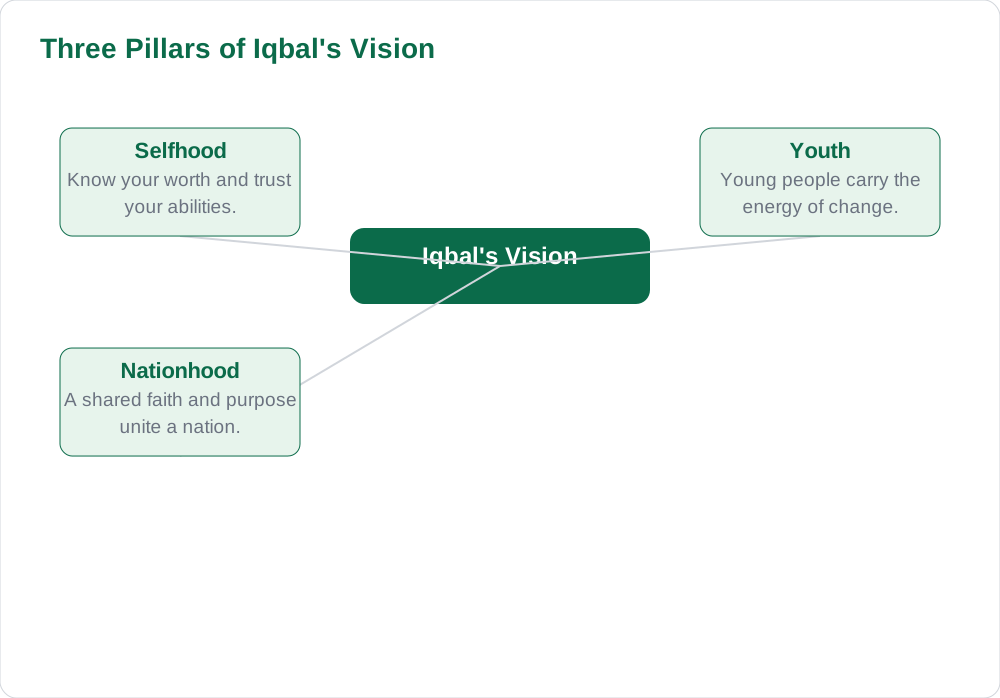
Iqbal's most famous idea is selfhood, which he called Khudi. Selfhood means knowing your worth, trusting your abilities, and refusing to live as a copy of others. A person with strong selfhood does not beg for respect; they earn it through character and work. A nation with selfhood does not borrow its identity; it builds on its own faith, history, and values.
For a pupil, selfhood begins with small choices. Do your own homework instead of copying. Speak honestly even when it is hard. Take pride in your language and culture while respecting others. These habits build the inner strength Iqbal wrote about. Explore more guides in the blog listing and the solved notes.
Youth: The Eagle and the Shaheen
Iqbal loved the image of the eagle, the shaheen, as a symbol of youth. The eagle flies high, lives alone, and never feeds on leftovers. In the same way, Iqbal wanted young people to aim high, think for themselves, and refuse easy comfort. He warned against a life of imitation, where young people copy others instead of finding their own path.
His message to students was demanding: study hard, build character, and serve a purpose larger than yourself. A pupil who wastes time on idle habits lives below the eagle's standard. A pupil who studies, helps others, and keeps a clean character lives up to it.
- Aim high instead of settling for easy comfort.
- Think for yourself instead of copying others.
- Build character through study and honest habits.
- Serve a purpose larger than your own wishes.
Nationhood: Islam as a Bond
Iqbal believed that Islam itself gives Muslims a form of nationhood. Muslims share a faith, a law, a history, and a sense of brotherhood that crosses race and language. This shared bond, he argued, could hold a nation together even when its people spoke different languages and lived in different provinces. It was this idea that later supported the demand for a separate Muslim homeland.
Pupils should note that Iqbal's nationhood was inclusive in one important way: it was based on shared belief and purpose, not on race or birth. Anyone who shared the faith and the purpose belonged. That is why his poetry still speaks to readers far beyond the subcontinent.
Action Over Complaint
Iqbal disliked complaint without action. He told readers that fate is not a chain; it is a field waiting for effort. A person who blames luck for failure has given up the power to change. A person who works, learns, and tries again becomes the maker of their own fate. This idea runs through his poetry like a drumbeat.
Apply it to school life. If a subject feels hard, the answer is practice, not complaint. If a class project fails, the answer is to learn the lesson and try again. Teachers admire pupils who act, and Iqbal's poetry asks every reader to become that kind of person. Find study help on the books page and the about page.
Iqbal's Legacy for Pupils Today
Iqbal's legacy lives in Pakistan's identity. His poetry is read in schools, his birthday is marked as a national day, and his idea of a separate Muslim homeland shaped the country's birth. But his deeper legacy is a way of thinking: know yourself, aim high, act with purpose, and serve your nation.
Try this exercise: choose one verse or line of Iqbal that you like, learn its meaning, and explain it to a friend in your own words. Teaching an idea is the best way to make it your own. That is exactly what Iqbal wanted — not readers who memorise poetry, but young people who live it.
- Know yourself: build selfhood through honest effort.
- Aim high: live like the eagle, not the crowd.
- Act with purpose: replace complaint with work.
- Serve your nation: use your talents for others.
AI Help: Muse AI
Muse AI is Meta's personal AI assistant, and it can help you understand Iqbal's vision by explaining one poem or idea, like selfhood, in short, simple lines. Muse AI does not give official STBB answers — always verify against your STBB book and your teacher. For final wording, always check your Sindh Textbook Board book and ask your teacher.
Join Muse with invite code LTGSWD — in the Muse app, go to Settings > Redeem token and enter the code.
Disclosure: LTGSWD is the author's Muse invite code.
5 key points you must know
- Selfhood (Khudi) means knowing your worth and trusting your abilities.
- Iqbal used the eagle as a symbol of high-aiming youth.
- He saw Islam as a bond of nationhood beyond race and language.
- He taught action over complaint: effort shapes fate.
- His legacy asks pupils to live his ideas, not only memorise them.
Frequently asked questions
What does Khudi (selfhood) mean in Iqbal's poetry?
It means knowing your worth, trusting your abilities, and refusing to live as a copy of others. A person with strong selfhood earns respect through character and work.
Why did Iqbal use the eagle as a symbol?
The eagle flies high, lives alone, and never feeds on leftovers. Iqbal wanted young people to aim high, think for themselves, and refuse easy comfort.
What did Iqbal mean by nationhood?
He believed Islam gives Muslims a shared faith, law, history, and brotherhood that can hold a nation together across languages and provinces.
How can a pupil live Iqbal's message today?
Do your own work honestly, aim high in study, replace complaint with practice, and use your talents to serve others.
Solved notes — preview free
These guides work best with the solved exercises. Preview the solved notes free on this website — 119 solved notes for Classes 6–10 in Sindhi, Urdu, English and Arabic medium. Or browse the full solved notes catalogue for your class and medium. New solved notes are added regularly — check the catalogue for coming-soon books.