A Weekly Review Ritual That Locks In Learning

Most pupils let each school week dissolve into the next: Monday's lessons are forgotten by Friday, and Friday's lessons are forgotten by the following Monday. A weekly review ritual stops that leak with a single short session. Once a week, at a fixed time, you revisit the week's notes, redo your mistakes, and run through your flashcards, locking the learning in before the next week piles on top of it. The ritual takes less than an hour, replaces hours of later relearning, and turns revision from a panic before exams into a steady habit. This article gives you a complete ritual you can start this weekend.
Why a Weekly Review Beats End-of-Term Cramming
Learning that is never revisited fades on a predictable curve: much of a week's lessons will be gone within days unless they are reviewed. A weekly review catches the learning while it is still retrievable, so a short revisit restores it fully. Waiting until the end of term means relearning from scratch, which takes far longer and feels far worse. The weekly ritual is therefore not extra work; it is the same work done at the cheapest possible time, while the memory is still cheap to restore.
A weekly rhythm also gives you a clear picture of your own progress. Each week, you can see which topics are solid, which are shaky, and which produced the most mistakes, and you can carry exactly that knowledge into the next week. Pupils who review weekly walk into exams with a short list of known weak points instead of a vague fear of everything. That clarity reduces exam anxiety more than any motivational advice, because it replaces guessing about what you know with evidence.
The Three Parts of the Ritual
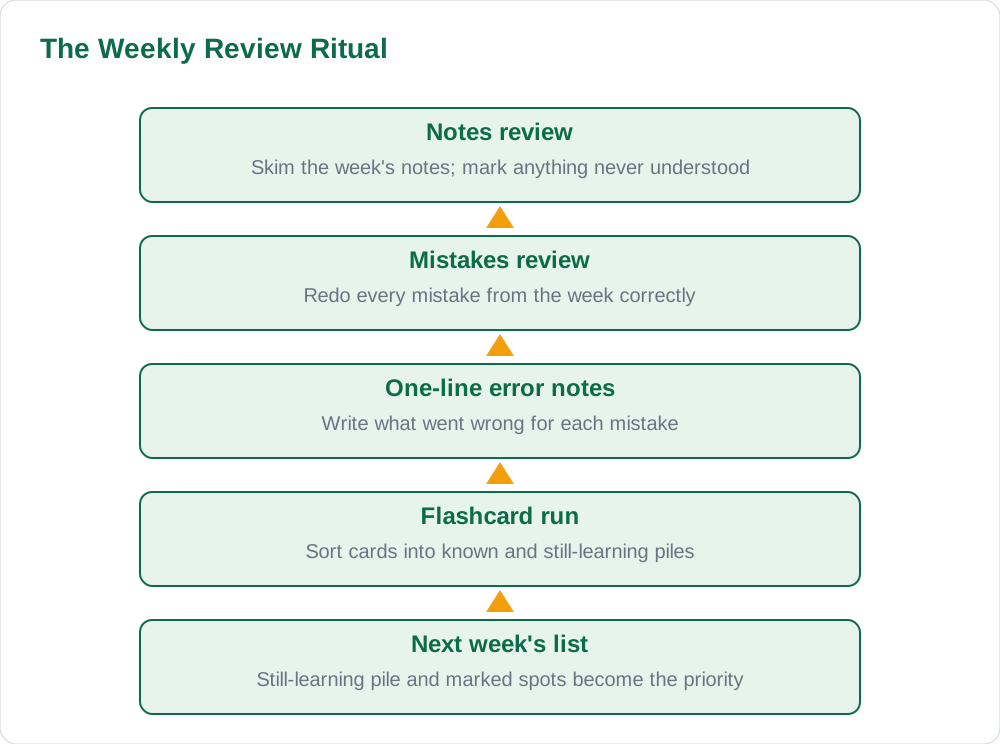
The ritual has three parts, in this order. First, notes review: read through the week's notes quickly, not to memorise them, but to refresh the shape of each topic and to spot anything you never understood. Mark those spots for restudy. Second, mistakes review: open your exercise books and look at every mistake from the week, redo each one correctly, and write a one-line note about what went wrong. Mistakes are the most valuable part of the ritual, because they point exactly at the marks you would otherwise lose.
Third, flashcard run: go through the week's flashcards, or the flashcards for topics due for a spaced revisit, sorting them into known and still-learning piles. The still-learning pile becomes next week's priority, and the known pile can wait for its next scheduled revisit. The whole ritual takes forty-five to sixty minutes for a normal school week, and it should feel like a tidy-up, not a study marathon. If it takes much longer, your week's notes are probably too long, and shortening them is itself a useful lesson. The blog has more weekly planning guides.
Choosing a Fixed Time and Place
A ritual only works if it happens, and it only happens if it has a fixed slot. Choose one regular time each week, such as Friday evening or Saturday morning, and protect it the way you protect a class. A fixed slot removes the daily decision about whether to review, which is the decision most often answered with no. Tell your family about the slot, so they can support it instead of interrupting it, and keep the materials ready: notes, exercise books, and flashcards in one place, so the ritual starts in minutes rather than after a search.
Use the same place each week if you can, a quiet corner with a table and good light, because a familiar place helps your brain switch into review mode quickly. If a week is exceptionally busy and the full hour is impossible, do a shortened ritual rather than skipping it: ten minutes of mistakes review alone is worth far more than nothing. A ritual kept imperfectly every week beats a perfect ritual kept once, because the power of the ritual is in its regularity, not in any single session. More planning help is in the solved notes and the book collection.
The Mistakes Book: Your Most Valuable Notebook
The heart of the weekly ritual is the mistakes book: a simple notebook where you copy each week's important mistakes, the correct version, and a one-line note about what went wrong. Over a term, this book becomes a personal map of your weaknesses, and revising from it is far more efficient than revising everything equally, because it targets exactly the points where you actually lose marks. Many top pupils say their mistakes book is the single most useful revision tool they own.
Keep the mistakes book honest and specific. A vague note like careless mistake helps no one; a specific note like forgot to convert centimetres to metres tells you exactly what to check next time. Review the mistakes book itself once a month, and you will notice patterns: the same kind of error appearing across subjects is a habit worth fixing deliberately. Pupils who fix one repeated error often gain marks in several subjects at once, because the habit, not the subject, was the problem. The [home page](/) links to more study resources.
- Copy each important mistake, the correct version, and what went wrong.
- Be specific: name the exact error, never just careless mistake.
- Review the mistakes book monthly to spot patterns across subjects.
- Fixing one repeated error can gain marks in several subjects at once.
Keeping the Ritual Alive All Term
The hardest part of any ritual is the third week, when the novelty fades and the first busy weekend tempts you to skip. Plan for that moment in advance: pair the ritual with something pleasant, such as a favourite snack afterwards, or do it with a friend so you hold each other to it. Track your streak simply, with ticks on a calendar, because a visible chain of weeks is surprisingly motivating to keep unbroken, and a single missed week is easy to forgive if the chain resumes immediately.
Let the ritual evolve as you learn what helps you most. If flashcards stop being useful for a subject, replace them with mind-map redraws for that subject. If mistakes review takes too long, limit it to the five most important mistakes. The ritual is a tool, not a rulebook, and adjusting it to fit your real week is how it survives the whole term. Pupils who keep a weekly review all term arrive at exams calm, because they have been revising all along, and their final revision is a short polish of a well-kept system, not a rescue mission.
AI Help: Muse AI
Muse AI is Meta's personal AI assistant. You can ask it to explain a concept in simple words, summarise a lesson, or make practice questions for revision.
For your weekly review, ask Muse AI to quiz you on the week's topics from your notes, so the ritual ends with a quick recall test that shows what is locked in and what needs another look.
Join Muse with invite code LTGSWD — in the Muse app, go to Settings > Redeem token and enter the code.
Disclosure: LTGSWD is the author's Muse invite code.
Muse AI does not give official STBB answers — always verify against your Sindh Textbook Board book and your teacher.
5 key points you must know
- A weekly review catches learning while it is still cheap to restore.
- The ritual has three parts: notes review, mistakes review, and a flashcard run.
- Fix a regular weekly slot and protect it like a class.
- Keep a mistakes book with each error, its correction, and what went wrong.
- A shortened ritual beats a skipped one; regularity matters more than perfection.
Frequently asked questions
How long should a weekly review take?
Forty-five to sixty minutes for a normal school week: a quick notes review, a mistakes review, and a flashcard run. If it takes much longer, your week's notes are probably too long, and shortening them is itself useful.
When is the best time for a weekly review?
A fixed slot each week, such as Friday evening or Saturday morning, works best. A fixed slot removes the daily decision about whether to review, which is the decision most often answered with no.
What is a mistakes book and why does it matter?
It is a notebook where you copy each week's important mistakes, the correct version, and a one-line note about what went wrong. Over a term it becomes a map of your weaknesses, and revising from it targets exactly where you lose marks.
What if I am too busy for the full ritual one week?
Do a shortened ritual rather than skipping it. Ten minutes of mistakes review alone is worth far more than nothing, and a ritual kept imperfectly every week beats a perfect ritual kept once.
How does a weekly review reduce exam anxiety?
It replaces guessing about what you know with evidence. Each week shows which topics are solid and which are shaky, so by exam time you have a short list of known weak points instead of a vague fear of everything.
Solved notes — preview free
These guides work best with the solved exercises. Preview the solved notes free on this website — 119 solved notes for Classes 6–10 in Sindhi, Urdu, English and Arabic medium. Or browse the full solved notes catalogue for your class and medium. New solved notes are added regularly — check the catalogue for coming-soon books.