Mind Maps for Revision: Turning Chapters into One Page
A chapter spread over ten pages of notes is hard to revise, because you cannot see the whole topic at once. A mind map solves this by putting the entire chapter on one page: the topic in the centre, main ideas as branches, and details as smaller twigs. The shape itself teaches you something, because you can see how ideas connect, which parts are large, and which parts you have forgotten. A good mind map is not a decoration; it is a working revision tool that you can redraw from memory, quiz yourself with, and carry into the final days before an exam. This article shows how to build one that actually helps.
Why One Page Beats Ten Pages for Revision
Revision fails when it feels endless. Opening a thick set of notes before a test makes many pupils give up before they start, or skim without really reading. A mind map removes that barrier: the whole chapter fits on one page, so starting revision feels possible, and finishing it feels achievable. That small psychological difference matters enormously in the weeks before exams, when motivation is low and the pile of chapters is high.
A mind map also shows structure, which linear notes hide. In ordinary notes, the tenth point looks as important as the first, and the connections between points are invisible. On a mind map, the main branches show the big ideas, the smaller branches show the details, and the layout shows which ideas belong together. When you revise from a map, you are learning the shape of the topic as well as its facts, and that shape is what lets you reconstruct an answer in the exam even if you forget a detail.
Building Your First Mind Map
Start with a blank page turned sideways, so you have room to spread out. Write the chapter title in the centre, in a box or a circle, and draw five or six main branches out from it, one for each major idea in the chapter. Label each branch with a single word or short phrase, never a sentence, because short labels keep the map readable. Then add smaller branches for details: definitions, examples, steps, or facts that belong under each main idea, again in a few words each.
Use colour to separate the branches, one colour per main branch, because colour helps your eyes find a branch instantly during revision. Add a small drawing or symbol on branches where it helps, such as a simple sketch for a process or a warning mark for a common mistake. Do not copy your notes word for word onto the map: the value of the map is in choosing what matters, so if everything goes on the map, nothing stands out. A map that takes twenty to thirty minutes to build is about right; a map that takes two hours has become a copying exercise. The blog has more revision tools to use with mind maps.
The Five Branches Every Revision Map Needs
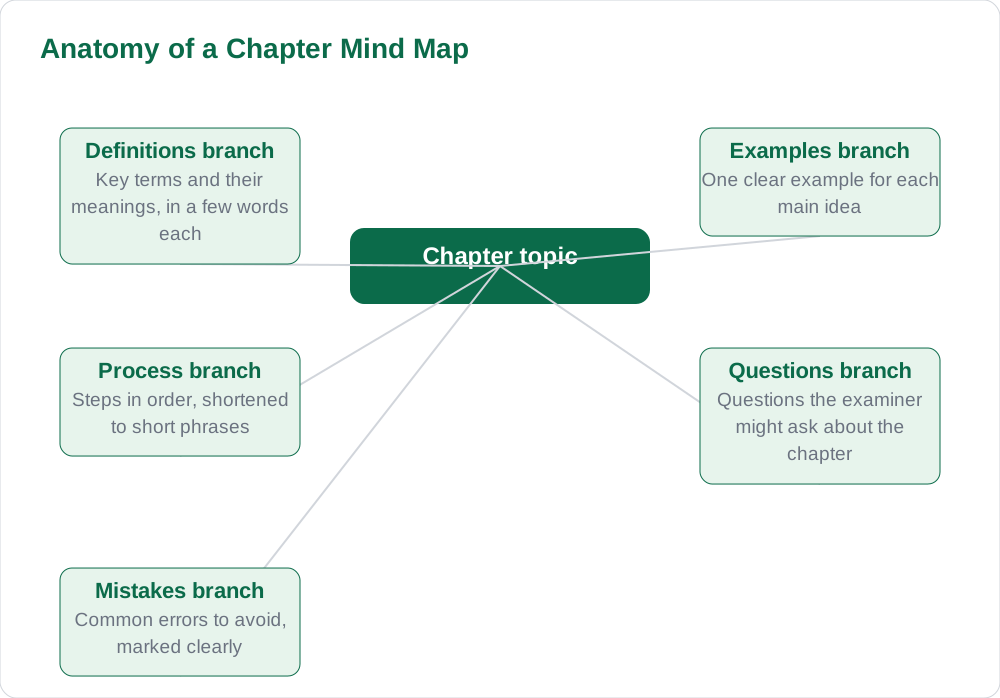
A revision mind map works best when its branches cover the kinds of knowledge exams actually test. Include a definitions branch for key terms and their meanings, because definition questions appear in almost every paper. Include an examples branch, with one clear example for each main idea, because examples turn abstract ideas into something you can picture. Include a process branch for any sequence in the chapter, shortened to short phrases in the correct order.
Add two branches that most pupils forget: a questions branch and a mistakes branch. The questions branch holds the questions an examiner might ask about the chapter, which turns the map into a self-test: cover the branches and try to answer the questions. The mistakes branch holds the common errors pupils make on this topic, such as confusing two similar terms or skipping a step. Revising your own likely mistakes is one of the highest-value uses of a map, because it targets exactly the marks you would otherwise lose. Material to map can be found in the solved notes and the book collection.
Revising from a Map: Cover, Recall, Redraw
A mind map is most powerful when you do not just look at it. The best revision routine is cover, recall, and redraw. First, study the finished map for a few minutes. Then cover it and redraw it from memory on a blank page, as completely as you can. Finally, compare your redrawn map with the original and add, in a different colour, everything you missed. The missing branches are your weak points, and they are now visible in a way that re-reading notes would never reveal.
Repeat this routine on later days, and you will find your redrawn map getting closer to the original each time. When you can redraw a chapter's map almost completely from memory, you know that chapter deeply, because you can reproduce its structure as well as its facts. This routine also makes excellent use of short gaps in the day: a single blank page and five minutes are enough for one redraw, which is why mind maps suit busy school weeks better than long note-reading sessions.
- Study the finished map for a few minutes first.
- Cover it and redraw it from memory on a blank page.
- Compare with the original and add missed branches in a different colour.
- Repeat on later days until the redraw is almost complete.
Mind Map Mistakes That Waste Your Time
The most common mind map mistake is making it too beautiful and too detailed. Hours spent colouring, decorating, and copying sentences feel productive but add little memory, and they steal time from real revision. A map should be useful, not pretty: clear labels, sensible colours, and honest selection of what matters. If your map looks like artwork but you cannot redraw it from memory, it has failed its real job.
The second mistake is never testing yourself with the map. A map that is only looked at gives the same false confidence as re-reading notes, because recognition feels like knowledge. Always pair the map with the cover-and-redraw routine, or with questions from its questions branch. The third mistake is making one giant map for a whole subject instead of one map per chapter. A subject-sized map is too crowded to read or redraw, while chapter-sized maps stay clear and can be revised one at a time. Keep maps small, tested, and chapter-sized, and they will repay the time many times over. More guidance is on the [home page](/) and the blog.
AI Help: Muse AI
Muse AI is Meta's personal AI assistant. You can ask it to explain a concept in simple words, summarise a lesson, or make practice questions for revision.
For mind maps, ask Muse AI to list the main branches of a chapter from your notes, then draw the map yourself and use it for cover-and-redraw revision.
Join Muse with invite code LTGSWD — in the Muse app, go to Settings > Redeem token and enter the code.
Disclosure: LTGSWD is the author's Muse invite code.
Muse AI does not give official STBB answers — always verify against your Sindh Textbook Board book and your teacher.
5 key points you must know
- A mind map puts a whole chapter on one page, so revision feels possible.
- Centre the topic, draw main branches for big ideas, and twigs for details.
- Include definitions, examples, process, questions, and common mistakes branches.
- Revise by covering the map, redrawing it from memory, and adding missed branches.
- Keep maps useful, not pretty, and one map per chapter, never one per subject.
Frequently asked questions
How long should a mind map take to build?
Twenty to thirty minutes is about right for one chapter. If a map takes two hours, it has become a copying exercise: the value is in choosing what matters, so keep labels short and leave out minor details.
What branches should a revision mind map have?
Definitions, examples, process steps, questions an examiner might ask, and common mistakes. The questions branch turns the map into a self-test, and the mistakes branch targets the marks you would otherwise lose.
Is it enough to just look at my mind map?
No, looking gives the same false confidence as re-reading. Cover the map, redraw it from memory, and add what you missed in a different colour. The missing branches reveal your weak points.
Should I make one mind map for a whole subject?
No, make one map per chapter. A subject-sized map is too crowded to read or redraw, while chapter-sized maps stay clear and can be revised one at a time.
Do mind maps need to be beautiful?
No, a map should be useful, not pretty. Clear labels, sensible colours, and honest selection matter far more than decoration, and a beautiful map you cannot redraw from memory has failed its job.
Solved notes — preview free
These guides work best with the solved exercises. Preview the solved notes free on this website — 119 solved notes for Classes 6–10 in Sindhi, Urdu, English and Arabic medium. Or browse the full solved notes catalogue for your class and medium. New solved notes are added regularly — check the catalogue for coming-soon books.