The Teach-Back Method: Learn by Explaining to Someone Else
There is a famous test of understanding: if you cannot explain something simply, you do not yet understand it. The teach-back method turns that test into a study technique. You learn a topic, then teach it to someone else, a friend, a parent, a younger sibling, or even an empty chair, in your own words and without the book. Where your explanation flows smoothly, your understanding is solid. Where you stumble, hesitate, or skip a part, you have found an exact gap to fix before the exam. This article shows how to run a teach-back session, what to do when you get stuck, and why explaining beats re-reading for almost every subject.
Why Explaining Reveals What Reading Hides
Reading gives you the words of an expert, and it is easy to mistake following those words for understanding them. Explaining removes that support: you must choose the words yourself, put ideas in order, and connect one point to the next. Any weak link in your understanding shows up immediately as a pause, a vague phrase, or a jump to the next point. Those moments feel uncomfortable, but they are the most valuable part of the session, because they show you precisely what to restudy instead of leaving you with a vague feeling that the chapter is sort of known.
Teaching also forces you to organise knowledge. To explain a topic, you must decide what comes first, what causes what, and what matters most, and that organisation is itself a form of learning. Pupils who teach a topic often report that it suddenly makes sense in a way reading never achieved, because they had to build the structure themselves. The listener does not need to be an expert either: a curious listener who asks simple questions is actually ideal, because their questions expose exactly the points a real examiner might probe.
Running a Teach-Back Session Step by Step
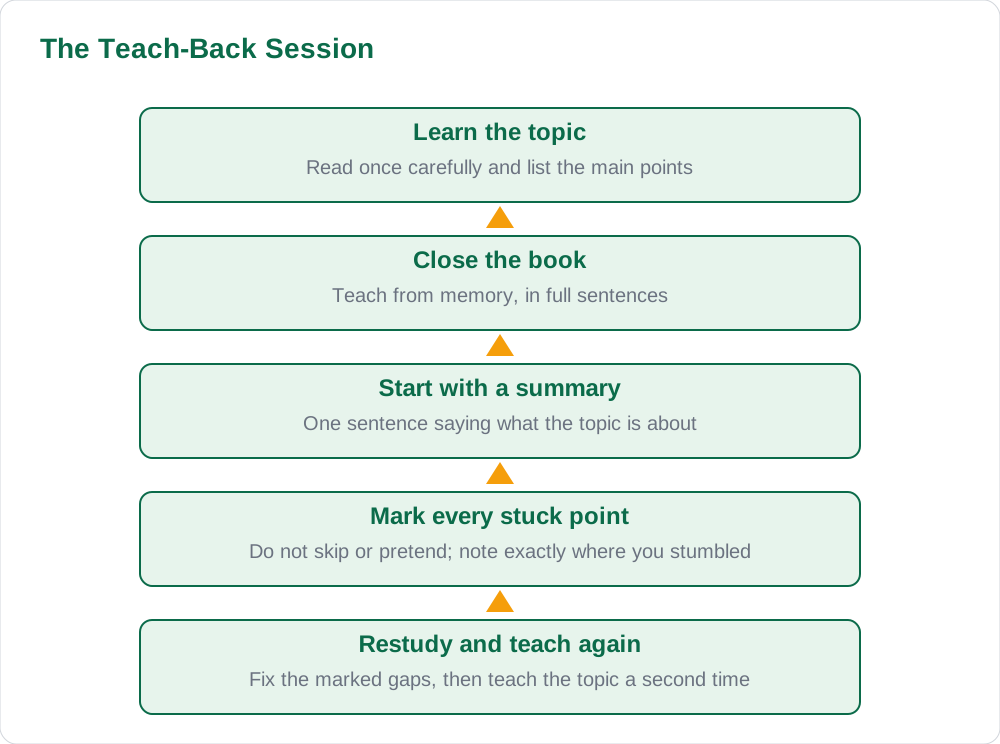
Begin by learning the topic normally: read the chapter or your notes once, carefully, and make a short list of its main points. Then close the book and teach the topic aloud from start to finish, as if your listener knows nothing about it. Start with a one-sentence summary of what the topic is about, then work through the main points in order, giving one example for each. Keep the book closed throughout, and speak in full sentences rather than listing keywords, because full sentences are what reveal gaps.
When you get stuck, do not pretend: mark the stuck point clearly and move on, then open the book afterwards and restudy just those marked points. Teach the topic a second time, and you will find the previously stuck parts flow much better. A session of fifteen to twenty minutes is enough for one topic, and two rounds of teaching beat one long round, because the second round consolidates what the first round exposed. You can find material to teach from the solved notes and the book collection.
Who to Teach When No Partner Is Available
The best listener is a willing friend or family member, because real questions make the session sharper. A parent does not need to know the subject: ask them to listen and to stop you whenever something is unclear, because an unclear explanation usually means an unclear understanding. A study partner can be even better, since you can take turns teaching each other different topics, which doubles the learning in the same time.
If no one is available, teach an empty chair, a mirror, or your phone's voice recorder. Speaking aloud is what matters, not the audience, because silent thinking lets you glide over gaps that speaking aloud would catch. Recording yourself has an extra benefit: playing the recording back lets you hear your own hesitations and vague phrases, which are the gaps to fix. Some pupils find teaching a younger sibling especially effective, because explaining to a younger listener forces the simplest, clearest language, which is the deepest test of understanding.
Questions Your Listener Should Ask You
A good listener does more than listen: they ask the questions an examiner would ask. The simplest and most powerful questions are why, how, and what if. Why does this happen? How does this step lead to the next? What would happen if this part changed? If you can answer those three questions about a topic, you understand it rather than merely remembering its words. Teach your listener to ask them, and welcome the questions instead of fearing them.
Also ask your listener to repeat back what they understood in their own words. If their version differs from what you meant, your explanation needs work, even if your own notes are correct. This feedback loop is what makes teaching stronger than solo revision: it tests whether your knowledge can survive being communicated, which is exactly what an exam answer must do. A listener who says I did not understand that part has given you a gift, because they have found a gap before the examiner does. More study methods are on the blog and the [home page](/).
- Why does this happen? Tests whether you know the cause, not just the fact.
- How does this step lead to the next? Tests whether you know the sequence.
- What would happen if this part changed? Tests whether you truly understand.
- Can you say it back to me? Tests whether your explanation actually communicates.
Fitting Teach-Back Into Exam Preparation
Teach-back works best as a regular habit, not a one-off performance. Choose one topic per day to teach, ideally the topic you studied that day, so the teaching becomes the revision for it. Over a week, you will have taught seven topics, and each one will be far stronger than topics you only read. Before a test, teach the topics you feel least sure about first, because those are the ones where teaching will find the most gaps, and fixing them early leaves time for a second round.
Keep a small teach-back log: the topic, the points where you stumbled, and whether the second round fixed them. This log becomes a precise revision list for the final days before an exam, showing exactly which points still need work. Pupils who keep such a log often find their final revision is calm and focused, because they are no longer guessing what they know. Teaching is not extra work on top of revision; it is revision done properly, and fifteen honest minutes of it beats an hour of comfortable re-reading.
AI Help: Muse AI
Muse AI is Meta's personal AI assistant. You can ask it to explain a concept in simple words, summarise a lesson, or make practice questions for revision.
For teach-back practice, ask Muse AI to act as a curious listener: explain a topic to it in your own words and ask it to point out any part that is unclear or missing.
Join Muse with invite code LTGSWD — in the Muse app, go to Settings > Redeem token and enter the code.
Disclosure: LTGSWD is the author's Muse invite code.
Muse AI does not give official STBB answers — always verify against your Sindh Textbook Board book and your teacher.
5 key points you must know
- Teaching exposes gaps that reading hides, because you must choose the words yourself.
- Learn a topic, close the book, and teach it aloud in full sentences.
- Mark every stuck point, restudy only those points, then teach a second time.
- Any listener works: a parent, a friend, a mirror, or a voice recording.
- Teach one topic per day and keep a log of stumbled points for final revision.
Frequently asked questions
What if I have no one to teach?
Teach an empty chair, a mirror, or your phone's voice recorder. Speaking aloud is what matters, because it catches gaps that silent thinking glides over. Playing a recording back lets you hear your own hesitations, which mark the gaps to fix.
Does my listener need to know the subject?
No, a listener who knows nothing about the topic is ideal. Ask them to stop you whenever something is unclear, because an unclear explanation usually means an unclear understanding, and their simple questions expose the points an examiner might probe.
What should I do when I get stuck while teaching?
Mark the stuck point clearly and move on, then restudy just those marked points afterwards and teach the topic a second time. The second round is where the previously stuck parts start to flow.
How long should a teach-back session last?
Fifteen to twenty minutes is enough for one topic. Two short rounds of teaching beat one long round, because the second round consolidates what the first round exposed.
Is teach-back useful for mathematics too?
Yes. Teach each step of a solution aloud, explaining why that step comes next. If you cannot explain why a step is taken, you have found a gap in understanding, even if you can copy the step from a worked example.
Solved notes — preview free
These guides work best with the solved exercises. Preview the solved notes free on this website — 119 solved notes for Classes 6–10 in Sindhi, Urdu, English and Arabic medium. Or browse the full solved notes catalogue for your class and medium. New solved notes are added regularly — check the catalogue for coming-soon books.