Sleep and Memory: Why Revision Works Better After Rest

Many pupils treat sleep as the enemy of revision, staying up late to squeeze in one more chapter before an exam. The science of memory says the opposite: sleep is part of revision, not a break from it. During sleep, your brain replays and strengthens what you studied during the day, moving fragile new memories into lasting storage. A pupil who studies well and sleeps well will remember more than a pupil who studies longer but sleeps badly. This article explains, in plain terms, how sleep consolidates memory, why all-night revision backfires, and how to plan your sleep so that your revision actually stays learned.
How Sleep Turns Study into Lasting Memory
When you study, you create fresh memories that are still fragile, like wet ink on a page. During sleep, particularly deep sleep, your brain replays the patterns of the day and strengthens the connections that hold those memories, while weakening unimportant details. This process is called consolidation, and it is why a topic that felt shaky in the evening can feel clearer the next morning, even without further study. Sleep does not just rest your body; it actively finishes the learning your studying started.
Sleep also organises memories, connecting new facts to older knowledge so they fit into your understanding. This is why a good night's sleep sometimes produces a sudden insight into a problem that resisted you the day before: the brain has had quiet time to arrange the pieces. Pupils who sleep after studying therefore gain twice: their memories become stronger, and their understanding becomes better organised. Skipping sleep to study more removes exactly the process that makes studying stick, which is a poor trade however urgent the exam feels.
Why All-Night Revision Backfires
All-night revision feels productive because the hours are long and the pages turn, but the memories made in those hours are the least likely to survive. Without sleep, consolidation never happens, so the night's work stays fragile and fades quickly, often before the exam itself. Worse, a sleep-deprived brain recalls poorly even the material it already knew: attention wanders, reading slows, and simple questions become confusing. An exam written on no sleep tests a tired brain, not a prepared one.
All-night sessions also damage the days that follow. One bad night makes the next day's studying less effective, because a tired brain learns slowly, and it often pushes bedtime later again, creating a cycle of tiredness that lasts through exam week. Pupils sometimes say they performed well after an all-nighter, but what they usually remember is the relief of finishing, not the marks they lost to careless errors. The evidence is consistent: a shorter, well-rested revision beats a longer, exhausted one, and the exam hall rewards the rested pupil. The blog has more exam preparation guides.
Planning Sleep Around Exam Week
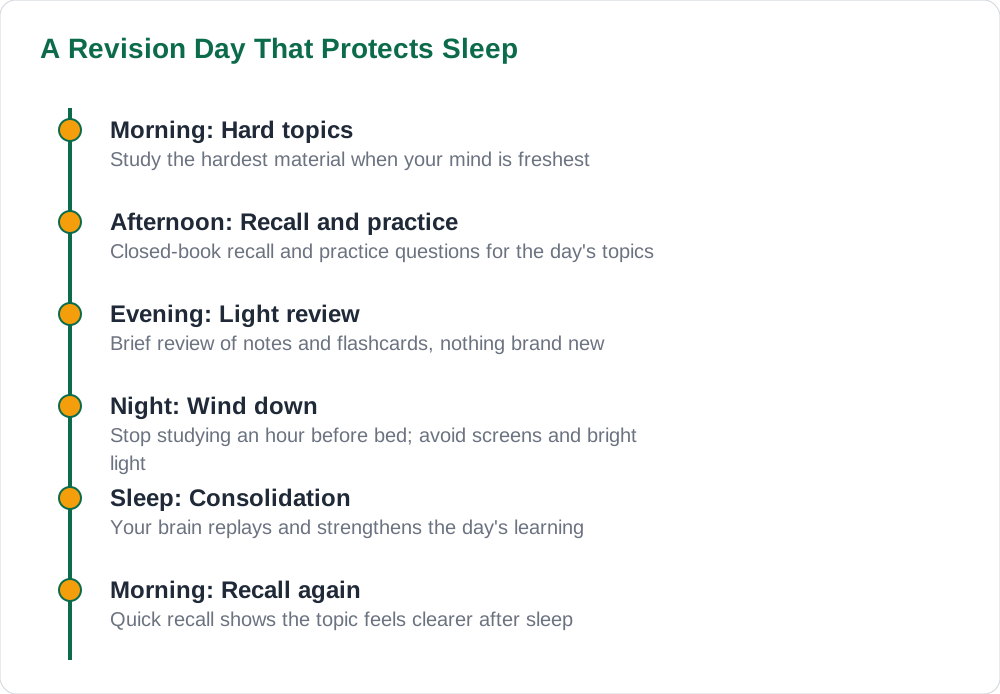
Treat sleep as a fixed appointment during exam week, not as whatever time is left over. Choose a regular bedtime that gives you enough sleep for your age and keep it steady across the week, because a regular rhythm helps your brain expect and use sleep well. Study the hardest material in the morning or early afternoon, when your mind is freshest, and use the evening for lighter review: flashcards, mind maps, or recall of topics already studied. Avoid starting anything brand new late at night, because new material studied just before bed has the least time to settle and the most chance to worry you.
Stop studying about an hour before bed, and use that hour to wind down: prepare your bag and stationery for the exam, lay out your clothes, and do something calm. Bright screens and exciting videos in that hour make falling asleep harder and sleep lighter, so keep them out of the wind-down if you can. If worries about the exam keep you awake, write them on a piece of paper beside your bed: the list will still be there in the morning, and writing it down tells your brain it does not need to hold it all night. Good exam preparation is on the [home page](/) and the book collection.
- Keep a regular bedtime through exam week, not just on exam nights.
- Study hard topics in the morning; use evenings for light review only.
- Stop studying an hour before bed and wind down calmly.
- Write exam worries on paper beside your bed instead of carrying them all night.
Naps, Rest Breaks, and Study Stamina
Short rest breaks during study are not laziness; they protect learning. Studying in focused blocks of twenty-five to forty minutes, followed by a short break, keeps attention sharp, while hours of unbroken study produce diminishing returns as focus fades. During breaks, move around, drink water, and look away from your books, because a break spent on a phone game is less refreshing than one spent moving or resting your eyes. Pupils who plan breaks in advance study longer in total, because they do not burn out halfway through the day.
A short nap of twenty minutes can also help on a heavy study day, if it does not replace night sleep or push bedtime later. A brief nap refreshes attention and can help consolidate the morning's learning, but a long afternoon sleep leaves you groggy and steals the night's sleep, which is far more valuable. The rule is simple: protect the night's sleep above all, use short breaks to keep daytime study sharp, and treat any nap as a small top-up, never as a substitute. More study stamina tips are in the solved notes section and the blog.
What to Do After a Bad Night Before an Exam
Sometimes, despite good plans, a bad night happens: worry, noise, or illness steals your sleep before an important paper. Do not panic, and do not try to compensate by cramming all morning, because a tired brain crams badly and arrives at the exam more stressed. Instead, do a short, calm review of your strongest topics and your mind maps, eat a proper breakfast, and arrive early so you can settle. Confidence on the day matters, and arriving calm with solid core knowledge beats arriving frazzled with half-learned new material.
During the paper, slow down deliberately: read each question twice, plan your answer briefly before writing, and check your work if time allows, because tired brains make careless errors that a second look catches. After the exam, restore your sleep that night rather than staying up to prepare for the next paper at full speed; a rested brain will learn the next subject far faster than an exhausted one. One bad night does not decide an exam, but how you handle it can: stay calm, trust your preparation, and protect the next night's sleep.
AI Help: Muse AI
Muse AI is Meta's personal AI assistant. You can ask it to explain a concept in simple words, summarise a lesson, or make practice questions for revision.
For sleep-friendly revision, ask Muse AI to make a short evening quiz from your notes, so your last study of the day is light recall rather than heavy new material before bed.
Join Muse with invite code LTGSWD — in the Muse app, go to Settings > Redeem token and enter the code.
Disclosure: LTGSWD is the author's Muse invite code.
Muse AI does not give official STBB answers — always verify against your Sindh Textbook Board book and your teacher.
5 key points you must know
- Sleep consolidates memory: the brain replays and strengthens the day's learning.
- All-night revision backfires because unconsolidated memories fade and recall worsens.
- Keep a regular bedtime through exam week and study hard topics in the morning.
- Stop studying an hour before bed and wind down without bright screens.
- Use short study breaks and brief naps, but never let them replace night sleep.
Frequently asked questions
Does sleep really help me remember what I studied?
Yes. During sleep, especially deep sleep, your brain replays the day's learning and strengthens the connections holding new memories, while organising them with older knowledge. A topic often feels clearer the next morning for exactly this reason.
Is an all-nighter ever worth it before an exam?
Almost never. Without sleep, the night's work stays fragile and fades quickly, and a tired brain recalls even known material poorly. A shorter, well-rested revision beats a longer, exhausted one in the exam hall.
When should I study the hardest topics?
In the morning or early afternoon, when your mind is freshest. Use evenings for lighter review such as flashcards or recall of already-studied topics, and avoid starting brand-new material late at night.
What should I do in the hour before bed during exam week?
Stop studying and wind down calmly: prepare your bag and stationery, lay out your clothes, and avoid bright screens. If exam worries keep you awake, write them on paper beside your bed for the morning.
What if I sleep badly the night before an exam?
Do not panic or cram all morning. Do a short, calm review of your strongest topics, eat properly, and arrive early. In the paper, read questions twice and check your work, since tired brains make careless errors a second look catches.
Solved notes — preview free
These guides work best with the solved exercises. Preview the solved notes free on this website — 119 solved notes for Classes 6–10 in Sindhi, Urdu, English and Arabic medium. Or browse the full solved notes catalogue for your class and medium. New solved notes are added regularly — check the catalogue for coming-soon books.