Mnemonics for Science Formulas and Sequences

Science asks pupils to remember many formulas, orders, and sequences: steps of a process, the order of planets, the parts of a system, or the letters of a formula. Plain repetition of such lists is slow and unreliable, because a list has no meaning to hold it together. A mnemonic gives the list a shape: a sentence, a rhyme, or a set of initials that is easier to remember than the list itself. Used well, a mnemonic can carry a whole sequence into the exam in seconds. Used carelessly, it can confuse you instead. This article shows how to build mnemonics that are safe, simple, and honest, and how to avoid the ones that cause more harm than good.
What a Mnemonic Is and Why It Works
A mnemonic is a memory aid that turns hard-to-remember information into something easier to recall, usually by linking it to words, sounds, or images you already know. The most common kind is an acrostic: a sentence whose first letters match the first letters of the items in order. Another kind is a rhyme or a short song, which uses rhythm to hold a sequence together. Both kinds work for the same reason: they replace a meaningless list with a meaningful pattern, and your brain remembers patterns far better than lists.
Mnemonics work best for information that is arbitrary in order, such as the sequence of steps in a process or the order of items in a classification. They do not replace understanding: you still need to know what each item means, because a mnemonic that helps you list the steps of a process is useless if you cannot explain any of them. Think of a mnemonic as a rope that holds the items together, not as a substitute for learning them. The rope helps you carry the list, but the items themselves still need to be understood.
Building a Safe Mnemonic in Four Steps
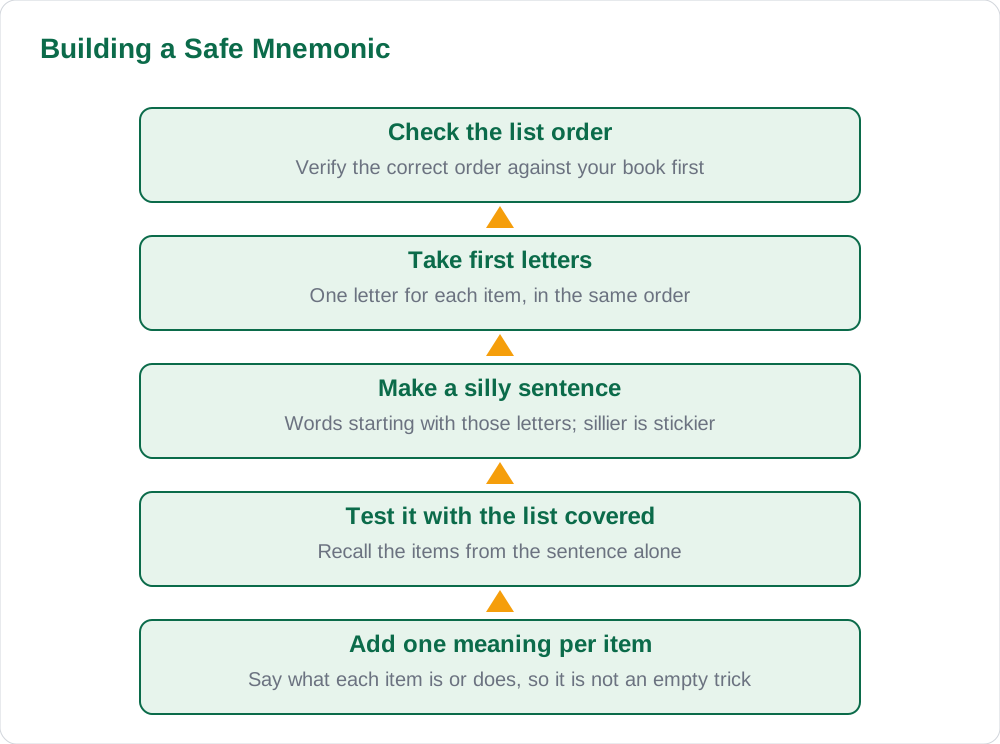
First, write the list in its correct order and check it against your book, because a mnemonic built on a wrong order will faithfully reproduce the wrong order in the exam. Second, take the first letter of each item and look for a sentence whose words start with those letters, in the same order. The sentence can be funny or silly; in fact, sillier sentences are easier to remember, because they stand out. Third, test the sentence by covering the list and recalling the items from the sentence alone. If you cannot, change the sentence until you can.
Fourth, and most importantly, link each item back to its meaning. After recalling the list through the mnemonic, say one sentence about each item: what it is or what it does. This step stops the mnemonic from becoming an empty trick and turns it into real revision. A mnemonic that you practise together with meanings will serve you in any question, while a mnemonic practised alone only helps questions that ask for the list itself. Practise the mnemonic a few times over several days, not fifty times in one sitting, so it becomes durable. The blog has more memory techniques to combine with this one.
Mnemonics for Formulas: Letters, Not Magic
Formulas need special care, because a formula is not just a list of letters: the letters stand for quantities, and their positions and relationships matter. A mnemonic for a formula should help you remember the letters and their arrangement, never replace the understanding of what each letter means. For example, a short phrase whose words match the letters of a formula can help you write the formula down, but you must also be able to say what each letter stands for and which unit it uses.
Keep formula mnemonics short and personal, and always write the full formula beside the mnemonic in your notes, so the two are learned together. If a mnemonic feels forced or confusing, drop it: a formula you understand and practise through solving problems will stay with you better than a clever phrase you cannot decode under pressure. Solving three practice problems with a formula teaches it more deeply than any phrase, so use mnemonics as a starting aid, not as the whole method. More practice material is in the solved notes and the book collection.
The Warning: When Mnemonics Confuse Instead of Help
The biggest danger of mnemonics is confusion between similar ones. If you build two mnemonics that sound alike, or that use the same starting letters, you may recall the wrong list in the exam. Avoid this by keeping your mnemonics clearly different: different sentence shapes, different humour, and different first words. If two lists share many letters, consider using a mnemonic for only one of them and learning the other through a different method, such as a diagram or a story.
Another danger is the mnemonic that is harder than the fact. If remembering the sentence takes more effort than remembering the list, the mnemonic is not helping, and you should abandon it without regret. Some pupils collect dozens of mnemonics from friends or the internet without testing them, and end up memorising a pile of sentences instead of the science. A small number of well-tested mnemonics, each practised with its meanings, will always beat a large collection of untested ones. Quality, not quantity, is the rule.
- Keep mnemonics clearly different so similar lists do not get mixed up.
- If two lists share many letters, use a mnemonic for only one of them.
- Drop any mnemonic that is harder to remember than the fact itself.
- Never collect untested mnemonics: test each one with the list covered.
Keeping Mnemonics Fresh Until the Exam
A mnemonic fades like any other memory if it is never revisited, so build it into your spaced revision. Recall the mnemonic and its list on the day you make it, again two days later, and again a week later, each time with the list covered. If a mnemonic survives those three revisits, it will almost certainly survive until the exam. If it fails on a revisit, repair it immediately: change the sentence, strengthen the weak item's meaning, or replace the mnemonic entirely.
Keep a single page in your notebook for your best mnemonics, with the list and its meaning beside each one. This page becomes a quick revision sheet in the final days before an exam, letting you run through many sequences in a few minutes. Do not add to this page in the last week before an exam, because new, untested mnemonics are the most likely to confuse you. The final week is for rehearsing the mnemonics you already trust, not for inventing new ones. Further revision planning is on the [home page](/) and the blog.
AI Help: Muse AI
Muse AI is Meta's personal AI assistant. You can ask it to explain a concept in simple words, summarise a lesson, or make practice questions for revision.
For mnemonics, ask Muse AI to suggest a short, silly sentence for a list of science terms you need in order, then test the sentence yourself and keep only the ones that genuinely help you recall the list.
Join Muse with invite code LTGSWD — in the Muse app, go to Settings > Redeem token and enter the code.
Disclosure: LTGSWD is the author's Muse invite code.
Muse AI does not give official STBB answers — always verify against your Sindh Textbook Board book and your teacher.
5 key points you must know
- A mnemonic turns a meaningless list into a pattern your brain remembers better.
- Check the list order against your book before building any mnemonic.
- Make the sentence silly and test it with the list covered before trusting it.
- Always add one meaning per item, so the mnemonic is not an empty trick.
- Keep mnemonics few, clearly different, and rehearsed over several days.
Frequently asked questions
What is a mnemonic in simple words?
A mnemonic is a memory aid, such as a sentence whose first letters match the items of a list in order, or a rhyme that holds a sequence together. It replaces a hard list with an easier pattern to recall.
Can a mnemonic replace understanding a formula?
No. A mnemonic can help you write a formula down, but you must also know what each letter stands for and which unit it uses. Practising problems with the formula teaches it more deeply than any phrase.
Why do some mnemonics confuse pupils?
Two mnemonics that sound alike or share starting letters can get mixed up in the exam. Keep your mnemonics clearly different, and use a mnemonic for only one of two very similar lists.
How do I know if a mnemonic is good?
Cover the list and try to recall the items from the sentence alone. If you can, and you can also say one meaning for each item, the mnemonic works. If remembering the sentence is harder than the list, drop it.
When should I stop making new mnemonics?
Do not add new, untested mnemonics in the last week before an exam, because they are the most likely to confuse you. The final week is for rehearsing the mnemonics you already trust.
Solved notes — preview free
These guides work best with the solved exercises. Preview the solved notes free on this website — 119 solved notes for Classes 6–10 in Sindhi, Urdu, English and Arabic medium. Or browse the full solved notes catalogue for your class and medium. New solved notes are added regularly — check the catalogue for coming-soon books.