Mixed Practice: Why Mixing Topics Improves Recall
Most pupils practise in blocks: twenty addition problems, then twenty subtraction problems, then twenty of something else. Blocked practice feels smooth, because each problem is like the last, and scores look high. But exam papers do not come in blocks: questions arrive mixed, and the pupil must first decide which method to use before using it. Blocked practice never trains that decision, so pupils who scored perfectly in blocked practice often freeze when the same problems appear mixed. Mixed practice, also called interleaving, fixes this by mixing problem types during practice, so every question trains both the method and the choice of method. This article shows how to mix practice without making it chaotic.
Why Blocked Practice Feels Good and Fails
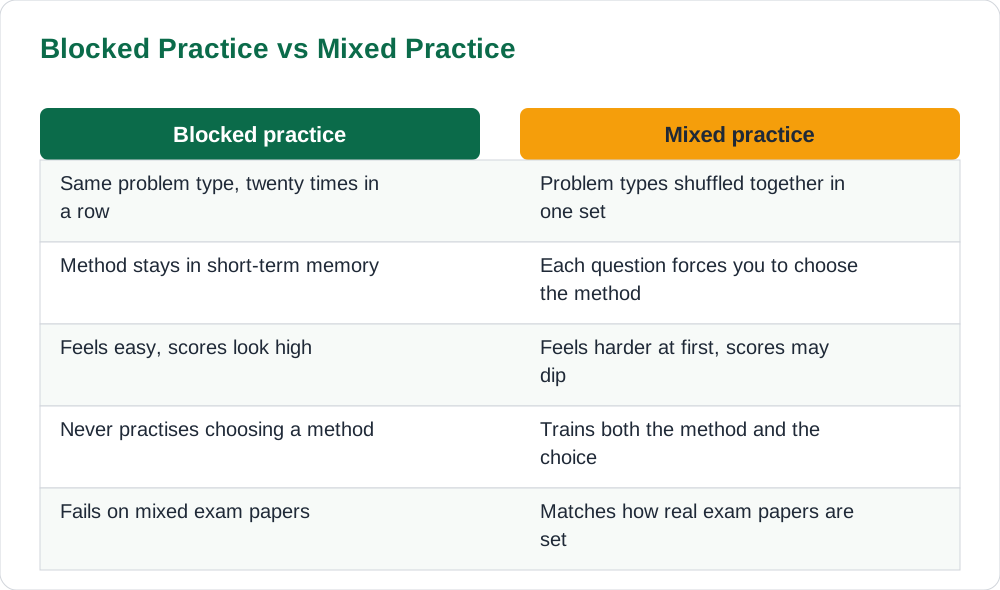
Blocked practice feels good because the method stays in your short-term memory from one problem to the next. By the third problem, you are not really choosing a method; you are repeating the one you used a minute ago. That repetition inflates practice scores and confidence, but it teaches very little about when to use the method, which is the skill the exam actually tests. When the exam mixes question types, the pupil who only practised in blocks must suddenly make choices they never practised, and that is where marks are lost.
Mixed practice feels harder at first, and that difficulty is the point. When problem types are shuffled, each question forces you to pause, identify the type, and select the right method before solving. That extra step is effortful, so practice scores may dip at first, and pupils sometimes conclude that mixing is not working. In fact, the opposite is true: the effort of choosing is what builds flexible recall, and the pupil who practises mixed will outperform the blocked pupil on a mixed test, which is what every real exam is. Trust the difficulty; it is the learning happening.
How to Mix Practice Without Chaos
Start by learning each method separately, in a short block, until you can use it correctly. Mixing only helps once you know the methods themselves; shuffling methods you have never learned is just confusion. Once each method is basically understood, switch to mixed sets: make a practice set that shuffles the types together, for example alternating between two or three kinds of problems, and solve them in the shuffled order without looking at which type each one is.
Build mixed sets from your own material: take questions from different exercises or different chapters and write them on separate slips of paper, then shuffle the slips. Work through the shuffled pile, and for each question, first name the type or method aloud before solving it, because naming the choice trains exactly the skill blocked practice skips. Check your answers after the set, not after each question, so you practise completing a question without immediate feedback, just as in an exam. The blog has more practice methods, and the solved notes provide material for mixed sets.
Mixing Topics Beyond Mathematics
Mixed practice is famous in mathematics, but it works in every subject where questions can take different forms. In science, mix questions that ask for definitions, explanations, diagrams, and calculations, instead of doing all definitions together and all calculations together. In languages, mix vocabulary, grammar, and comprehension questions in one session, so you must switch skills as an exam requires. In Islamiat or history, mix questions about different lessons or themes, so recalling one topic does not depend on having just studied it.
The key in every subject is the same: the practice set should resemble the exam in its mixture, not in its tidiness. A mixed session of twenty questions covering three topics trains flexible recall far better than three tidy blocks of twenty questions each, even though the tidy version feels more organised. Keep a simple record of which types you got wrong in mixed sets, because those types are the ones that need another short blocked session before the next mixed set. Mixing and blocking are partners, not enemies: block to learn a method, mix to learn when to use it.
A Weekly Mixed-Practice Routine
A practical weekly routine uses both styles in their right places. On the day you learn a new method or topic, practise it in a short block until you can use it correctly. The next day, mix it with one or two older topics in a shuffled set, so the new method must compete with older ones for selection. Later in the week, build a longer mixed set covering everything learned that week, and use it as your weekly review. This rhythm, block then mix then weekly mix, turns each week's learning into flexible, exam-ready knowledge.
Keep mixed sets short enough to finish in one sitting, around twenty to thirty minutes, so you can check them properly afterwards. After checking, spend five minutes on the errors: for each wrong answer, note whether the method was wrong or the choice of method was wrong, because the second kind of error is the one mixed practice exists to fix. Over a few weeks, choice errors should fall sharply, and that fall is the clearest sign that your recall has become flexible rather than just familiar. More routines are on the [home page](/) and the book collection.
- Day one: short blocked practice until the new method works correctly.
- Day two: mix the new method with one or two older topics in a shuffled set.
- End of week: a longer mixed set covering everything learned that week.
- After checking, note whether each error was method or choice of method.
Common Worries About Mixed Practice
The most common worry is that mixed practice lowers practice scores, and pupils take that as proof it is not working. It is actually proof it is working: the lower score shows that the practice is now testing real choice, not just repetition. Scores in mixed practice rise over a few weeks, and more importantly, scores on mixed tests, which is what exams are, rise faster than they would under blocked practice alone. Judge mixed practice by your test results, not by your first mixed session.
Another worry is that mixing feels slow, because each question takes longer when you must choose a method first. That slowness is temporary: as choosing becomes automatic, speed returns, and it returns with accuracy attached. Pupils who persist through the slow phase find that exam questions feel easier, because the exam's mixture no longer surprises them. If mixing ever feels overwhelming, reduce the mix to two types instead of three or four, and build up gradually. Mixed practice should stretch you, not drown you, and a two-type mix is already a large improvement over pure blocking.
AI Help: Muse AI
Muse AI is Meta's personal AI assistant. You can ask it to explain a concept in simple words, summarise a lesson, or make practice questions for revision.
For mixed practice, ask Muse AI to create a shuffled practice set from two or three topics you have studied, so you can practise choosing the right method for each question.
Join Muse with invite code LTGSWD — in the Muse app, go to Settings > Redeem token and enter the code.
Disclosure: LTGSWD is the author's Muse invite code.
Muse AI does not give official STBB answers — always verify against your Sindh Textbook Board book and your teacher.
5 key points you must know
- Blocked practice repeats one method, so it never trains choosing a method.
- Mixed practice shuffles problem types, training both method and choice.
- Learn each method in a short block first, then mix it with older topics.
- Name the type or method aloud before solving each mixed question.
- Judge mixed practice by test results, not by the first session's lower scores.
Frequently asked questions
What is mixed practice in simple words?
Mixed practice means shuffling different problem types together in one practice set, instead of doing all of one type and then all of another. Each question forces you to choose the right method before solving it.
Why does blocked practice fail in exams?
Blocked practice keeps the method in short-term memory, so you repeat it without choosing. Exams mix question types, so they test the choice of method, which blocked practice never trains.
Should I start a new topic with mixed practice?
No. Learn each new method in a short block first, until you can use it correctly, then mix it with older topics. Mixing only helps once you know the methods themselves.
Why do my scores drop when I start mixing?
Because mixed practice now tests real choice, not repetition, so the first sessions feel harder. Scores rise over a few weeks, and scores on mixed tests, which is what exams are, rise faster than under blocked practice.
Can mixed practice work outside mathematics?
Yes. In science, mix definition, explanation, diagram, and calculation questions. In languages, mix vocabulary, grammar, and comprehension. In any subject, the practice set should resemble the exam in its mixture.
Solved notes — preview free
These guides work best with the solved exercises. Preview the solved notes free on this website — 119 solved notes for Classes 6–10 in Sindhi, Urdu, English and Arabic medium. Or browse the full solved notes catalogue for your class and medium. New solved notes are added regularly — check the catalogue for coming-soon books.