Linking New Facts to Ideas You Already Know

Have you ever remembered a new word instantly because it sounded like a word you already knew, while another fact you repeated ten times vanished by morning? That difference is the whole secret of linking. Memory does not store facts in separate boxes; it stores them in a web, and a new fact survives when it is tied to something already in the web. Repetition alone tries to hammer a fact in by force, but a link gives it a place to live. This article shows how to build those links deliberately, using things you already know from daily life, earlier classes, and your own interests, so new school material sticks with far less effort.
How Memory Links Actually Work
Think of your memory as a net of connected ideas rather than a list. When you learn something new, your brain looks for a hook: an existing idea that is similar, related, or even opposite. If it finds one, the new fact attaches to it, and later, thinking of the familiar idea pulls the new fact along with it. That is why a pupil who already knows how a water pump works can learn about the human heart faster than one who has never seen a pump: the heart becomes another pump, and the familiar idea carries the new one.
Repetition without a link is weaker because it builds no hook. You can repeat a definition twenty times and still lose it, because nothing in your memory points to it when you need it. A single strong link, by contrast, can hold a fact for months. The link does not have to be logical or scientific; it only has to be vivid and personal. A funny, strange, or surprising connection works better than a dull, sensible one, because your brain pays more attention to what surprises it. The blog has more memory techniques to try alongside this one.
Finding a Familiar Hook for a New Fact
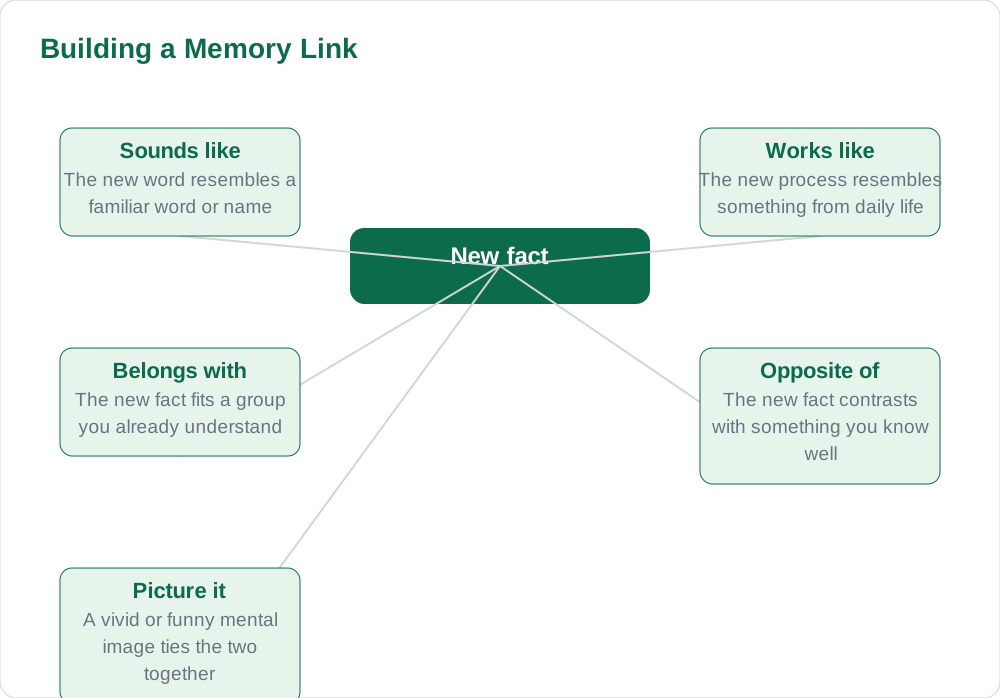
Start by asking one question about anything new: what does this remind me of? A new science term might sound like an everyday word, a historical event might resemble something in your own life, and a grammar rule might match a pattern in your first language. Write the connection down next to the fact in your notes, in your own words, because a link you invent yourself is always stronger than one someone else gives you. Even a rough or silly connection counts, as long as it is yours and you can picture it.
If no hook comes to mind immediately, build one from categories you already understand. Place the new fact in a group: is it a cause, an effect, a part of a whole, or an example of a rule? Comparing it with a known member of the same group creates the link. For example, a new type of plant can be linked to a plant you know by asking how it is similar and how it differs. Two or three sentences of comparison in your notes are enough to give the fact a home in your memory, and that home is what you will return to in the exam. Browse the solved notes for material to practise linking with.
Using Everyday Life as a Link Library
Your daily life is full of ready-made hooks, and the best pupils use them without realising it. Cooking gives links for measurement, heat, and change; the bazaar gives links for trade, money, and bargaining; sports give links for rules, teamwork, and scoring; family routines give links for sequences and responsibilities. When a lesson mentions a process, ask where you have seen a similar process at home. A pupil who has watched bread rise has a living picture of a slow chemical change, and that picture will carry the textbook definition far better than the definition alone.
Deliberately collect these links in your notes. Beside each new definition or process, write a short everyday example in brackets, such as a kitchen, market, or playground comparison. In revision, read the example first and try to recall the definition from it, so the link is practised in the same direction the exam will use it. Over time you will build a personal library of comparisons that makes new chapters feel familiar instead of foreign, because every new topic arrives with a few friendly faces already attached to it.
Linking Across Subjects and Classes
Links become even stronger when they cross subjects, because a fact tied to two subjects has two ways back into memory. A lesson on water in science connects to a geography lesson on rivers and rainfall; a history lesson on trade connects to a mathematics lesson on profit and loss; a language lesson on describing a place connects to a social studies lesson on that same place. When you notice such a crossing, write it down: a short note saying this topic also appears in another subject turns two separate memories into one connected web.
Earlier classes are another rich source of hooks. Almost every new topic builds on something from a previous year, even when the textbook does not say so. Before starting a new chapter, spend two minutes recalling what you learned about the same theme last year, and let the new material attach to that older knowledge. Pupils who do this find new chapters easier, not because they are cleverer, but because they arrive with hooks ready. Teachers love this habit too, because a pupil who connects lessons is showing real understanding, not just memorisation. More study ideas are on the [home page](/) and the book collection.
- Science and geography: water cycles, rivers, rainfall, and climate link naturally.
- History and mathematics: trade, taxes, profit, and loss share the same ideas.
- Language and social studies: describing a place uses knowledge from both subjects.
- This year and last year: every new chapter builds on an older topic you already know.
When Links Go Wrong: Keeping Them Honest
Links are powerful, but a careless link can mislead. A comparison that is only partly true can plant a wrong idea that feels right because the link is vivid. For example, comparing an electric current to flowing water helps with the idea of flow, but water and electricity differ in important ways, and carrying the comparison too far creates mistakes. The rule is simple: use the link to remember, then check the real definition against your book, and note where the comparison stops being true.
Also avoid links that are so complicated that you have to memorise the link itself. If remembering the connection takes more effort than remembering the fact, the link is not helping. Keep links short, visual, and personal, and test them by recall: cover the fact, look at the hook, and see whether the fact comes back. If it does, the link works. If it does not, try a different hook rather than forcing the same one. A small set of strong, honest links will serve you far better than a large set of clever but confusing ones.
AI Help: Muse AI
Muse AI is Meta's personal AI assistant. You can ask it to explain a concept in simple words, summarise a lesson, or make practice questions for revision.
For linking new facts, ask Muse AI to suggest an everyday comparison for a topic you find hard, then check the comparison against your textbook and keep only the parts that are accurate.
Join Muse with invite code LTGSWD — in the Muse app, go to Settings > Redeem token and enter the code.
Disclosure: LTGSWD is the author's Muse invite code.
Muse AI does not give official STBB answers — always verify against your Sindh Textbook Board book and your teacher.
5 key points you must know
- Memory is a web: a new fact survives when tied to something already known.
- Ask what a new fact reminds you of, and write the connection in your own words.
- Use everyday life: cooking, markets, sports, and home routines are full of hooks.
- Link across subjects and earlier classes to give a fact two ways back into memory.
- Check every link against the book, and drop links that mislead or overcomplicate.
Frequently asked questions
Why does linking help more than repetition?
Repetition without a link builds no hook in memory, so the fact has nothing pointing to it later. A link attaches the new fact to an existing idea, and thinking of the familiar idea later pulls the new fact along with it.
What makes a good memory link?
A good link is vivid, personal, and simple: something you invented yourself that you can picture easily. Funny or surprising connections work especially well, because your brain pays more attention to what surprises it.
Can a link ever be wrong?
Yes, a comparison that is only partly true can plant a wrong idea. Use the link to remember, then check the real definition against your book, and note where the comparison stops being true.
How do I link topics across different subjects?
When you notice the same theme in two subjects, write a short note connecting them, such as water in science and rivers in geography. That note turns two separate memories into one connected web with two routes back to the fact.
What if I cannot find any link for a new fact?
Place the fact in a group: is it a cause, an effect, a part of a whole, or an example of a rule? Comparing it with a known member of the same group creates a link, and two or three sentences of comparison are enough.
Solved notes — preview free
These guides work best with the solved exercises. Preview the solved notes free on this website — 119 solved notes for Classes 6–10 in Sindhi, Urdu, English and Arabic medium. Or browse the full solved notes catalogue for your class and medium. New solved notes are added regularly — check the catalogue for coming-soon books.