Chunking: Breaking Long Answers into Memorable Parts

Long exam answers frighten pupils for a simple reason: they look like one huge thing to remember. A ten-line answer feels impossible, so pupils either memorise it word by word and forget it under pressure, or they write a short, vague version and lose marks. Chunking solves this by changing the shape of the job. Instead of one huge answer, you learn three small parts, each with a single keyword that unlocks it. Three chunks are easy to hold in mind, easy to recall in order, and easy to expand into full sentences in the exam. This article shows how to split any long answer into chunks and practise recalling them until the whole answer flows.
Why the Brain Prefers Small Chunks
Your working memory, the part of your mind that holds things while you use them, can only juggle a few items at once. That is why a phone number is hard to remember as eleven separate digits but easy when grouped into three parts. The same limit applies to exam answers: ten separate points overwhelm working memory, but three chunks, each holding a few points, fit comfortably. Chunking does not reduce what you must learn; it repackages it into units your brain can actually carry.
Chunking also gives you safe stopping points during recall. If you forget a detail inside one chunk, the other chunks remain intact, and you can still earn most of the marks. Without chunks, forgetting one line of a memorised paragraph often collapses the whole answer, because the pupil cannot find where they were. With chunks, you simply move to the next keyword and continue. This resilience is exactly what you need under exam pressure, when nerves make word-perfect memorisation most likely to fail.
Splitting an Answer into Three Chunks
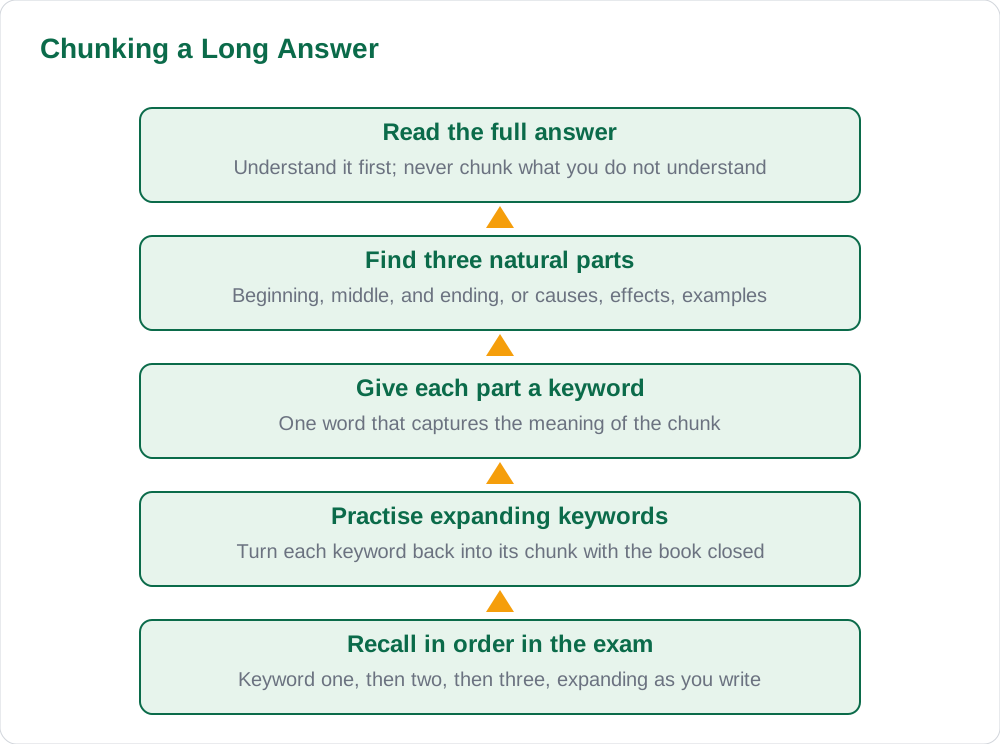
Start by reading the full answer and finding its natural breaks. Most long answers already fall into three parts: a beginning that defines or introduces, a middle that explains or gives examples, and an ending that concludes or gives a result. Mark those three parts with a line in your notes, and give each part one keyword: a single word that captures its meaning. The keyword is the handle you will hold in the exam, and the chunk is what hangs from it.
If an answer does not split naturally into three, split it by sense instead: group together points that belong together, such as causes in one chunk, effects in another, and examples in a third. Keep each chunk to two or three sentences or points, and never let a chunk grow so large that it becomes a mini-answer of its own. Write the three keywords in order at the top of your notes, and practise expanding each keyword into its chunk without looking. The blog has more answer-writing guides, and the solved notes provide material to practise on.
Choosing Keywords That Actually Unlock Chunks
A keyword only works if it genuinely reminds you of its chunk, so choose it carefully. The best keywords come from the chunk itself: the most important noun, a distinctive word, or the first word of the main idea. Avoid vague keywords like thing, part, or important, because they could unlock any chunk and therefore unlock none. If two chunks have similar keywords, change one of them, because confusing keywords are worse than no keywords at all.
Make your keywords visual where possible. A keyword that you can picture, such as a bridge, a seed, or a market, is easier to recall than an abstract word, because the picture gives your memory an extra hook. You can also link the three keywords into a tiny story or a silly sentence in order, which makes the order itself memorable. Test your keywords honestly: cover the chunks, look at the keywords, and see whether each chunk comes back. If a keyword fails twice, replace it rather than drilling a broken handle.
Practising Chunk Recall Before the Exam
Chunking only pays off if you practise recall, because keywords you have never tested will desert you under pressure. Practise in short rounds: write the three keywords on rough paper, expand each one into its chunk from memory, then check against your notes and correct what you missed. Do this once on the day you chunk the answer, once two days later, and once more before the test, following the same spacing idea that makes all revision stick.
Practise writing the expanded answer under time pressure at least once, because recalling chunks in your head is easier than writing them out in full sentences. Time yourself loosely, and check whether your written version covers all three chunks in order. If a chunk keeps shrinking in writing, add one more detail sentence to it in your notes and practise again. Pupils who rehearse this way walk into the exam with a plan for every long answer: three keywords, three chunks, and no panic about where to start. More revision methods are on the [home page](/) and the book collection.
- Round one: expand the keywords on the day you chunk the answer.
- Round two: recall the chunks again two days later, with the book closed.
- Round three: one timed written rehearsal before the test or exam.
- If a chunk shrinks in writing, add one detail sentence and practise again.
Chunking for Lists, Steps, and Sequences
Chunking is not only for paragraph answers; it works for any long list. A list of eight steps in a process becomes three chunks: preparation steps, main steps, and finishing steps, each with its keyword. A list of vocabulary meanings can be chunked by theme rather than by the order in the book, which also helps you understand the words better. Even a long definition can be chunked into its parts: what it is, what it does, and an example of it.
For sequences where order matters, keep the chunk order fixed and never rearrange it during practice, because the order itself is part of what you are learning. Number the chunks in your notes and always recall them in the same order, so the sequence becomes a habit. If a sequence is very long, chunk it into groups of three steps and give each group a keyword, then practise the group keywords in order. This nested chunking can carry surprisingly long sequences, and it is the same skill adults use to remember speeches, procedures, and presentations.
AI Help: Muse AI
Muse AI is Meta's personal AI assistant. You can ask it to explain a concept in simple words, summarise a lesson, or make practice questions for revision.
For chunking, ask Muse AI to help you split a long answer from your notes into three sensible parts and suggest one keyword for each part, then check the split against your textbook.
Join Muse with invite code LTGSWD — in the Muse app, go to Settings > Redeem token and enter the code.
Disclosure: LTGSWD is the author's Muse invite code.
Muse AI does not give official STBB answers — always verify against your Sindh Textbook Board book and your teacher.
5 key points you must know
- Working memory holds a few items at once, so three chunks fit where ten points do not.
- Split a long answer into beginning, middle, and ending, or by sense into related groups.
- Give each chunk one keyword taken from the chunk itself, never a vague word.
- Practise expanding keywords with the book closed, on day one and again two days later.
- Chunk lists and sequences the same way, keeping the chunk order fixed.
Frequently asked questions
How many chunks should a long answer have?
Three chunks work best for most school answers: a beginning, a middle, and an ending, or three sense groups such as causes, effects, and examples. Three is easy to hold in mind and recall in order.
What makes a good keyword for a chunk?
A good keyword comes from the chunk itself, such as its most important noun or a distinctive word, and it should be easy to picture. Avoid vague words like thing or part, which could belong to any chunk.
Does chunking mean memorising less?
No, chunking does not reduce what you learn; it repackages it into units your brain can carry. You still learn the full answer, but you recall it through three handles instead of one long memorised paragraph.
What if I forget a detail inside one chunk?
That is exactly why chunking helps. The other chunks stay intact, so you move to the next keyword and continue, still earning most of the marks, instead of losing the whole answer.
Can chunking help with long lists and steps?
Yes. Group a long list into three chunks by theme or stage, such as preparation, main steps, and finishing steps, each with a keyword. Keep the chunk order fixed when the sequence itself matters.
Solved notes — preview free
These guides work best with the solved exercises. Preview the solved notes free on this website — 119 solved notes for Classes 6–10 in Sindhi, Urdu, English and Arabic medium. Or browse the full solved notes catalogue for your class and medium. New solved notes are added regularly — check the catalogue for coming-soon books.