Tackling Islamiat MCQs Built Around Key Terms
Tackling Islamiat MCQs built around key terms becomes much easier once you learn one habit: define the key term first, before you look at the options. Many Islamiat objective questions in Sindh board papers turn on a single important term from the lesson, such as a concept, a practice, or a quality, and the options test whether you really understand what that term means. Students who jump straight to the options often pick a familiar-sounding choice that describes a related but different concept. Students who pause to define the term in their own words already know what the answer must look like, so wrong options stand out clearly. This guide shows you how to identify key terms, define them accurately, and use those definitions to answer confidently, while staying faithful to what your textbook and teacher actually teach.
Finding the Key Term in the Question
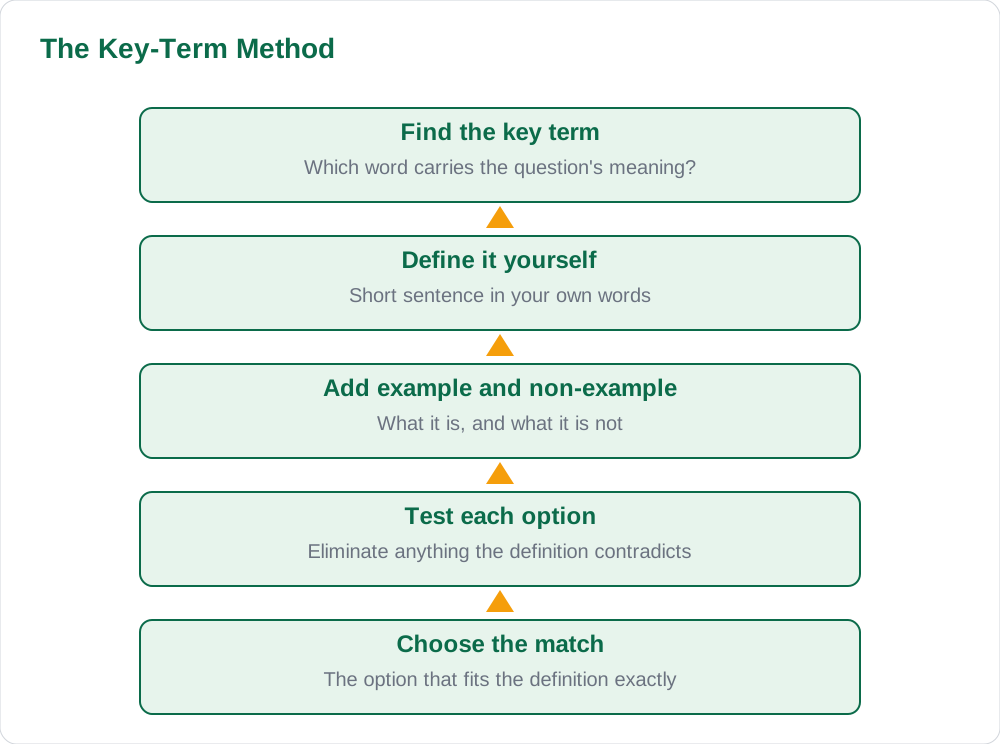
Every key-term question has a centre of gravity: one word or short phrase that carries the meaning of the whole question. It may be the subject of the sentence, a term in quotation marks, or a word repeated from your lesson headings. Train yourself to find it by asking which word, if misunderstood, would make the whole question unanswerable. That word is your key term, and it deserves your full attention before anything else. Underline it mentally, and resist the urge to read the options until you have thought about it, because the options are designed to reward students who know the term and mislead those who only half-know it.
Key terms often belong to families of related concepts that students confuse, such as two practices that sound similar or two qualities that overlap. The question usually tests exactly that confusion, so defining the term precisely, including what it is not, matters as much as knowing what it is. When you study, make a habit of writing each key term with its definition in your own words, plus one example and one non-example from the lesson. That four-part note, term, definition, example, non-example, is the strongest preparation for key-term MCQs, and it also deepens your understanding of the lesson itself. More Islamiat study help is on the blog.
Defining the Term Before Reading Options
Once you have found the key term, define it silently in a short sentence before you look at the options. Your definition does not need textbook wording; it needs to capture the essential meaning accurately. For example, if the key term names a moral quality, your definition should state what that quality means in behaviour, not just repeat the word. If it names a practice, your definition should state what is done and why. This self-definition becomes your answer key: any option that matches it survives, and any option that contradicts it is eliminated, even if it sounds learned or familiar.
If you cannot define the term fully, define what you do know about it, such as its category, its opposite, or one clear example. Partial knowledge still narrows the options, because an option that belongs to a different category or describes the opposite quality can be removed. Do not let a perfect definition become the enemy of a useful one: a rough but correct sense of the term is enough to eliminate two options in most questions, and the remaining comparison is far easier. When you truly cannot define the term at all, use the elimination method on the options themselves and make your best educated guess. Read The Elimination Technique for MCQs: Removing Wrong Options for that method.
Using Definitions to Eliminate Distractors
Distractors in key-term questions usually fail in predictable ways, and your definition exposes them. One distractor describes a related concept from the same lesson, which fools students who know the chapter generally but not the specific term. Another gives a definition that is too narrow, covering only part of the term's meaning, or too broad, covering things the term does not include. A third uses impressive wording that sounds religious or scholarly but states something your textbook does not teach. Test each option against your definition word by word, and eliminate any option that adds, removes, or changes an essential part of the meaning.
Be especially careful with options that are true statements about Islam in general but do not define the key term asked. A question about one specific concept is not answered by a general truth, however correct that truth may be. Always ask whether the option defines this term, not merely whether it states something true. This discipline protects you from the most common key-term trap, and it also protects your understanding, since it trains you to keep concepts distinct instead of blending them into vague familiarity. The solved notes can help you revise key terms chapter by chapter.
Avoiding Guesses Dressed as Knowledge
Key-term questions tempt students to guess from familiar-sounding words, and that temptation is dangerous in Islamiat, where precision matters. An option may use Arabic-derived wording that feels authentic, yet describe a different concept, and a student who chooses by feeling rather than definition will be misled. The safeguard is to slow down and demand evidence: does this option match the definition I formed, or does it merely sound right? If you cannot connect an option to your definition, treat it as suspect, not as likely. This habit of demanding a reason for every choice is the difference between confident answering and hopeful guessing.
Accuracy also means never inventing meanings for terms you have not studied. If a term is genuinely unfamiliar, say so to yourself honestly, eliminate what you can, and guess calmly rather than convincing yourself that a familiar option must be right. After the exam, look up every unfamiliar term in your textbook and add it to your notes, so the same gap does not recur. Honest self-assessment during practice is what turns weak topics into strong ones, and it is far more valuable than a lucky guess that hides a gap in understanding. For tracking gaps, see Keeping an MCQ Error Log for Repeated Mistakes.
Revising Key Terms for the Exam
Revise key terms actively, not by rereading the chapter passively. Cover the definitions in your notes and try to recall each term's meaning, example, and non-example from memory, then check yourself. Make flashcards with the term on one side and the definition plus example on the other, and shuffle them so you practise recall in random order, just as the exam will test you. Group related terms together and practise distinguishing them, since exam questions often target exactly those confusions. A short daily session of ten terms, done this way, builds stronger recall than an hour of rereading the night before the exam.
Use your textbook as the final authority for every definition, and check any definition you are unsure about with your teacher. Study guides and notes are helpful, but when they differ from the textbook, the textbook wins, because the exam is based on it. When you practise with past-style questions, always verify the correct option's definition in the book, even when you answered correctly, since confirming the definition cements it. This textbook-first habit keeps your Islamiat understanding accurate and exam-ready, and it gives you confidence that your definitions, not your guesses, are answering the questions. The books page lists the Islamiat textbooks to revise from.
AI Help: Muse AI
Muse AI is Meta's personal AI assistant, and it can help you practise Islamiat key-term MCQs. For example, you can ask it to explain a key term from your lesson in simple words, or to quiz you by giving a term and asking you to define it before revealing the answer.
Join Muse with invite code LTGSWD — in the Muse app, go to Settings > Redeem token and enter the code.
Disclosure: LTGSWD is the author's Muse invite code.
Muse AI does not give official STBB answers — always verify against your Sindh Textbook Board book and your teacher.
5 key points you must know
- Find the key term first: the word whose meaning decides the whole question.
- Define the term in your own words before reading any option.
- Use the definition to eliminate related-but-different concepts and over-broad options.
- Never choose an option merely because it sounds familiar or scholarly.
- Revise terms with definition, example, and non-example, checked against the textbook.
Frequently asked questions
What if a question has more than one important term?
Then identify the main term, usually the subject of the question, and define that first. Use the other terms as supporting clues, but judge the options mainly against the main term's definition, since that is what the question turns on.
Should I memorise textbook definitions word for word?
Understanding matters more than word-for-word memorisation. Learn the essential meaning in your own words, plus an example and a non-example, so you can recognise the correct definition even when the exam phrases it differently.
What if my definition is only partly right?
A partly right definition still helps, because it lets you eliminate options from the wrong category or describing the opposite quality. Eliminate what you can, compare the survivors carefully, and look up the full definition after practice.
How do I avoid confusing similar terms?
Study similar terms side by side, writing what makes each one distinct. Practise questions that target the confusion directly, and always note the distinguishing feature, not just the shared background, in your revision notes.
Solved notes — preview free
These guides work best with the solved exercises. Preview the solved notes free on this website — 119 solved notes for Classes 6–10 in Sindhi, Urdu, English and Arabic medium. Or browse the full solved notes catalogue for your class and medium. New solved notes are added regularly — check the catalogue for coming-soon books.