Class 9 Maths: Trigonometry Ratios Introduction
The class 9 maths trigonometry ratios intro topic opens a new branch of mathematics that relates the angles of a right-angled triangle to the ratios of its sides. For a chosen acute angle, the three main ratios are sine, cosine and tangent, written sin, cos and tan. Sine is opposite over hypotenuse, cosine is adjacent over hypotenuse, and tangent is opposite over adjacent. This article explains each ratio with a clearly labelled triangle, works through original examples including heights and distances, introduces the standard angles 30, 45 and 60 degrees, and warns about the calculator and labelling mistakes that cost marks. Trigonometry may feel abstract at first, but every ratio is just a fraction from one triangle, and the examples will make that concrete. For more Class 9 maths, visit the [solved notes collection](/solved.html) and the [books library](/books.html).
Labelling a Right Triangle for Trigonometry
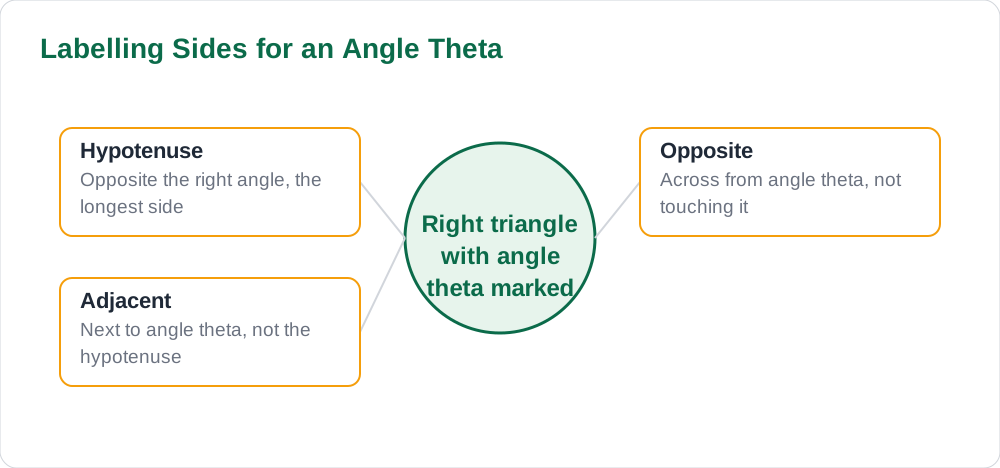
Trigonometry always starts by choosing an angle, because the labels opposite and adjacent depend on which angle you pick. In a right-angled triangle, the hypotenuse is fixed: it is the side opposite the right angle and the longest side. For your chosen acute angle, the opposite side is the one across the triangle from that angle, not touching it, and the adjacent side is the one next to the angle that is not the hypotenuse. If you switch to the other acute angle, the opposite and adjacent sides swap roles, while the hypotenuse stays the same. This is the single most important labelling skill in the chapter, so practise it until it is instant.
A memory aid for the three ratios is SOH CAH TOA: sine equals opposite over hypotenuse, cosine equals adjacent over hypotenuse, and tangent equals opposite over adjacent. Say it as three words, Soh Cah Toa, and write it at the top of your working whenever you start a trigonometry question. It prevents the common error of dividing the wrong pair of sides, which gives a plausible-looking but wrong number. Always draw the triangle, mark the right angle, label the chosen angle, and write O, A and H on the three sides before choosing a ratio.
Sine, Cosine and Tangent Explained
Sine of an angle is the ratio of the opposite side to the hypotenuse. If a right-angled triangle has hypotenuse 10 cm and the side opposite a 30-degree angle is 5 cm, then sin 30 degrees equals 5 divided by 10, which is 0.5. Cosine is the adjacent side over the hypotenuse: in the same triangle, if the adjacent side is about 8.66 cm, cos 30 degrees is about 0.866. Tangent is opposite over adjacent, so tan 30 degrees is 5 divided by 8.66, about 0.577. Notice that sine and cosine are always less than or equal to 1 for acute angles, because the hypotenuse is the longest side, while tangent can be less than or greater than 1 depending on the angle.
The ratios depend only on the angle, not on the size of the triangle. A small triangle and a large triangle with the same angles have the same ratios, because the triangles are similar and their sides scale together. That is why trigonometric ratios are functions of the angle alone, and why tables and calculators can list sin, cos and tan for each angle. When you use a calculator, check that it is in degree mode, not radian mode, because a radian-mode answer will be completely wrong and may still look plausible. If your calculator gives sin 30 as a negative number or something far from 0.5, the mode is wrong.
Standard Angles: 30, 45 and 60 Degrees
Three angles have exact ratios worth memorising: 30, 45 and 60 degrees. The 45-degree ratios come from an isosceles right-angled triangle with legs of 1 unit: the hypotenuse is root 2, so sin 45 and cos 45 are both 1 over root 2, and tan 45 is 1. The 30-degree and 60-degree ratios come from an equilateral triangle of side 2 units cut in half: the half-triangle has hypotenuse 2, one leg 1, and the other leg root 3, so sin 30 is 1/2, cos 30 is root 3 over 2, tan 30 is 1 over root 3, and the 60-degree values swap the sine and cosine.
A useful check is that sin and cos swap between complementary angles: sin 30 equals cos 60, both 1/2, and sin 60 equals cos 30, both root 3 over 2. This happens because the opposite side for one acute angle is the adjacent side for the other. In exams, standard-angle questions often appear without a calculator, so memorising this small table is essential. Write the table from the two special triangles rather than memorising isolated numbers, because reconstructing it from the triangles protects you if you forget one value under pressure.
- sin 30 = 1/2, cos 30 = root 3 / 2, tan 30 = 1 / root 3.
- sin 45 = cos 45 = 1 / root 2, tan 45 = 1.
- sin 60 = root 3 / 2, cos 60 = 1/2, tan 60 = root 3.
Worked Example: Finding a Height
A classic application is finding the height of a tall object from its shadow and the angle of elevation. Suppose the sun makes an angle of 60 degrees with the ground, and a pole casts a shadow 5 m long. The pole, its shadow and the sun ray form a right-angled triangle, with the pole as the opposite side to the 60-degree angle and the shadow as the adjacent side. The ratio linking opposite and adjacent is tangent, so tan 60 = height divided by 5. Since tan 60 is root 3, about 1.732, the height is 5 × 1.732 = 8.66 m. The formula used here is tan θ = opposite / adjacent, rearranged to opposite = adjacent × tan θ.
A second example uses sine. A ladder 8 m long leans against a wall at 70 degrees to the ground. The height it reaches is the opposite side to the 70-degree angle, and the ladder is the hypotenuse, so sin 70 = height divided by 8, giving height = 8 × sin 70, about 8 × 0.9397 = 7.52 m. The skill in both examples is the same: draw the triangle, label the known side and angle, identify which side is unknown, and pick the ratio that links the known pair to the unknown. If you pick the ratio first and then fit the labels to it, you will often pick wrongly, so label first, then choose.
Finding an Angle and Avoiding Mistakes
Trigonometry also works backwards: given two sides, you can find an angle using the inverse ratios, written sin⁻¹, cos⁻¹ and tan⁻¹ on a calculator. For example, if the opposite side is 6 cm and the hypotenuse is 10 cm, sin θ = 0.6, so θ = sin⁻¹ 0.6, about 36.87 degrees. The inverse buttons are usually the shifted functions of sin, cos and tan, so check your calculator layout before the exam. Always sanity-check an inverse answer: an angle in a right-angled triangle must be between 0 and 90 degrees, and if your calculator returns something outside that range, you used the wrong ratio or the wrong mode.
The most common mistakes are labelling opposite and adjacent for the wrong angle, using radian mode, and rounding too early. Keep at least four decimal places in intermediate ratios and round only the final angle or length. Another mistake is writing the ratio upside down, such as hypotenuse over opposite for sine; the SOH CAH TOA aid prevents this if you write it down. Finally, never mix a ratio with the Pythagoras theorem in the same step: find the missing side by one method, then use trigonometry, or vice versa, but keep the steps separate so each can be checked. More practice advice is in the study tips section and on the about page.
AI Help: Muse AI
Muse AI is Meta's personal AI assistant. It can help with this topic by explaining SOH CAH TOA in simple words, or by generating right-triangle problems where you practise choosing the correct ratio.
Join Muse with invite code LTGSWD — in the Muse app, go to Settings > Redeem token and enter the code. Disclosure: LTGSWD is the author's Muse invite code. Muse AI does not give official STBB answers — always verify against your STBB book and your teacher. Always verify against your Sindh Textbook Board book and your teacher before using anything in classwork.
5 key points you must know
- sin θ = opposite / hypotenuse, cos θ = adjacent / hypotenuse, tan θ = opposite / adjacent.
- The hypotenuse is always opposite the right angle and is the longest side.
- Opposite and adjacent swap when you choose the other acute angle.
- Standard angles: 30, 45 and 60 degrees have exact ratios from special triangles.
- Check calculator degree mode, label sides first, and round only the final answer.
Frequently asked questions
What does SOH CAH TOA mean?
It is a memory aid: Sine = Opposite over Hypotenuse, Cosine = Adjacent over Hypotenuse, Tangent = Opposite over Adjacent.
Why are sine and cosine always less than 1 for acute angles?
Because both divide a shorter side by the hypotenuse, which is the longest side of the triangle, so the fraction is always less than 1.
How do I find an angle from two sides?
Compute the ratio from the two known sides, then use the inverse function on your calculator, such as sin⁻¹, cos⁻¹ or tan⁻¹, to recover the angle.
What is the angle of elevation?
The angle between the horizontal ground and the line of sight looking upward to an object. It is the acute angle at the observer in the right-angled triangle.
Can tangent be greater than 1?
Yes. Tangent is opposite over adjacent, and for angles above 45 degrees the opposite side is longer than the adjacent side, so tan exceeds 1.
Solved notes — preview free
These guides work best with the solved exercises. Preview the solved notes free on this website — 119 solved notes for Classes 6–10 in Sindhi, Urdu, English and Arabic medium. Or browse the full solved notes catalogue for your class and medium. New solved notes are added regularly — check the catalogue for coming-soon books.