Class 9 Maths: Surface Area of Cubes, Cylinders and Spheres
The class 9 maths surface area solids topic asks how much material covers the outside of a three-dimensional object. That is a practical question: paint covers surface area, wrapping paper covers surface area, and the metal of a tin is bought by its surface area. This article explains the formulae for cubes, cuboids, cylinders, cones and spheres, shows how to choose between total surface area and curved surface area, and works through original examples involving a tin, a water tank and a ball. The key skill is visualising the solid unfolded into its net, because every formula in this chapter is just the area of a net. For more Class 9 maths, visit the [solved notes collection](/solved.html) and the [books library](/books.html).
Total Surface Area Versus Curved Surface Area
Total surface area, often written TSA, is the area of the entire outer surface, including every face, base and lid. Curved surface area, written CSA, is the area of only the curved part, excluding flat bases or ends. For a closed tin, you need the total surface area, because the tin has a top and a bottom as well as a curved side. For an open water tank, you need the curved surface area plus the area of the base, but not a lid, because there is none. For a pipe, which is open at both ends, only the curved surface area matters. Reading the question carefully to decide which parts exist is more important than memorising any single formula.
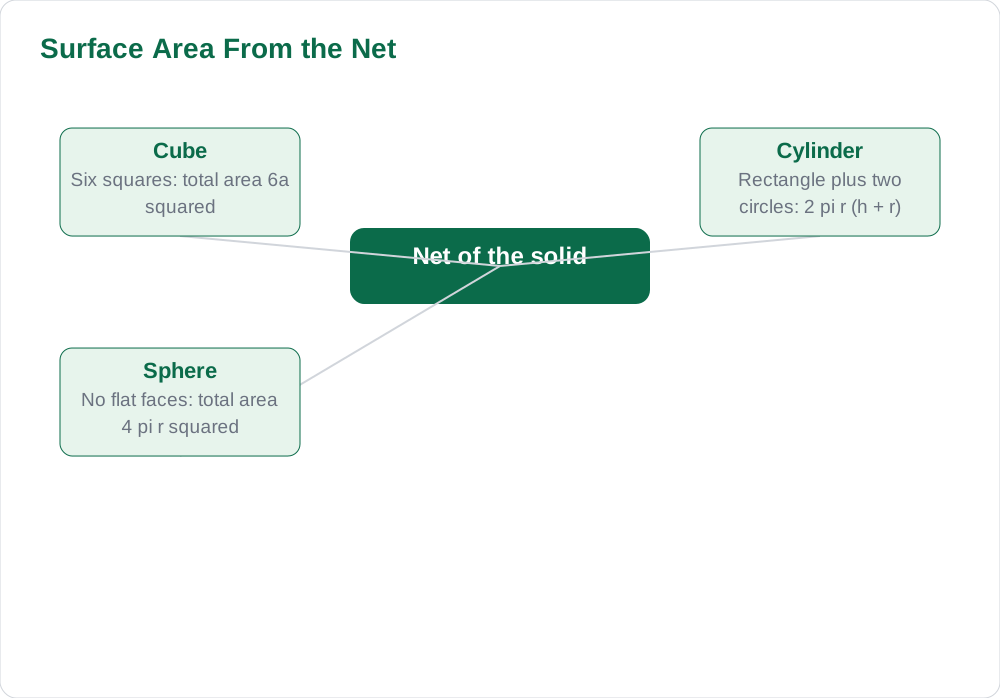
A net makes the distinction visible. Unfold a cylinder and you get a rectangle for the curved surface plus two circles for the ends. The rectangle has length equal to the circumference of the base, 2πr, and height equal to the height of the cylinder, h, so its area is 2πrh, which is the curved surface area. Adding the two circles, each πr², gives the total surface area 2πrh + 2πr², which factorises to 2πr(h + r). Whenever you forget a formula, sketch the net and add the areas of its pieces; the formula will rebuild itself, and you will also see immediately whether a base or lid should be included.
Cubes and Cuboids
A cube of side a has six identical square faces, so its total surface area is 6a². A cuboid of length l, breadth b and height h has three pairs of rectangular faces, giving a total surface area of 2(lb + bh + hl). These formulae are straightforward, but the units and the wording still trap students. Area must be in square units, so if the sides are in centimetres, the answer is in square centimetres. If a question gives mixed units, such as metres and centimetres, convert everything to one unit before calculating.
Consider an original example. A cuboidal box measures 40 cm by 30 cm by 20 cm. Its total surface area is 2(40×30 + 30×20 + 20×40) = 2(1200 + 600 + 800) = 2 × 2600 = 5200 square centimetres. If the box is open at the top, subtract the top face, 40×30 = 1200, giving 4000 square centimetres of material. A second example: painting a cube of side 5 m on all faces needs 6 × 25 = 150 square metres of painted surface, and if one litre of paint covers 10 square metres, 15 litres are needed. Always finish with the practical interpretation the question asks for, not just the raw area.
Cylinders: Tins and Tanks
A closed cylindrical tin of radius 7 cm and height 10 cm has a curved surface area of 2πrh = 2 × (22/7) × 7 × 10 = 440 square centimetres, and two circular ends totalling 2πr² = 2 × (22/7) × 49 = 308 square centimetres, giving a total surface area of 748 square centimetres. Using π as 22/7 is convenient when the radius is a multiple of 7, because the 7 cancels; otherwise use 3.14 or the value your teacher specifies, and keep it consistent through the whole calculation. If the question asks for the area of metal needed, that is the total surface area, since the tin is closed.
An open cylindrical water tank of radius 2 m and height 3 m needs a different treatment. Its curved surface area is 2πrh = 2 × 3.14 × 2 × 3 = 37.68 square metres, and its base is πr² = 3.14 × 4 = 12.56 square metres, giving 50.24 square metres of material, with no lid. If the tank is to be painted inside and outside, double the figure. The lesson is always the same: draw the solid, shade the parts that exist, and add only those parts. Students who memorise one formula and apply it to every cylinder question will get the open-tank question wrong, even with perfect arithmetic.
Spheres and Hemispheres: Balls and Bowls
A sphere of radius r has surface area 4πr². There is no separate curved and total surface area for a sphere, because the whole surface is curved. A ball of radius 7 cm therefore has surface area 4 × (22/7) × 49 = 616 square centimetres. A hemisphere, which is half a sphere, is trickier. Its curved surface area is half of the sphere, 2πr², but its total surface area adds the flat circular base, πr², giving 3πr². Confusing 2πr² with 3πr² is the most common error with hemispheres, so always ask whether the flat face counts.
Consider a hemispherical bowl of radius 10 cm, open at the top. The inside surface to be polished is the curved part only, 2π × 100 = 200π, about 628 square centimetres. If instead the bowl were a solid hemisphere, such as a paperweight, its total surface would be 3π × 100 = 300π, about 942 square centimetres, including the flat base. The same object, described two ways, gives two different answers, which shows why reading the description matters more than the formula. In your working, write the words curved surface area or total surface area explicitly, so the examiner sees which one you intended.
- Sphere: surface area 4 pi r squared.
- Hemisphere curved surface: 2 pi r squared; total surface: 3 pi r squared.
- Always state whether the flat base or lid is included.
Choosing the Right Formula Under Exam Pressure
Build a quick decision routine. First, name the solid and write its formula from the net, not from memory alone. Second, list which parts exist: lids, bases, open ends. Third, check the units and convert them to a single unit. Fourth, substitute carefully, keeping π as a symbol until the last step so that cancellations, especially with radius 7, are visible. Fifth, give the answer in square units with a sensible degree of rounding, and re-read the question to confirm you answered for the right parts, for example material for one tin versus paint for ten tins, which multiplies the area by ten.
A final mixed example ties the chapter together. A cylindrical container of radius 3.5 cm and height 12 cm, closed at both ends, has total surface area 2πr(h + r) = 2 × (22/7) × 3.5 × 15.5 = 341 square centimetres. The formula used here is 2πr(h + r), with the radius cancelling neatly against 22/7, which is a sign the numbers were chosen kindly. If your numbers do not cancel, that is not necessarily an error; it simply means the question expects a decimal answer. Trust the method, check the parts, and let the arithmetic follow. More exam technique is in the study tips section.
AI Help: Muse AI
Muse AI is Meta's personal AI assistant. It can help with this topic by quizzing you on surface area formulae, or by checking whether you remembered to include the lid, base or flat face in a problem.
Join Muse with invite code LTGSWD — in the Muse app, go to Settings > Redeem token and enter the code. Disclosure: LTGSWD is the author's Muse invite code. Muse AI does not give official STBB answers — always verify against your STBB book and your teacher. Always verify against your Sindh Textbook Board book and your teacher before using anything in classwork.
5 key points you must know
- Total surface area covers every face; curved surface area covers only the curved part.
- Cube: 6a². Cuboid: 2(lb + bh + hl).
- Cylinder: curved 2πrh, total 2πr(h + r).
- Sphere: 4πr². Hemisphere: curved 2πr², total 3πr².
- Always check which parts exist, convert units first, and give answers in square units.
Frequently asked questions
What is the difference between total and curved surface area?
Total surface area includes all faces, bases and lids. Curved surface area includes only the curved part, so for a cylinder it excludes the two circular ends.
How much material does an open tank need?
The curved surface area plus one base, but no lid. For radius r and height h, that is 2πrh + πr².
Why is the hemisphere total surface 3πr²?
The curved half-sphere contributes 2πr² and the flat circular base contributes πr², giving 3πr² in total.
Should I use π as 22/7 or 3.14?
Use 22/7 when the radius is a multiple of 7, since the 7 cancels neatly. Otherwise use 3.14 or the value your teacher specifies, and stay consistent.
What if the question gives mixed units?
Convert all lengths to a single unit before calculating. The area will then be in the square of that unit.
Solved notes — preview free
These guides work best with the solved exercises. Preview the solved notes free on this website — 119 solved notes for Classes 6–10 in Sindhi, Urdu, English and Arabic medium. Or browse the full solved notes catalogue for your class and medium. New solved notes are added regularly — check the catalogue for coming-soon books.