Class 9 Maths: Quadrilaterals and Their Properties
The class 9 maths quadrilaterals properties topic is really a comparison exercise: five or six special quadrilaterals share many features, and the exam tests whether you know exactly which properties belong to which shape. A parallelogram has opposite sides parallel and equal, a rectangle adds equal diagonals and right angles, a rhombus adds equal sides, a square combines both, and a trapezium has just one pair of parallel sides. This article builds a clear comparison, explains the diagonal properties that distinguish the shapes, and works through original examples where you must identify a quadrilateral from its properties or prove a property from a diagram. Keep the comparison table in your mind as you read, and test yourself at the end of each section. For more Class 9 geometry, visit the [solved notes collection](/solved.html) and the [books library](/books.html).
The Quadrilateral Family Tree
Every quadrilateral in this chapter belongs to a family tree that starts with the general quadrilateral, a four-sided figure whose angles sum to 360 degrees. A trapezium is a quadrilateral with at least one pair of parallel sides. A parallelogram is a quadrilateral with both pairs of opposite sides parallel, which automatically makes opposite sides equal and opposite angles equal. A rectangle is a parallelogram with a right angle, which forces all four angles to be right angles. A rhombus is a parallelogram with all sides equal. A square is both a rectangle and a rhombus, so it inherits every property of both, and it sits at the bottom of the tree as the most specialised shape.
Understanding this hierarchy prevents a common error: students often treat the shapes as unrelated boxes rather than nested sets. Every square is a rectangle, every rectangle is a parallelogram, and every parallelogram is a trapezium in the inclusive sense used in many textbooks. When a question asks whether a property holds for a parallelogram, a property of rectangles does not automatically qualify, because rectangles are a smaller group. But a property of parallelograms holds for rectangles, rhombuses and squares, because they are all parallelograms. Thinking in sets, not lists, makes these questions much easier.
Parallelogram Properties and Their Proofs
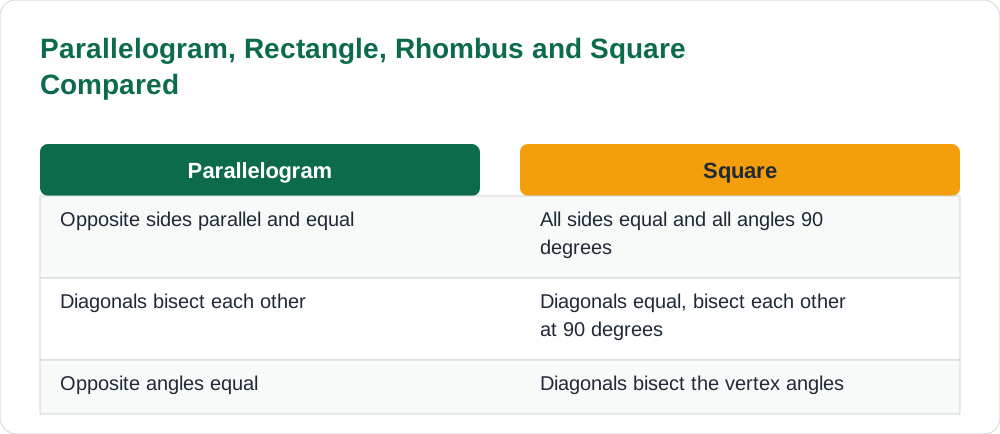
A parallelogram has four defining properties. Opposite sides are equal, opposite angles are equal, diagonals bisect each other, and consecutive angles are supplementary. The diagonal properties are worth understanding rather than memorising. Draw a parallelogram and one diagonal: it creates two triangles that are congruent by ASA, using alternate angles from the parallel sides and the common diagonal as the included side. From that congruence, opposite sides are equal. Draw both diagonals and use the same idea to show they bisect each other.
Consecutive angles are supplementary because they are co-interior angles on a transversal cutting parallel sides, which connects this chapter to the parallel-lines rules. A useful worked example: if one angle of a parallelogram is 72 degrees, the opposite angle is also 72 degrees, and each adjacent angle is 180 minus 72, which is 108 degrees. Another: if the diagonals of a quadrilateral bisect each other, the quadrilateral is a parallelogram, which is the converse direction and a common proof question. State the converse carefully, naming the property you used, because examiners award marks for the reasoning, not just the conclusion.
Rectangle, Rhombus and Square: What Each Adds
A rectangle is a parallelogram with all angles 90 degrees, and its special property is that its diagonals are equal in length as well as bisecting each other. This is why a rectangular door frame stays rigid when measured across both diagonals: if the diagonals are equal and bisect each other, the frame is a true rectangle. A rhombus is a parallelogram with all sides equal, and its special property is that its diagonals bisect each other at right angles and bisect the vertex angles. A diamond shape on a playing card is a rhombus, and folding it along a diagonal shows the symmetry clearly.
A square combines everything: all sides equal, all angles 90 degrees, diagonals equal, diagonals bisecting each other at right angles, and diagonals bisecting the vertex angles into 45-degree angles. When a question gives you a square, you may use any of these properties without proving them, but you must still name the property you use. A typical exam trap gives a quadrilateral with equal diagonals and asks whether it must be a rectangle; the answer is no, because an isosceles trapezium also has equal diagonals. You need the parallelogram condition as well, so check both conditions before concluding.
The Trapezium and the Kite
A trapezium has exactly one pair of parallel sides in the exclusive definition, or at least one pair in the inclusive definition, and students should use whichever definition their textbook states. Its key property is that the angles between the parallel sides, the co-interior angles, are supplementary. An isosceles trapezium, where the non-parallel sides are equal, additionally has equal base angles and equal diagonals, which makes it look deceptively like a rectangle in a rough sketch. Always check side markings and angle markings rather than trusting the appearance of the diagram.
A kite is a different kind of special quadrilateral: it has two distinct pairs of adjacent equal sides, one pair of equal opposite angles, and diagonals that cross at right angles, with one diagonal bisected by the other. A kite is not a parallelogram, because its opposite sides are not parallel or equal in general. Kites appear in questions about symmetry, since a kite has exactly one line of symmetry along its longer diagonal. If a problem mentions a quadrilateral with perpendicular diagonals, consider both the rhombus and the kite, and use the other given information to decide which one fits.
- Trapezium: one pair of parallel sides; angles between them are supplementary.
- Isosceles trapezium: non-parallel sides equal, base angles equal, diagonals equal.
- Kite: two pairs of adjacent equal sides; diagonals perpendicular, one bisected.
Worked Problems: Identifying and Proving Shapes
Consider an original problem. Quadrilateral ABCD has AB parallel to CD, AB equal to CD, and angle A equal to 90 degrees. Because one pair of opposite sides is both parallel and equal, ABCD is a parallelogram. Because a parallelogram with a right angle is a rectangle, ABCD is a rectangle. Notice the two-step deduction: first the parallelogram, then the rectangle. Skipping the middle step and jumping straight to rectangle may still earn the answer mark but loses reasoning marks, so write both steps.
A second problem works backwards from diagonals. A quadrilateral has diagonals that are equal and bisect each other. Equal diagonals alone suggest a rectangle or an isosceles trapezium, but bisecting diagonals are a parallelogram property, so the quadrilateral must be a parallelogram with equal diagonals, which is a rectangle. This style of reasoning, combining two properties to narrow down the shape, is exactly what the hardest questions in this chapter require. Practise by making your own cards: write a property on one side and the shapes that have it on the other, then quiz yourself until the combinations are instant. More revision ideas are in the study tips section.
AI Help: Muse AI
Muse AI is Meta's personal AI assistant. It can help with this topic by quizzing you on quadrilateral properties, or by checking whether a set of given properties really proves a shape is a rectangle or a rhombus.
Join Muse with invite code LTGSWD — in the Muse app, go to Settings > Redeem token and enter the code. Disclosure: LTGSWD is the author's Muse invite code. Muse AI does not give official STBB answers — always verify against your STBB book and your teacher. Always verify against your Sindh Textbook Board book and your teacher before using anything in classwork.
5 key points you must know
- A parallelogram has opposite sides parallel and equal, opposite angles equal, and diagonals that bisect each other.
- A rectangle adds right angles and equal diagonals to the parallelogram properties.
- A rhombus adds equal sides and diagonals that bisect at right angles.
- A square combines rectangle and rhombus properties.
- A trapezium has one pair of parallel sides; a kite has two pairs of adjacent equal sides.
Frequently asked questions
Is a square a rectangle?
Yes. A square satisfies the definition of a rectangle, a parallelogram with a right angle, and adds the extra condition that all sides are equal. Every square is a rectangle, but not every rectangle is a square.
How do the diagonals of a rhombus behave?
They bisect each other at right angles and bisect the vertex angles. They are not generally equal in length, unlike the diagonals of a rectangle.
If a quadrilateral has equal diagonals, is it a rectangle?
Not necessarily. An isosceles trapezium also has equal diagonals. You also need the diagonals to bisect each other, which makes it a parallelogram, before concluding it is a rectangle.
What is the angle sum of a quadrilateral?
360 degrees. You can prove this by drawing a diagonal, which divides the quadrilateral into two triangles, each with an angle sum of 180 degrees.
How can I prove a quadrilateral is a parallelogram?
Show one of these: both pairs of opposite sides parallel, both pairs of opposite sides equal, one pair of opposite sides both parallel and equal, opposite angles equal, or diagonals bisecting each other.
Solved notes — preview free
These guides work best with the solved exercises. Preview the solved notes free on this website — 119 solved notes for Classes 6–10 in Sindhi, Urdu, English and Arabic medium. Or browse the full solved notes catalogue for your class and medium. New solved notes are added regularly — check the catalogue for coming-soon books.