Class 9 Maths: Pythagoras Theorem and Proofs

The class 9 maths pythagoras theorem proofs topic is one of the most useful ideas in all of geometry, because it connects the three sides of a right-angled triangle with one short equation. The theorem says that in a right-angled triangle, the square of the hypotenuse is equal to the sum of the squares of the other two sides. If the sides around the right angle are called a and b, and the hypotenuse is called c, then a squared plus b squared equals c squared. This article explains the statement carefully, works through a simple proof you can understand and reproduce, explains the converse, and then solves several original worked problems. You will also learn the common mistakes that cost marks, such as using the theorem on a triangle that is not right-angled, or mixing up which side is the hypotenuse. For more solved Class 9 material, visit the [solved notes collection](/solved.html) and browse the [books library](/books.html).
What the Theorem Actually Says
A right-angled triangle has one angle of exactly 90 degrees, and the side opposite that angle is called the hypotenuse. The hypotenuse is always the longest side of the triangle, which is a useful check on your answers: if the side you call the hypotenuse turns out shorter than another side, something has gone wrong. The other two sides are often called the legs, or the base and the perpendicular, depending on how the triangle is drawn. The theorem states a precise relationship between these three lengths, and it works for every right-angled triangle, no matter how large or small, and no matter which way it is turned on the page.
Written as a formula, the theorem is a² + b² = c², where c is the hypotenuse and a and b are the other two sides. Notice that the formula is about squares of lengths, not about the lengths themselves, so you cannot simply add a and b to get c. For example, if the legs are 3 cm and 4 cm, then c² = 9 + 16 = 25, so c = 5 cm. The numbers 3, 4 and 5 form a famous Pythagorean triple, a set of whole numbers that fits the theorem exactly. Other well-known triples include 5, 12, 13 and 8, 15, 17, and spotting them can speed up your work, though you should always verify with the formula rather than guessing.
- The hypotenuse is the side opposite the 90-degree angle and is always the longest side.
- The theorem only applies to right-angled triangles — never use it on other triangles.
- Square the sides first, then add or subtract; never add the sides and then square the result.
A Proof You Can Understand and Retell
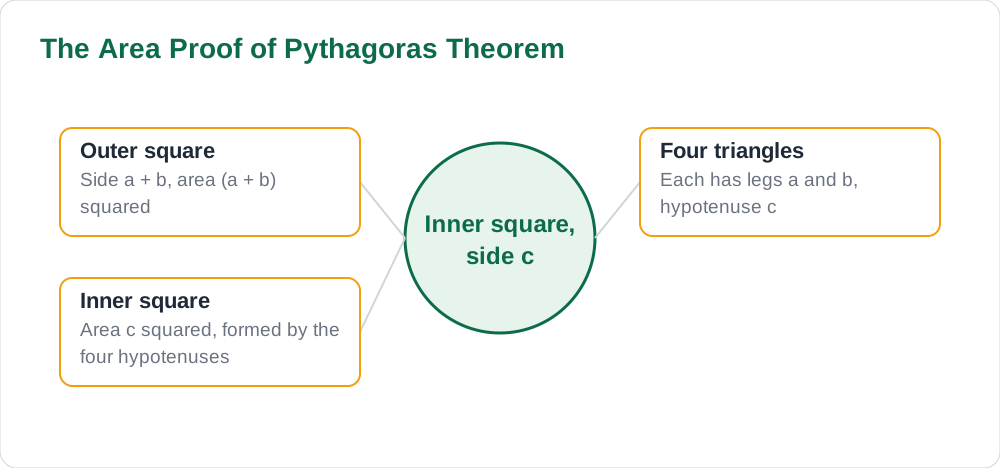
One of the clearest proofs uses area. Start with a large square whose side is (a + b). Inside it, place four identical copies of the right-angled triangle, one in each corner, so that their hypotenuses form a smaller square in the middle with side c. The area of the large square can be worked out in two ways. Directly, it is (a + b)², which expands to a² + 2ab + b². Indirectly, it is the area of the four triangles plus the area of the inner square, which is 4 times (ab divided by 2) plus c², giving 2ab + c². Setting the two expressions equal gives a² + 2ab + b² = 2ab + c², and cancelling 2ab from both sides leaves a² + b² = c².
This proof is worth learning because it shows why the theorem is true rather than asking you to memorise it blindly. When you retell it in an exam, draw the diagram first, label the sides a, b and c, and then write the two area calculations side by side so the examiner can follow your reasoning. A good habit is to state what you are proving at the start and to end with a clear conclusion sentence, such as therefore the square on the hypotenuse equals the sum of the squares on the other two sides. If you forget the algebra mid-proof, redraw the figure and recount the areas; the picture itself carries the argument, and the algebra only tidies it up.
The Converse: Testing Whether a Triangle Is Right-Angled
The converse of the theorem runs in the opposite direction. It says that if the sides of a triangle satisfy a² + b² = c², where c is the longest side, then the triangle must be right-angled, with the right angle opposite the longest side. This is extremely useful because it lets you test a triangle from its side lengths alone, without measuring any angle. Carpenters and builders use exactly this idea, often with a 3-4-5 rope, to check that a corner is square before building on it.
To apply the converse, always square the longest side on its own, then square the other two sides and add them. If the two results are equal, the triangle is right-angled. If they are not equal, it is not right-angled. For example, sides 6, 8 and 10 give 6² + 8² = 36 + 64 = 100 and 10² = 100, so the triangle is right-angled. Sides 4, 5 and 6 give 4² + 5² = 16 + 25 = 41, but 6² = 36, so that triangle is not right-angled. The most common error here is squaring the wrong side as c, so always identify the longest side first and write it down before you start calculating.
Worked Problems: Finding a Missing Side
There are two kinds of missing-side problem. In the first, the hypotenuse is missing. Suppose the legs are 9 cm and 12 cm. Then c² = 9² + 12² = 81 + 144 = 225, so c = 15 cm, taking the positive square root because a length cannot be negative. In the second kind, a leg is missing. Suppose the hypotenuse is 13 cm and one leg is 5 cm. Then the missing leg, call it b, satisfies b² = 13² − 5² = 169 − 25 = 144, so b = 12 cm. Notice the subtraction: when the hypotenuse is known, you subtract the known leg squared from the hypotenuse squared. Many students add here by habit, so write the formula with the unknown isolated before substituting numbers.
A second worked example uses decimals, which often appear in real measurements. A ladder 6.5 m long leans against a wall with its foot 2.5 m from the wall. The height it reaches is found from h² = 6.5² − 2.5² = 42.25 − 6.25 = 36, so h = 6 m. Always finish such problems with a sentence in words, and check that your answer is sensible: the height reached must be less than the ladder length, and the hypotenuse in any answer must be the longest side. If your answer fails either check, rework the arithmetic before moving on. More practice material is available through the study tips section of this site.
- Hypotenuse missing: add the squares of the two legs, then take the square root.
- Leg missing: subtract the known leg squared from the hypotenuse squared, then take the square root.
- Always give the answer with units, and check that the hypotenuse is the longest side.
Common Mistakes and How to Avoid Them
The single most damaging mistake is applying the theorem to a triangle that has no right angle. If the question does not state or mark a right angle, you cannot use Pythagoras, and you must look for another method. A second mistake is misidentifying the hypotenuse: students sometimes take the side drawn at the bottom of the diagram as c, but the hypotenuse is defined by position opposite the right angle, not by how the triangle is drawn. Rotate the page mentally if it helps, and mark the right angle clearly on your diagram before labelling any side.
A third mistake is arithmetic carelessness with squares and square roots. Squaring 12 gives 144, not 24, and the square root of 225 is 15, not 112.5. Write each squaring step on its own line so a slip is easy to spot. A fourth mistake is rounding too early: keep full values through the working and round only the final answer, as the question asks. Finally, never forget the units, and never leave a squared answer, such as c² = 225, as your final answer when the question asks for a length. Take the square root, and state the length plainly. For a refresher on how to organise your revision, see the about page for how this site is structured.
AI Help: Muse AI
Muse AI is Meta's personal AI assistant. It can help with this topic by walking you through a Pythagoras proof step by step, or by generating fresh right-triangle practice problems with worked solutions so you can test yourself before an exam.
Join Muse with invite code LTGSWD — in the Muse app, go to Settings > Redeem token and enter the code. Disclosure: LTGSWD is the author's Muse invite code. Muse AI does not give official STBB answers — always verify against your STBB book and your teacher. Always verify against your Sindh Textbook Board book and your teacher before using anything in classwork.
5 key points you must know
- In a right-angled triangle, a² + b² = c², where c is the hypotenuse.
- The area proof places four triangles inside a square of side a + b to show the result.
- The converse tests right angles: if the longest side squared equals the sum of the other two squares, the angle is 90 degrees.
- Hypotenuse missing means add the squares; a leg missing means subtract.
- Always check that the hypotenuse is the longest side and give answers with units.
Frequently asked questions
Can the Pythagoras theorem be used on any triangle?
No. It applies only to right-angled triangles. If there is no 90-degree angle, the relationship a² + b² = c² does not hold, and using it will give a wrong answer.
How do I know which side is the hypotenuse?
The hypotenuse is the side opposite the right angle. It is always the longest side of the triangle, regardless of how the triangle is drawn or rotated.
What is a Pythagorean triple?
A Pythagorean triple is a set of three whole numbers that satisfies the theorem exactly, such as 3, 4, 5 or 5, 12, 13. They are useful shortcuts, but you should still verify with the formula.
Why do I subtract when finding a leg?
Because the formula is a² + b² = c². If c and one leg are known, rearrange to get the unknown leg squared equals c² minus the known leg squared, then take the square root.
What if the answer is not a whole number?
That is normal. Leave the answer as a surd if your teacher asks for an exact value, or round to the number of decimal places the question requests, rounding only at the final step.
Solved notes — preview free
These guides work best with the solved exercises. Preview the solved notes free on this website — 119 solved notes for Classes 6–10 in Sindhi, Urdu, English and Arabic medium. Or browse the full solved notes catalogue for your class and medium. New solved notes are added regularly — check the catalogue for coming-soon books.