Class 9 Maths: Parallel Lines and Angle Rules
The class 9 maths parallel lines angles topic gives you a small set of rules that unlock a huge number of geometry problems. When a straight line called a transversal crosses two parallel lines, it creates eight angles, but those angles fall into just a few equal groups. Alternate angles are equal, corresponding angles are equal, and co-interior angles add to 180 degrees. This article explains each rule with a clear picture in words, shows the letter shapes that help you spot them, and works through problems where the rules combine with triangle facts. Master these rules and you will also find later topics easier, because parallel lines appear inside parallelograms, trapeziums and many circle diagrams. For more geometry support, visit the [solved notes collection](/solved.html) and the [books library](/books.html).
The Transversal Picture: Eight Angles, Few Values
Imagine two horizontal parallel lines crossed by a slanted transversal. At each crossing point there are four angles, making eight in total, but because the lines are parallel, those eight angles take only two distinct values: four acute angles that are all equal, and four obtuse angles that are all equal, with each acute angle plus each obtuse angle making 180 degrees. This is the key insight of the whole chapter. Once you find one angle, you can fill in the rest of the diagram by equality and by straight-line supplementary pairs, without measuring anything else.
It helps to label the diagram systematically. Number the angles at the upper crossing 1 to 4, and those at the lower crossing 5 to 8, in the same order. Then angle 1 equals angle 5, angle 2 equals angle 6, and so on, because they occupy corresponding positions. Writing the numbers down stops the common error of matching angles that merely look similar but sit in different positions. Always check your labelling against the diagram before calculating, because a mislabelled angle at the start corrupts every step that follows.
Corresponding Angles: The F Shape
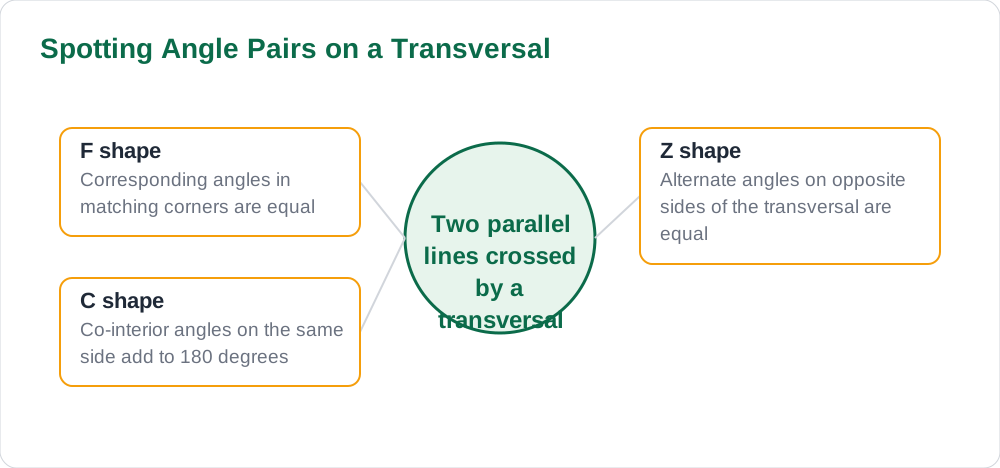
Corresponding angles occupy the same relative position at each crossing, such as both at the top right. They are equal when the lines are parallel, and the shape they form with the transversal looks like the letter F, which is a useful memory aid. For example, if the top-right angle at the upper crossing is 72 degrees, the top-right angle at the lower crossing is also 72 degrees. The F can face any direction, including upside down or backwards, so train yourself to look for the pattern of two angles in matching corners rather than for a literal upright F.
Corresponding angles also give a test for parallel lines. If a transversal crosses two lines and a pair of corresponding angles is equal, then the two lines are parallel. This converse direction appears in questions that ask you to prove lines parallel from given angle information. State the test explicitly, naming the pair of angles and the rule, rather than just asserting that the lines look parallel. In formal work, the reason is written as corresponding angles are equal, so the lines are parallel, and that single sentence carries the mark.
Alternate Angles: The Z Shape
Alternate angles lie on opposite sides of the transversal and between the two parallel lines, forming a Z shape. They are equal when the lines are parallel. For example, if the lower-left interior angle at the upper crossing is 65 degrees, the upper-right interior angle at the lower crossing is also 65 degrees. The Z may be stretched or flipped, but the defining feature never changes: the two angles are inside the parallel lines, on opposite sides of the transversal, and they are not adjacent to each other.
Alternate angles are particularly useful inside triangles and quadrilaterals, where a diagonal acts as a transversal across a pair of parallel sides. In a parallelogram, for instance, the diagonal creates alternate angles that prove opposite sides behave symmetrically. When solving a problem, mark each alternate pair as you find it, using small arcs or matching letters, so that you do not reuse the same angle twice or confuse an alternate pair with a corresponding pair. The two rules give equal angles, but they apply to different positions, and naming the wrong one can cost a reasoning mark even when the number is right.
Co-Interior Angles: The C Shape
Co-interior angles, also called consecutive interior angles, lie on the same side of the transversal and between the parallel lines, forming a C shape. Unlike the other two pairs, they are not equal; they are supplementary, meaning they add to 180 degrees. If one co-interior angle is 118 degrees, its partner is 62 degrees. This is the rule students most often get wrong, because after learning that parallel lines give equal angles, they apply equality everywhere. Pause whenever you see a C shape and remind yourself that this pair sums rather than matches.
A worked example combines all three rules. Suppose a transversal crosses parallel lines and one given angle is 50 degrees. Its vertically opposite angle is also 50 degrees, its corresponding angle at the other crossing is 50 degrees, and its alternate angle is 50 degrees. The angle next to it on a straight line is 130 degrees, and the co-interior partner of the original 50-degree angle is also 130 degrees. One given angle thus determines all eight, and a careful student can fill the entire diagram in under a minute. Practise this drill with different starting angles until it feels automatic.
- Corresponding angles are equal and form an F shape.
- Alternate angles are equal and form a Z shape.
- Co-interior angles add to 180 degrees and form a C shape.
Combining Angle Rules With Triangles
Real exam problems rarely ask for a single angle rule in isolation. A typical question gives a diagram with parallel lines and a triangle, and asks for an unknown angle that requires two or three steps. The routine is to work outwards from the given information: use a parallel-line rule to find an angle inside the triangle, then use the triangle angle sum to find the next angle, then perhaps use a straight line or vertically opposite angles to reach the target. Write each step with its reason, because the chain of reasons is what earns method marks even if the final number slips.
Consider an original example. Lines AB and CD are parallel, and a transversal meets them. The angle at the upper crossing on the inside is 74 degrees. Its alternate angle inside a triangle at the lower crossing is also 74 degrees. If another angle of that triangle is 52 degrees, the third angle is 180 minus 74 minus 52, which is 54 degrees. Notice how the parallel-line rule supplied the first angle and the triangle rule finished the job. When you practise, cover the solution and try to name the rule for each step before looking, because recognising which rule applies is the real skill being tested. More practice guidance is in the study tips section.
AI Help: Muse AI
Muse AI is Meta's personal AI assistant. It can help with this topic by generating parallel-line diagrams and asking you to find missing angles, then checking your reasons for each step.
Join Muse with invite code LTGSWD — in the Muse app, go to Settings > Redeem token and enter the code. Disclosure: LTGSWD is the author's Muse invite code. Muse AI does not give official STBB answers — always verify against your STBB book and your teacher. Always verify against your Sindh Textbook Board book and your teacher before using anything in classwork.
5 key points you must know
- A transversal across parallel lines creates eight angles with only two distinct values.
- Corresponding angles are equal and form an F shape.
- Alternate angles are equal and form a Z shape.
- Co-interior angles add to 180 degrees and form a C shape.
- Always write the reason for each angle you find, and combine rules step by step.
Frequently asked questions
What is a transversal?
A transversal is a straight line that crosses two or more other lines. The angle rules in this chapter describe what happens when it crosses two parallel lines.
Are alternate angles always equal?
Alternate angles are equal only when the two lines are parallel. If the lines are not parallel, the alternate angles will differ.
How do I remember which pair adds to 180 degrees?
Remember the C shape. Co-interior angles form a C, and C stands for the pair that combines, adding to 180 degrees, unlike the equal F and Z pairs.
What are vertically opposite angles?
When two lines cross, the angles opposite each other are vertically opposite and equal. This rule works whether or not any lines are parallel.
Can I use these rules to prove lines are parallel?
Yes. If a pair of corresponding angles is equal, or a pair of alternate angles is equal, or a pair of co-interior angles sums to 180 degrees, then the lines are parallel.
Solved notes — preview free
These guides work best with the solved exercises. Preview the solved notes free on this website — 119 solved notes for Classes 6–10 in Sindhi, Urdu, English and Arabic medium. Or browse the full solved notes catalogue for your class and medium. New solved notes are added regularly — check the catalogue for coming-soon books.