Class 9 Maths: Area of a Triangle by Heron's Formula

The class 9 maths heron area triangle topic solves a problem that the familiar base-times-height formula cannot: finding the area of a triangle when you know all three sides but no height. Heron formula, named after the ancient mathematician Hero of Alexandria, works from the semi-perimeter, which is half the perimeter of the triangle. If the sides are a, b and c, and the semi-perimeter is s, then the area is the square root of s times (s minus a) times (s minus b) times (s minus c). This article explains the formula step by step, works through original examples with full arithmetic, and shows when Heron formula is the right tool and when the simpler formula is better. For more Class 9 maths, visit the [solved notes collection](/solved.html) and the [books library](/books.html).
When Base Times Height Is Not Enough
The standard area formula, half times base times height, is simple and fast, but it needs a height, which is the perpendicular distance from a vertex to the opposite side. In many problems the height is not given and is hard to find without extra work. A triangular field, for example, might be surveyed by measuring its three boundary lengths, with no height measured at all. In such cases Heron formula is the right tool, because it uses only the three sides. Recognising which formula fits the given data is half the skill in this chapter, so always list what you know before choosing a method.
Heron formula also works for right-angled and isosceles triangles, but it is rarely the quickest choice there. For a right-angled triangle, half the product of the two legs is faster. For an equilateral triangle of side a, there is a special result, root 3 divided by 4 times a squared, which you can derive from Heron formula but should use directly once you know it. The rule of thumb is: if you know a base and its height, use half base times height; if you know three sides and no height, use Heron. If you know two sides and the included angle, there is a trigonometry formula, but that belongs to a later chapter.
The Semi-Perimeter Method Step by Step
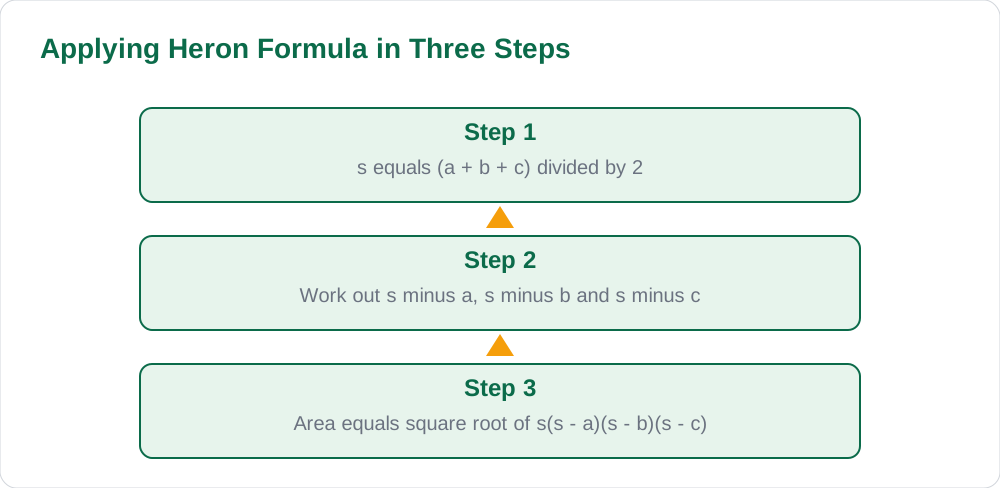
The method has three clear steps. First, add the three sides to get the perimeter, then halve it to get the semi-perimeter s. The formula for the semi-perimeter is s = (a + b + c) divided by 2. Second, compute the three differences s minus a, s minus b and s minus c. These are all positive, because each side is shorter than the sum of the other two in any real triangle, so s is larger than each individual side. Third, multiply s by the three differences and take the square root. The result is the area, in square units matching the units of the sides.
Work through the steps in order and write each one down, because the arithmetic is where marks are lost. A typical slip is forgetting to halve the perimeter, which makes every later number wrong. Another is mixing up the differences, for example computing s minus a twice and omitting s minus c. Labelling the sides a, b and c at the start and writing the three differences in a column prevents both errors. Keep the numbers exact through the multiplication, and round only the final area, to the precision the question asks for.
Worked Example: Sides 13, 14 and 15
Take a triangle with sides 13 cm, 14 cm and 15 cm. First, the perimeter is 13 + 14 + 15 = 42 cm, so the semi-perimeter is s = 42 divided by 2 = 21 cm. Next, the differences are s minus a = 21 − 13 = 8, s minus b = 21 − 14 = 7, and s minus c = 21 − 15 = 6. Then the area is the square root of 21 × 8 × 7 × 6. Multiplying gives 21 × 8 = 168, 7 × 6 = 42, and 168 × 42 = 7056. The square root of 7056 is 84, so the area is 84 square centimetres. Notice how the numbers factorised neatly, which is common in textbook-style examples but not guaranteed in real measurements.
It is worth checking this answer by an independent route. A triangle with sides 13, 14 and 15 can be split by an altitude into two right-angled triangles, and the height turns out to be 12 cm with a base of 14 cm, giving half times 14 times 12 = 84 square centimetres, which agrees. You will not always have such a check available, but when a second method is possible, use it for the final answer in an exam only if time permits; otherwise trust the Heron working, provided each step was written down and checked for arithmetic slips.
Worked Example: A Decimal and an Application
Heron formula also handles measurements that are not whole numbers. Consider a triangular plot with sides 8.5 m, 10.5 m and 12 m. The perimeter is 8.5 + 10.5 + 12 = 31 m, so s = 15.5 m. The differences are 15.5 − 8.5 = 7, 15.5 − 10.5 = 5, and 15.5 − 12 = 3.5. The area is the square root of 15.5 × 7 × 5 × 3.5, which is the square root of 1898.75, approximately 43.57 square metres. In a practical context, such as ordering turf or paint for the plot, you would round up to a sensible figure, but in an exam, give the answer to the precision requested, usually two decimal places.
A second application is finding the area of a quadrilateral by splitting it along a diagonal into two triangles and applying Heron formula to each, when the sides and the diagonal are known. This technique appears in problems about fields and floor plans, where the shape is irregular but measurable. The key step is choosing a diagonal that divides the quadrilateral into two triangles whose sides are all known. Add the two triangle areas for the total. Always draw the split and label the diagonal length on your diagram, because using the wrong diagonal, or forgetting to add both parts, are the two most common errors in such problems.
- Write s and the three differences in a column before multiplying.
- Keep full precision until the final answer, then round as asked.
- For a quadrilateral, split it by a diagonal and apply Heron to each triangle.
Common Mistakes and a Self-Check Routine
The most frequent mistake is using the full perimeter instead of the semi-perimeter, which roughly doubles the numbers inside the square root and gives a badly wrong area. The second is forgetting the square root at the end, leaving an answer in the wrong units and far too large. The third is a negative or zero difference, which signals that the given sides cannot form a triangle at all, because one side is at least as long as the other two combined; if you meet this in a problem, recheck the side lengths before continuing, since a negative value under a square root means something was copied wrongly.
Build a self-check routine: after finding s, confirm that s is larger than each side. After computing the product, estimate its size roughly to see whether the square root is plausible. Finally, check the units, which must be square units, and compare the answer with a rough estimate, such as half the product of the two shorter sides, which is an upper bound for the area. If your answer exceeds that bound, it is certainly wrong. These thirty seconds of checking save more marks than any amount of extra practice on new problems. More exam technique is available in the study tips section.
AI Help: Muse AI
Muse AI is Meta's personal AI assistant. It can help with this topic by working through a Heron formula example step by step, or by generating triangle side lengths for you to practise on with answers to check against.
Join Muse with invite code LTGSWD — in the Muse app, go to Settings > Redeem token and enter the code. Disclosure: LTGSWD is the author's Muse invite code. Muse AI does not give official STBB answers — always verify against your STBB book and your teacher. Always verify against your Sindh Textbook Board book and your teacher before using anything in classwork.
5 key points you must know
- Heron formula finds a triangle area from its three sides, with no height needed.
- The semi-perimeter is s = (a + b + c) divided by 2.
- Area = square root of s(s - a)(s - b)(s - c).
- If a base and height are known, half base times height is quicker.
- Always check that s exceeds each side, and give the answer in square units.
Frequently asked questions
Who was Heron, and why is the formula named after him?
Hero of Alexandria was an ancient Greek mathematician and engineer. The formula is attributed to him, though similar results were known earlier. It is usually spelled Heron formula in school textbooks.
Can Heron formula be used for a right-angled triangle?
Yes, it works for any triangle, but for a right-angled triangle half the product of the two legs is much faster, so use that instead when you can.
What if one of the differences is negative?
Then the three lengths cannot form a triangle, because one side is too long. Recheck the side lengths and your value of s, since a copying error is the usual cause.
What units does the answer have?
Square units matching the side units. Sides in centimetres give an area in square centimetres; sides in metres give square metres.
Is there a shortcut for an equilateral triangle?
Yes. For side a, the area is root 3 divided by 4 times a squared. You can derive it from Heron formula, but memorising the shortcut saves time.
Solved notes — preview free
These guides work best with the solved exercises. Preview the solved notes free on this website — 119 solved notes for Classes 6–10 in Sindhi, Urdu, English and Arabic medium. Or browse the full solved notes catalogue for your class and medium. New solved notes are added regularly — check the catalogue for coming-soon books.