Class 9 Maths: Coordinate Geometry Basics

The class 9 maths coordinate geometry basics topic turns geometry into arithmetic by giving every point an address made of two numbers. The coordinate plane is formed by a horizontal x-axis and a vertical y-axis crossing at the origin, and any point is described by an ordered pair (x, y), where x tells you how far to move horizontally and y tells you how far to move vertically. This article explains the four quadrants, how to plot and read points, how to find the distance between two points, and how to find a midpoint, with original worked examples and the sign errors that most often cost marks. Once coordinates feel natural, graphs, lines and shapes all become easier, because you can calculate instead of measuring. For more Class 9 maths, visit the [solved notes collection](/solved.html) and the [books library](/books.html).
The Coordinate Plane and the Four Quadrants
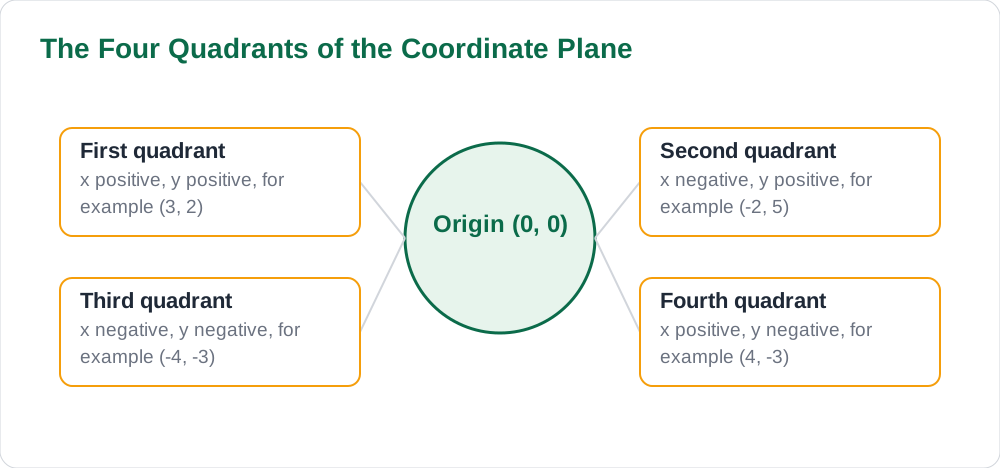
The plane is divided by the axes into four regions called quadrants, numbered counter-clockwise starting from the top right. In the first quadrant, both coordinates are positive. In the second, x is negative and y is positive. In the third, both are negative. In the fourth, x is positive and y is negative. Points on the axes themselves belong to no quadrant: a point on the x-axis has y equal to zero, and a point on the y-axis has x equal to zero. The origin is (0, 0), where the axes cross.
The order in an ordered pair matters enormously. The point (3, 2) is not the same as (2, 3): the first is three units right and two units up, while the second is two units right and three units up. A reliable habit is to read coordinates as along the corridor and up the stairs, meaning x first, then y. When plotting, move horizontally from the origin first, then vertically, and mark the point with a dot and its label. When reading a point from a graph, drop vertically to the x-axis to read x, and go horizontally to the y-axis to read y, rather than guessing from the grid.
Plotting Points and Reading Coordinates
To plot (4, −3), start at the origin, move four units to the right along the x-axis, then three units down, and mark the point in the fourth quadrant. To plot (−2, 5), move two units left and five units up, landing in the second quadrant. Negative coordinates reverse the direction: negative x means left, negative y means down. Students often plot the y movement first out of habit, which swaps the point, so say the movements aloud as you draw, for example right four, down three, until the order is automatic.
Reading points is the reverse skill. Given a marked point, count the horizontal distance from the y-axis, with left as negative, and the vertical distance from the x-axis, with down as negative. A point on the x-axis, such as (5, 0), has no vertical movement, and a point on the y-axis, such as (0, −4), has no horizontal movement. Practise with a set of ten mixed points, plotting half and reading half, and check each one against its coordinates. Speed matters less than accuracy here, because a single swapped coordinate ruins every later calculation that uses the point.
The Distance Formula
The distance between two points P(x1, y1) and Q(x2, y2) is the square root of (x2 − x1)² + (y2 − y1)². This is the Pythagoras theorem in disguise: the horizontal difference and the vertical difference are the legs of a right-angled triangle, and the distance is the hypotenuse. Writing the formula with the subtraction inside the squares is important, because squaring removes the sign, so it does not matter which point you call first, but the subtraction must be done before squaring, not after.
Work an example. The distance between A(1, 2) and B(4, 6) is found from the differences 4 − 1 = 3 and 6 − 2 = 4, giving the square root of 9 + 16, which is the square root of 25, which is 5 units. A second example with negatives: the distance between P(−1, 3) and Q(2, −1) uses differences 2 − (−1) = 3 and −1 − 3 = −4, giving the square root of 9 + 16 = 5 units again. Notice how subtracting a negative becomes addition, and how the negative difference still squares to a positive number. Writing the differences on separate lines before squaring prevents the most common sign errors.
The Midpoint Formula and Its Uses
The midpoint of two points is found by averaging the coordinates: the midpoint of P(x1, y1) and Q(x2, y2) is ((x1 + x2) divided by 2, (y1 + y2) divided by 2). For example, the midpoint of A(2, 3) and B(6, 7) is (4, 5), since (2 + 6) divided by 2 is 4 and (3 + 7) divided by 2 is 5. The midpoint formula is useful for finding the centre of a line segment, for checking whether diagonals of a quadrilateral bisect each other, and for locating the centre of a shape drawn on a grid.
A typical combined problem asks whether a quadrilateral is a parallelogram by checking that its diagonals share a midpoint. If quadrilateral ABCD has vertices A(1, 1), B(5, 1), C(6, 4) and D(2, 4), the midpoint of diagonal AC is (3.5, 2.5) and the midpoint of diagonal BD is also (3.5, 2.5). Since the diagonals bisect each other, ABCD is a parallelogram. This shows how coordinate geometry connects to the quadrilateral chapter: the same property, proved by averaging instead of by construction. Always show both midpoints explicitly, because the equality of the two results is the whole argument.
- Distance: square root of (x2 - x1) squared plus (y2 - y1) squared.
- Midpoint: average the x-coordinates and average the y-coordinates.
- Equal diagonal midpoints prove a parallelogram.
Common Sign Errors and How to Avoid Them
Sign errors dominate the mistakes in this chapter. The first is swapping x and y, which moves the point to a different quadrant or a mirror position. The second is mishandling subtraction of negatives in the distance formula, such as writing 2 − (−1) as 1 instead of 3. The third is forgetting to halve in the midpoint formula, or halving only one coordinate. The fourth is reading a point from a graph by counting grid squares from the wrong axis, which shifts the coordinate by the origin offset. Each of these is a small slip with a large consequence, because later steps inherit the wrong point.
Defend against them with a short routine. Write the coordinates of every point in brackets before calculating. Write the differences on their own lines, showing the subtraction explicitly. Check the quadrant of your answer against the signs: a point with a negative x and a positive y must be in the second quadrant, so if your plot lands elsewhere, recheck. Finally, estimate the distance roughly from the diagram before calculating, since a wildly different computed distance signals an error. These habits take seconds and protect the marks that the formula knowledge has already earned. More revision routines are in the study tips section and on the about page.
AI Help: Muse AI
Muse AI is Meta's personal AI assistant. It can help with this topic by generating coordinate pairs for plotting practice, or by checking your distance and midpoint calculations step by step.
Join Muse with invite code LTGSWD — in the Muse app, go to Settings > Redeem token and enter the code. Disclosure: LTGSWD is the author's Muse invite code. Muse AI does not give official STBB answers — always verify against your STBB book and your teacher. Always verify against your Sindh Textbook Board book and your teacher before using anything in classwork.
5 key points you must know
- A point is an ordered pair (x, y): x first, then y.
- Quadrant signs: first (+, +), second (−, +), third (−, −), fourth (+, −).
- Distance = square root of (x2 − x1)² + (y2 − y1)².
- Midpoint = average of the x-coordinates and average of the y-coordinates.
- Points on the axes have one coordinate zero and belong to no quadrant.
Frequently asked questions
Is (3, 2) the same point as (2, 3)?
No. The order matters: (3, 2) is three right and two up, while (2, 3) is two right and three up. They are different points.
Which quadrant is the point (-5, 0) in?
None. It lies on the x-axis, because its y-coordinate is zero. Points on either axis belong to no quadrant.
Does the order of points matter in the distance formula?
No. Because the differences are squared, swapping the points gives the same distance. What matters is subtracting before squaring.
How is the distance formula related to Pythagoras?
The horizontal and vertical differences form the legs of a right-angled triangle, and the distance between the points is its hypotenuse.
Can the midpoint formula prove a parallelogram?
Yes. If the two diagonals of a quadrilateral have the same midpoint, they bisect each other, which proves the quadrilateral is a parallelogram.
Solved notes — preview free
These guides work best with the solved exercises. Preview the solved notes free on this website — 119 solved notes for Classes 6–10 in Sindhi, Urdu, English and Arabic medium. Or browse the full solved notes catalogue for your class and medium. New solved notes are added regularly — check the catalogue for coming-soon books.