Class 9 Maths: Congruent Triangles and Conditions
The class 9 maths congruent triangles topic asks a simple question with a precise answer: when are two triangles exactly the same shape and size? Two triangles are congruent when every matching side and every matching angle is equal, so that one triangle could be placed exactly on top of the other. You do not need to check all six measurements, though. Four shortcut conditions, SSS, SAS, ASA and RHS, let you prove congruence from just three pieces of information. This article explains each condition, shows how to write a proper congruence proof, and warns against the famous trap condition that does not work. Worked examples use original triangles, and the diagrams show exactly how to label matching parts. For further Class 9 material, visit the [solved notes collection](/solved.html) and the [books library](/books.html).
What Congruence Means
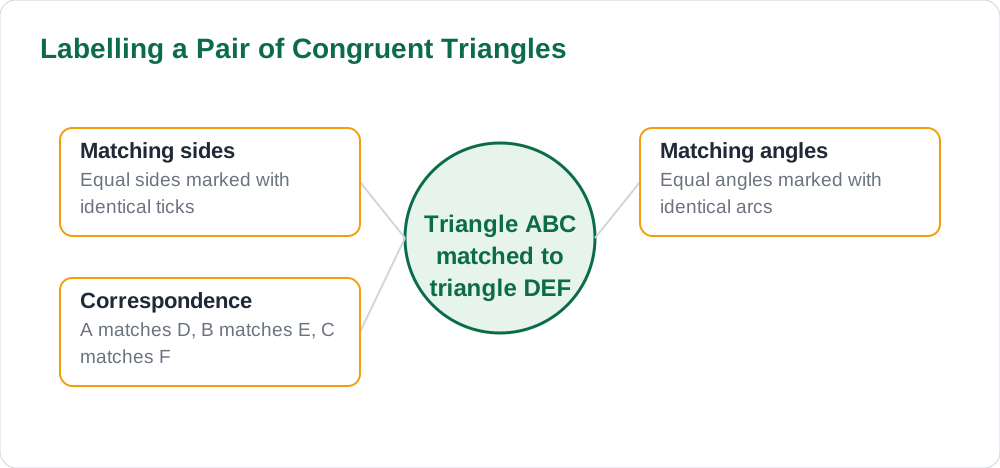
Congruent figures are identical in shape and size. Two congruent triangles have three pairs of equal sides and three pairs of equal angles, with the equal parts matching up in the same order around the triangle. The order matters: when you write triangle ABC is congruent to triangle DEF, you are claiming that A matches D, B matches E and C matches F. Getting the correspondence wrong is one of the most common errors in this chapter, so always list the matching vertices carefully before writing the congruence statement.
Congruence is different from similarity. Similar triangles have the same shape but may differ in size, while congruent triangles must match in size as well. In everyday language, two different-sized photographs of the same scene are similar, but two identical prints are congruent. In geometry problems, the symbol for congruence is an equals sign with a tilde above it, and you should use it in your statements rather than a plain equals sign, because it carries the extra meaning that the whole figures match, not just one measurement.
SSS, SAS and ASA: The Three Main Conditions
SSS stands for side-side-side: if the three sides of one triangle equal the three sides of another, the triangles are congruent. This works because three side lengths fix a triangle rigidly; try drawing a triangle with sides 5 cm, 6 cm and 7 cm in two different ways and you will always get the same shape, up to flipping it over. SAS stands for side-angle-side: two sides and the angle between them determine the triangle. The word between is crucial, because the angle must be the included angle, the one formed by the two sides you know. If the known angle is not between the known sides, SAS does not apply.
ASA stands for angle-side-angle: two angles and the side between them determine the triangle, since the third angle follows from the angle sum of a triangle. AAS, where the known side is not between the two angles, is equally valid for the same reason, and many textbooks accept it as a version of ASA. In a proof, list the three equalities, name the condition, and then state the congruence with the correct correspondence. For example, if AB equals DE, angle B equals angle E, and BC equals EF, then triangle ABC is congruent to triangle DEF by SAS. Writing the equalities in matching order makes the correspondence obvious and earns full marks.
RHS: The Right-Angled Triangle Condition
RHS is the special condition for right-angled triangles. It says that if the hypotenuse and one side of one right-angled triangle equal the hypotenuse and the corresponding side of another right-angled triangle, the triangles are congruent. The right angle itself is part of the condition, so you need the hypotenuse, one side, and the knowledge that both triangles are right-angled. RHS is really a consequence of the Pythagoras theorem, since knowing the hypotenuse and one leg fixes the other leg, reducing the situation to SSS.
A typical RHS problem gives two right-angled triangles sharing or mirroring a side. For example, in a rectangle, the diagonal divides it into two right-angled triangles that share the hypotenuse and have opposite sides of the rectangle equal, so the triangles are congruent by RHS. From that congruence you can then deduce further equal angles, which is often the real point of the question. Always state the right angles explicitly in your proof, because RHS is meaningless without them, and name the hypotenuse rather than just writing a side length.
The SSA Trap: Why It Does Not Prove Congruence
SSA, two sides and a non-included angle, is the famous condition that fails. Given two sides and an angle that is not between them, it is usually possible to draw two different triangles fitting the same measurements, one with an acute angle where the other has an obtuse angle. This is sometimes called the ambiguous case. Examiners love it, because students who memorise letter combinations without understanding will confidently write SSA and lose the mark. The rule is simple: if the angle is not between the two known sides, and the triangle is not right-angled with the known side as the hypotenuse, you do not have a congruence condition.
To avoid the trap, always draw a quick sketch and mark the known parts before choosing a condition. Ask yourself where the known angle sits relative to the known sides. If it is between them, SAS applies. If it is at one end of the known side together with another known angle, ASA applies. If you have three sides, SSS applies. If the triangle is right-angled and you know the hypotenuse and a side, RHS applies. If none of these descriptions fits, you probably need more information, and the triangles may not be provably congruent at all.
- SSA does not prove congruence, except in the RHS right-angled case.
- In SAS, the angle must be between the two known sides.
- Always sketch and mark known parts before naming a condition.
Writing a Full Congruence Proof
A strong proof has four parts. First, state what is given, quoting the diagram or question. Second, list the three equalities with a reason for each, such as given, common side, vertically opposite angles, or alternate angles. Third, name the condition and write the congruence statement with the correct correspondence. Fourth, if the question asks for a further result, deduce it from the congruence, using the phrase corresponding parts of congruent triangles are equal, often shortened to CPCT.
Consider an original example. In triangle ABC and triangle PQR, AB equals PQ, angle B equals angle Q, and BC equals QR. The equalities are two sides and the included angle, so triangle ABC is congruent to triangle PQR by SAS. It then follows that AC equals PR and angle A equals angle P. Practise writing proofs in this full form even when a question seems easy, because the habit protects you on harder questions where the equalities are hidden behind parallel lines or shared sides. For more worked geometry, see the study tips section and the about page.
AI Help: Muse AI
Muse AI is Meta's personal AI assistant. It can help with this topic by checking your congruence proofs step by step, or by generating triangle pairs and asking you to identify which condition, if any, proves them congruent.
Join Muse with invite code LTGSWD — in the Muse app, go to Settings > Redeem token and enter the code. Disclosure: LTGSWD is the author's Muse invite code. Muse AI does not give official STBB answers — always verify against your STBB book and your teacher. Always verify against your Sindh Textbook Board book and your teacher before using anything in classwork.
5 key points you must know
- Congruent triangles match in all sides and angles, with a correct vertex correspondence.
- SSS needs three equal sides; SAS needs two sides and the included angle.
- ASA needs two angles and the side between them; AAS is equally valid.
- RHS applies only to right-angled triangles, using the hypotenuse and one side.
- SSA does not prove congruence and is the classic trap in this chapter.
Frequently asked questions
What is the difference between congruent and similar triangles?
Congruent triangles are identical in shape and size, while similar triangles have the same shape but may be different sizes. Congruence is a stronger condition.
Why must the angle in SAS be the included angle?
Because two sides and a non-included angle can produce two different triangles. Only when the angle sits between the two sides is the triangle fixed.
Is AAS a valid congruence condition?
Yes. If two angles and a non-included side are equal, the third angle must also be equal by the angle sum of a triangle, so the situation reduces to ASA.
What does CPCT mean?
Corresponding parts of congruent triangles are equal. Once you have proved two triangles congruent, any matching side or angle is equal, and you can use that in the next step.
Can two triangles be congruent if only their angles match?
No. Equal angles alone give similarity, not congruence. You need at least one side to fix the size.
Solved notes — preview free
These guides work best with the solved exercises. Preview the solved notes free on this website — 119 solved notes for Classes 6–10 in Sindhi, Urdu, English and Arabic medium. Or browse the full solved notes catalogue for your class and medium. New solved notes are added regularly — check the catalogue for coming-soon books.