Class 9 Maths: Circle Theorems Simplified

The class 9 maths circle theorems topic looks intimidating because a circle diagram can carry many lines at once, but the whole chapter rests on a handful of rules that you can learn one at a time. Once you know that the angle at the centre is twice the angle at the circumference, that angles in the same segment are equal, and that opposite angles of a cyclic quadrilateral add to 180 degrees, most circle problems become a short chain of small steps. This article explains each theorem in plain language, shows how to spot it in a diagram, and works through original examples. It also teaches a reliable problem-solving routine: label everything you know, look for the theorem that fits, and write a reason for every angle you find. For more Class 9 maths support, browse the [solved notes collection](/solved.html) and the [books library](/books.html).
The Language of a Circle Diagram
Before the theorems make sense, the vocabulary must be automatic. The centre is the fixed point inside the circle, the radius is the distance from the centre to any point on the circle, and a chord is a line joining two points on the circle. An arc is a part of the circumference, and a segment is the region cut off by a chord. The angle subtended by an arc means the angle formed at a point by lines drawn to the two ends of the arc. When two angles stand on the same chord or the same arc, they are related, and almost every circle theorem is a statement about such a pair.
A tangent is a line that touches the circle at exactly one point, and the radius drawn to that point of contact is perpendicular to the tangent. That single fact unlocks many problems, because it creates a right angle you can use with other geometry. A cyclic quadrilateral is a four-sided figure whose four vertices all lie on the circle. Keep a mental picture of each term, and when a new diagram appears, spend thirty seconds naming every part before you calculate anything. Students who skip this step often apply the right theorem to the wrong angle, and the whole solution drifts off course.
Angle at the Centre Is Twice the Angle at the Circumference
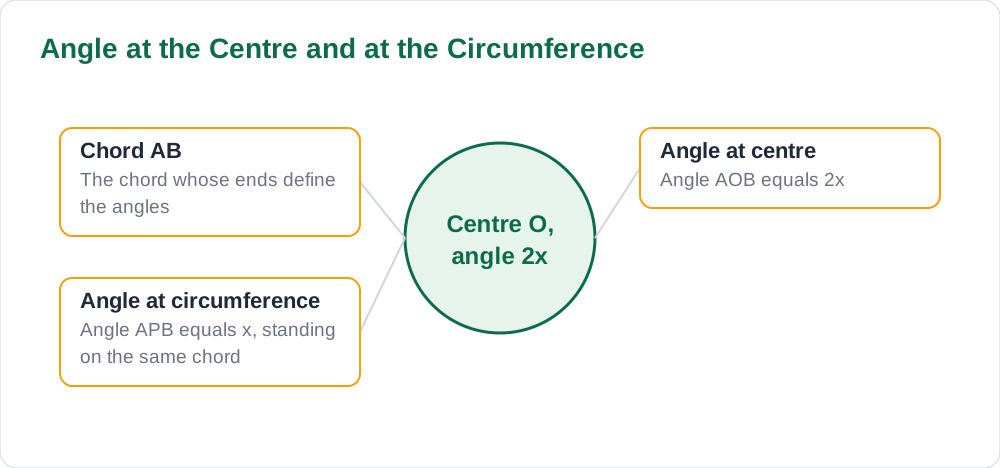
This is the most important circle theorem. If an arc subtends an angle at the centre and also subtends an angle at any point on the circumference, the centre angle is twice the circumference angle. In symbols, if the angle at the centre is 2x, the angle at the circumference standing on the same arc is x. The rule works on the major arc as well as the minor arc, but you must be careful about which angle you are doubling: the two angles must stand on the same chord or arc, and the circumference angle must be on the opposite arc from the centre angle you are considering.
A classic special case is the angle in a semicircle. A diameter subtends an angle of 180 degrees at the centre, so the angle at the circumference in a semicircle is half of that, which is 90 degrees. Any triangle drawn inside a semicircle with the diameter as one side is therefore right-angled, and this is a favourite exam question because it combines circle theorems with the Pythagoras theorem. Whenever you see a diameter in a circle diagram, immediately mark the right angle in the semicircle, even before reading the rest of the question, because it is almost certainly needed.
Angles in the Same Segment Are Equal
If two angles stand on the same chord and lie in the same segment, they are equal. This is really a consequence of the centre-angle theorem, since both angles are half of the same centre angle, but it is far quicker to use directly. In a diagram, look for two angles that open onto the same chord from the same side of the chord. They may be drawn in very different positions and sizes, which is why students miss them, so trace each angle back to the chord it stands on rather than judging by appearance.
Consider a worked example. Points A, B, C and D lie on a circle, and angle ACB is 38 degrees. Angle ADB stands on the same chord AB and lies in the same segment as angle ACB, so angle ADB is also 38 degrees, with no further calculation needed. A longer problem might then use that angle inside a triangle, combining it with the angle sum of a triangle to find a third angle. The skill is chaining: each theorem gives you one new angle, and that angle becomes the input for the next step. Write each step on its own line with its reason, so the chain is visible to the examiner.
Cyclic Quadrilaterals: Opposite Angles Sum to 180 Degrees
A quadrilateral inscribed in a circle is called cyclic, and its opposite angles are supplementary, meaning they add up to 180 degrees. This follows from the centre-angle theorem applied twice, once to each pair of opposite arcs. In practice, if you know one angle of a cyclic quadrilateral, you immediately know its opposite angle by subtracting from 180. For example, if angle ABC is 110 degrees, the opposite angle ADC is 70 degrees. This rule is often combined with the exterior angle rule: the exterior angle of a cyclic quadrilateral equals the interior opposite angle, which is a handy shortcut when the diagram extends a side beyond the circle.
To prove a quadrilateral is cyclic in the first place, you show that a pair of opposite angles sums to 180 degrees, or that two angles subtend equal angles on the same chord. Exam questions sometimes ask this in reverse: given some angle information, decide whether four points lie on a circle. Work methodically by testing the condition, and state your conclusion with its reason. A common trap is assuming a quadrilateral is cyclic just because it is drawn inside a circle in the diagram; only the vertices lying exactly on the circumference make it cyclic, so check the diagram markings rather than the general impression.
- Opposite angles of a cyclic quadrilateral add to 180 degrees.
- An exterior angle of a cyclic quadrilateral equals the interior opposite angle.
- To prove points are concyclic, show opposite angles sum to 180 degrees.
A Reliable Routine for Circle Problems
Start every circle problem by marking the centre, any radii, any diameters and any tangents, and writing down every angle you are given. Then scan for the theorems in a fixed order: first the centre-angle rule, then angles in the same segment, then cyclic quadrilateral rules, then tangent-radius right angles. Working in a fixed order stops you from hunting randomly and missing the obvious step. After each angle you find, write the angle and its reason, such as angle at centre twice angle at circumference, so that even a small arithmetic slip does not cost all the method marks.
Next, use ordinary triangle and straight-line facts to fill the remaining gaps: angles on a straight line add to 180 degrees, angles in a triangle add to 180 degrees, and base angles of an isosceles triangle are equal, which matters because any triangle formed by two radii is isosceles. Finally, re-read the question to check you answered what was asked, not just the first angle you found. Many questions ask for a second angle that follows from the first, and students lose the final mark by stopping early. Keep a checklist of these steps beside you while you practise, and it will soon become automatic. More revision guidance is available in the study tips section.
AI Help: Muse AI
Muse AI is Meta's personal AI assistant. It can help with this topic by explaining a circle theorem in simple words, or by quizzing you with angle-chasing problems and checking each step of your reasoning.
Join Muse with invite code LTGSWD — in the Muse app, go to Settings > Redeem token and enter the code. Disclosure: LTGSWD is the author's Muse invite code. Muse AI does not give official STBB answers — always verify against your STBB book and your teacher. Always verify against your Sindh Textbook Board book and your teacher before using anything in classwork.
5 key points you must know
- The angle at the centre is twice the angle at the circumference on the same arc.
- An angle in a semicircle is always 90 degrees.
- Angles in the same segment, standing on the same chord, are equal.
- Opposite angles of a cyclic quadrilateral sum to 180 degrees.
- A tangent is perpendicular to the radius at the point of contact.
Frequently asked questions
What does subtended mean in circle theorems?
An angle is subtended by an arc or chord when its two arms pass through the ends of that arc or chord. The angle is said to stand on the arc or chord.
Why is the angle in a semicircle 90 degrees?
A diameter subtends 180 degrees at the centre, and the angle at the circumference is half the angle at the centre on the same arc, so it is 90 degrees.
How do I spot angles in the same segment?
Find the chord both angles stand on, and check that both angles lie on the same side of that chord. If they do, the angles are equal.
What is a cyclic quadrilateral?
A quadrilateral whose four vertices all lie on the circumference of a circle. Its opposite angles add to 180 degrees.
Do I need to give reasons for each angle?
Yes. In geometry questions, method marks depend on reasons. Write the theorem name beside each angle you find, such as angle at centre twice angle at circumference.
Solved notes — preview free
These guides work best with the solved exercises. Preview the solved notes free on this website — 119 solved notes for Classes 6–10 in Sindhi, Urdu, English and Arabic medium. Or browse the full solved notes catalogue for your class and medium. New solved notes are added regularly — check the catalogue for coming-soon books.