Liaquat Ali Khan: Pakistan's First Prime Minister

Liaquat Ali Khan was Pakistan's first Prime Minister and one of Quaid-e-Azam's closest companions. He took office when Pakistan was a new nation facing enormous problems: millions of refugees, almost no administrative machinery, shortage of funds, and the division of assets with India. His job was not glamorous. It was practical, tiring, and full of difficult decisions. For students, his life teaches how a leader manages a crisis, builds institutions, and keeps a new country united. He is remembered for the Objectives Resolution, for his foreign policy work, and for his sacrifice in the service of Pakistan.
Early Life and Partnership with Quaid-e-Azam
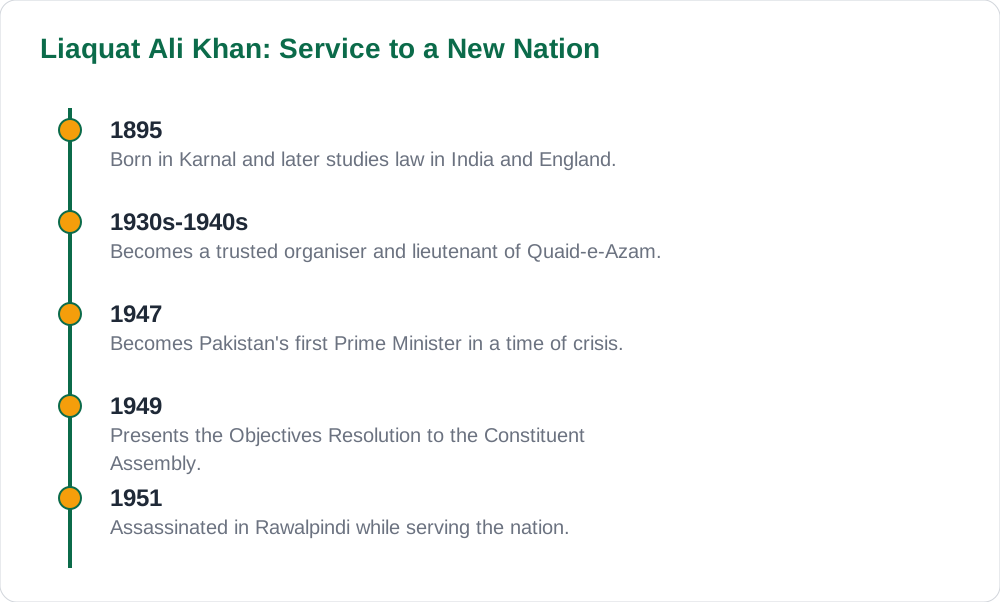
Liaquat Ali Khan was born in 1895 in Karnal, in present-day India, into a respected family. He studied law in India and in England, and he joined the Muslim League, where he soon became a trusted lieutenant of Quaid-e-Azam. He was known for organisation, hard work, and loyalty. While Jinnah gave the movement its vision and legal direction, Liaquat managed much of its day-to-day organisation. Students should notice this partnership. Great work is rarely done alone. It needs a visionary and an organiser, a speaker and a worker, a planner and a team.
His early career teaches the value of being reliable. Liaquat was not famous for loud speeches alone. He was famous for doing the work assigned to him, on time and properly. In school, the reliable student is the one teachers trust with class duties, group leadership, and event organisation. Reliability is built by small habits: submitting work on time, keeping promises to group members, and preparing before meetings. A student who is reliable becomes useful to every team.
The Impossible First Years of Pakistan
When Pakistan was created in 1947, it faced problems that would test any government. Refugees arrived in huge numbers, needing food, shelter, and medical care. Government offices had to be built from almost nothing. Records, funds, and equipment were divided in a difficult and often unfair process. Liaquat Ali Khan, as Prime Minister, had to manage these crises while keeping the country stable. He worked long hours, travelled to meet people, and tried to build trust between provinces and communities.
Students can learn crisis management from this period. When many problems arrive at once, panic does not help. The right method is to list problems, solve the most urgent first, and ask for help where needed. A student facing many pending assignments can use the same method: make a list, start with the nearest deadline, finish one task completely, and then move to the next. Leaders do not solve everything in one day. They solve one problem at a time, steadily, until the situation improves. Find study help on the solved notes page.
The Objectives Resolution of 1949
In March 1949, Liaquat Ali Khan presented the Objectives Resolution in the Constituent Assembly. This document set out the guiding principles for Pakistan's future constitution. It stated that sovereignty belongs to Almighty Allah, that the state would exercise authority through the chosen representatives of the people, and that principles of democracy, freedom, equality, tolerance, and social justice would be observed. It also promised fundamental rights, including freedom of religion, and protection for minorities.
For students, the Objectives Resolution is important because it explains the values Pakistan was meant to stand for. It was not only a political document. It was a promise about how citizens would be treated. Students can connect it to school life: a good school also runs on principles, such as fairness, respect for all students, freedom to ask questions, and protection for weaker students. When you learn the Objectives Resolution, do not only memorise its date. Understand its ideas: democracy, justice, equality, and respect for every citizen. See class books on the books page.
- Sovereignty belongs to Almighty Allah, exercised through elected representatives.
- Democracy, freedom, equality, tolerance, and social justice were set as guiding principles.
- Fundamental rights and protection for minorities were promised in the resolution.
Foreign Policy and the Image of Pakistan
Liaquat Ali Khan also shaped Pakistan's early foreign policy. He visited the United States in 1950, where he presented Pakistan as a new, independent, and friendly nation. He wanted Pakistan to be respected in the world, to build trade and friendship, and to keep its independence in foreign affairs. He also spoke for the rights of Muslims in other parts of the world and for peaceful settlement of disputes. His tours and speeches gave the young nation confidence on the world stage.
The lesson for students is about presentation and dignity. How you present yourself matters. A neat notebook, polite speech, honest answers, and respectful behaviour create a good impression, just as a nation's diplomacy creates its image. Students who represent their school in competitions, debates, or sports should remember that they carry the name of their class and school. Good manners, fair play, and honest effort are the best ambassadors for any student.
Assassination and Legacy
Liaquat Ali Khan was assassinated in Rawalpindi in October 1951 while addressing a public meeting. His death was a great loss for Pakistan, because the country lost an experienced leader at a very early stage. He is remembered as Shaheed-e-Millat, the Martyr of the Nation. His life ended in service, in front of the people he served. Students should remember him not only for his tragic death but for his years of steady work: organisation, constitution-building, and crisis management.
His legacy teaches that leadership is service, not privilege. A prime minister, a class monitor, or a team captain all hold a position of trust. The position is valuable only when it is used to serve others fairly. A student leader who uses power to favour friends or punish rivals fails that test. A student leader who listens, works hard, and treats everyone fairly passes it. Liaquat's life shows that true honour comes from service, sacrifice, and keeping the nation's interest above personal gain. More subject guides are on the blog home.
AI Help: Muse AI
Muse AI is Meta's personal AI assistant. It can explain history in simple words, summarise a lesson, and make practice questions for revision. For this article, you can ask Muse AI to explain the Objectives Resolution in five simple points for students. Join Muse with invite code LTGSWD — in the Muse app, go to Settings > Redeem token and enter the code. Disclosure: LTGSWD is the author's Muse invite code. Muse AI does not give official Sindh Textbook Board answers — always verify against your Sindh Textbook Board book and your teacher.
4 key points you must know
- Liaquat Ali Khan was Pakistan's first Prime Minister and a close companion of Quaid-e-Azam.
- He managed refugee, administrative, and financial crises in the first years of Pakistan.
- The Objectives Resolution of 1949 set guiding principles for the constitution.
- Leadership is service, not privilege, and reliability builds trust.
Frequently asked questions
Who was Pakistan's first Prime Minister?
Liaquat Ali Khan was Pakistan's first Prime Minister, taking office in 1947 after independence under the leadership of Quaid-e-Azam.
What was the Objectives Resolution?
Presented in March 1949, it set out guiding principles for Pakistan's constitution, including democracy, freedom, equality, tolerance, social justice, and fundamental rights.
Why is Liaquat Ali Khan called Shaheed-e-Millat?
He is called Martyr of the Nation because he was assassinated in Rawalpindi in 1951 while addressing a public meeting in the service of Pakistan.
What can students learn from his leadership?
Be reliable, solve problems one at a time in a crisis, respect principles and rights, and use any position of trust to serve others fairly.
Solved notes — preview free
These guides work best with the solved exercises. Preview the solved notes free on this website — 119 solved notes for Classes 6–10 in Sindhi, Urdu, English and Arabic medium. Or browse the full solved notes catalogue for your class and medium. New solved notes are added regularly — check the catalogue for coming-soon books.