Karachi Boards Result Season 2026: The Big Lessons for Class 10 and 12 Students
With the BIEK HSC Part-I results completed on 26 October 2026 and the BSEK Class 9 Science Group result announced on 28 October 2026, Karachi's 2026 result season is now complete, and it is worth stepping back to ask what the whole season actually taught us. The two results share a defining feature — the new 40% grading rule — and they share a pattern: full-pass rates below the levels of previous years, large partial-pass groups, and a great deal of public confusion about what the numbers mean. This wrap-up draws the lessons together for the students who matter most now: those moving into Class 10 and those moving into Part-II. It makes no new claims and invents no new figures; every number here comes from the two announcements themselves.
The Season in One Paragraph
BIEK announced its HSC Part-I results in two stages: Pre-Engineering on 2 October 2026, with 15,044 registered, 14,683 appeared, and 6,310 passing all six papers, followed by all remaining groups on 26 October 2026 under Press Release No. BIEK/PR/152/2026. The 26 October groups ranged from Pre-Medical, with 11,966 of 24,544 appeared students passing all six papers (48.75%), and Science General at 49.48%, down through Commerce, Arts, and Home Economics at 29.07%. Two days later, BSEK announced the Class 9 Science Group result, with 180,054 registered, 177,923 appeared, 123,757 passing all papers, 53,849 failed, and an overall pass percentage of 69.56%, down from 78.26% in 2025. Together, the two announcements cover hundreds of thousands of Karachi students, and together they tell one story above all others.
That story is the new grading rule. Class 9 from the 2026 annual examinations, and the intermediate examinations under the same system, now require 40% in a paper to pass, raised from 33%, and anything below 40% is recorded as ungraded. The rule was decided by the Inter Board Coordination Commission together with the Sindh Universities and Boards Department, and Class 10 follows from 2027. Every other lesson of the season flows from this single change, because it redefines what a pass is, what a partial pass means, and how students should study. Students who understand the rule understand the season; students who still think in terms of 33% will keep misreading their own results.
Lesson One: The Bar Moved, So Study Must Move Too
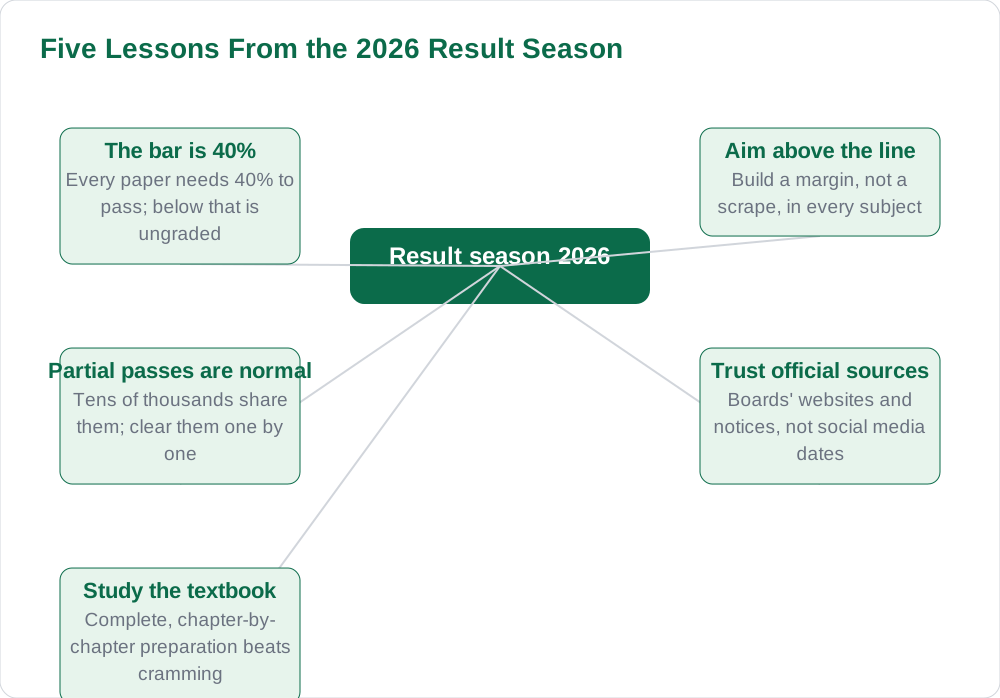
The most practical lesson of the season is also the simplest: aiming at the pass line no longer works, because the line is higher and the margin for error is thinner. Under the old 33% rule, a student could pass a paper with patchy preparation; under the 40% rule, the same preparation leaves the paper ungraded. The students who fared best this season were not necessarily the most talented but the most consistent — those who revised every chapter, practised full answers under time, and tested themselves regularly enough to find weak spots early. For Class 10 and Part-II students, the implication is direct: build a study routine that leaves a comfortable margin above 40% in every subject, and treat any subject where you hover near the line as an urgent priority, not a safe pass.
This lesson also reframes what a good study method looks like. Rote memorisation of a few expected questions is a fragile strategy under a higher threshold, because it collapses when the paper asks something unexpected. Textbook-first study, by contrast, covers the whole syllabus and survives surprises. Students moving into Class 10 should work through their Sindh Textbook Board books chapter by chapter, use solved exercises to check understanding, and take timed practice tests that mimic examination conditions. The book collection and the solved notes exist for exactly this kind of steady, complete preparation, and the students who use them systematically will be the ones who clear 40% with room to spare.
Lesson Two: Partial Passes Are Normal — and Manageable
The second lesson is about the large middle of both results. BSEK's breakdown shows 21,999 students passing six papers, 11,006 passing five, 7,431 passing four, and thousands more in the lower bands, while BIEK's group figures imply similarly large numbers of students with some papers open, since no group's full-pass rate reached half of appeared students. A partial pass is therefore not an exceptional disaster; it is the normal outcome for a large share of the cohort under the new rule, and it should be treated as a defined task — clear a known list of papers — rather than as a verdict on a student's ability. Schools and families can help enormously by saying this plainly, because shame is the main reason partial-pass students hide their open papers instead of working on them.
Manageability has a practical side too. A student with one or two open papers can clear them while keeping up with the next class, provided the revision is regular and targeted at the chapters where marks were lost. A student with more open papers needs a sequenced plan, starting with the paper closest to 40%, and honest conversations with teachers about priorities. In both cases, the next step is the same: watch the board's official website — bsek.edu.pk or biek.edu.pk — for the reappearance notice, keep all documents safe, and revise in the meantime rather than waiting passively. The blog carries step-by-step guides for students clearing individual papers.
Lesson Three: Read Numbers Carefully
The third lesson is about information itself. This season produced a flood of confident claims — subject-wise failure rates, reasons for the BSEK pass rate falling from 78.26% to 69.56%, and lists of toppers — most of which the boards never published. The board has published no single official reason for the BSEK fall, no subject-wise breakdown for either result in the reporting used here, and no position-holder or topper names for the BIEK or BSEK 2026 results. Students who learned to ask for a source before believing a claim were protected from all of this; students who forwarded every dramatic post were not. The habit of checking whether a claim names the board's release or a named official is a study skill in its own right, and it will matter even more in future seasons.
The same discipline applies to the Hyderabad inquiry, the season's other major story. A three-member committee formed on 23 October 2026 is examining allegations about BISE Hyderabad's Class XII 2026 pre-medical and pre-engineering results, with a report due within 30 days, and the announced results have not been cancelled. The allegations remain allegations, no student has been named as a beneficiary of manipulation, and the responsible response is to wait for the official report rather than to repeat rumours. Karachi's students have now seen, in one season, both how results work and how result stories can mislead; carrying that scepticism forward is itself one of the season's most valuable lessons.
Lesson Four: The Next Year Starts Now
The final lesson is about timing. Class 10 students will sit their examinations under the 40% rule from 2027, and Part-II students face the same standard, so the preparation that matters is the preparation that starts now, not the preparation that starts a month before the examinations. November is the right month to set the pattern: a weekly timetable that covers every subject, short regular tests, textbook-first revision, and a standing habit of checking official board websites for notices. Students with open papers from this season should fold those papers into the same timetable, giving the closest-to-passing paper the first slot, so that the new year and the old papers move forward together rather than competing.
There is also a wider reason for optimism. The Sindh Textbook Board's 2026-27 textbook series, with 195 titles and 52 million sets distributed from 19 February 2026, means the books students need are available, and the promised revised curriculum from the next academic year aims to reduce excessive book burden while emphasising research, scientific thinking, and creativity. No new STBB announcement was verified on 29 October 2026, so the curriculum change remains a next-year development to watch, but the direction is towards study that rewards understanding over memorisation — exactly the kind of study the 40% rule demands. Students who build that habit now, in Class 10 and Part-II, will be ready for whatever the next result season brings. The [home page](/) gathers the site's guides for the year ahead.
AI Help: Muse AI
Muse AI is Meta's personal AI assistant. You can ask it to explain a concept in simple words, summarise a lesson, or make practice questions for revision.
As you start Class 10 or Part-II, you can ask Muse AI to help you plan a steady weekly study routine or to explain a difficult concept in simple words, then check everything against your textbook and your teacher.
Join Muse with invite code LTGSWD — in the Muse app, go to Settings > Redeem token and enter the code.
Disclosure: LTGSWD is the author's Muse invite code.
Muse AI does not give official STBB answers — always verify against your Sindh Textbook Board book and your teacher.
5 key points you must know
- Karachi's 2026 result season is complete: BIEK Part-I (26 October) and BSEK Class 9 Science (28 October).
- The defining change is the 40% pass threshold, up from 33%; below 40% is ungraded.
- Partial passes are common and manageable: clear open papers one by one, starting with the smallest gap.
- No official reason for the BSEK rate fall and no topper names were published — distrust unsourced claims.
- Class 10 follows the 40% rule from 2027, so build the margin habit now.
Frequently asked questions
Which Karachi results completed the 2026 season?
BIEK completed HSC Part-I on 26 October 2026, following Pre-Engineering on 2 October, and BSEK announced the Class 9 Science Group result on 28 October 2026. Together these complete Karachi's main 2026 result season.
What is the single biggest lesson of the season?
The pass threshold is now 40%, not 33%. Students must aim comfortably above 40% in every paper, because a mark below 40% is recorded as ungraded and the paper must be reappeared in.
Why did the BSEK pass rate fall to 69.56%?
The board has published no single official reason for the fall from 78.26% in 2025. The threshold change mechanically moves some students from full pass to partial pass, but the board has not attributed the whole fall to it.
Are partial passes something to be ashamed of?
No. Tens of thousands of students hold partial passes this year under the new rule. A partial pass is a defined list of papers to clear, not a verdict on ability, and teachers deal with it every year.
What should Class 10 students do differently now?
Study textbook-first, chapter by chapter, test yourself weekly, and build a margin above 40% in every subject, since Class 10 comes under the new grading scheme from 2027.
Solved notes — preview free
These guides work best with the solved exercises. Preview the solved notes free on this website — 119 solved notes for Classes 6–10 in Sindhi, Urdu, English and Arabic medium. Or browse the full solved notes catalogue for your class and medium. New solved notes are added regularly — check the catalogue for coming-soon books.