Important Questions: Class 9 Physics (Chapter-wise)
Important questions class 9 physics revision works best when you study by chapter weight instead of reading the whole book in order. Every year, teachers and examiners return to the same core ideas: definitions that must be stated exactly, numericals that test one formula at a time, and diagrams that show you understand a process rather than memorised words. This guide walks through the chapters of Class 9 Physics in the order of revision priority, explains the question types each chapter produces, and shows how to prepare them without guessing. It is a general revision guide, not a leaked paper and not a claim that any particular question will appear. Use it alongside your own textbook, your class notes, and the [solved notes](/solved.html) on this site, and check each concept against your [STBB books](/books.html) before you write it in an exam.
How to Use This Revision Guide
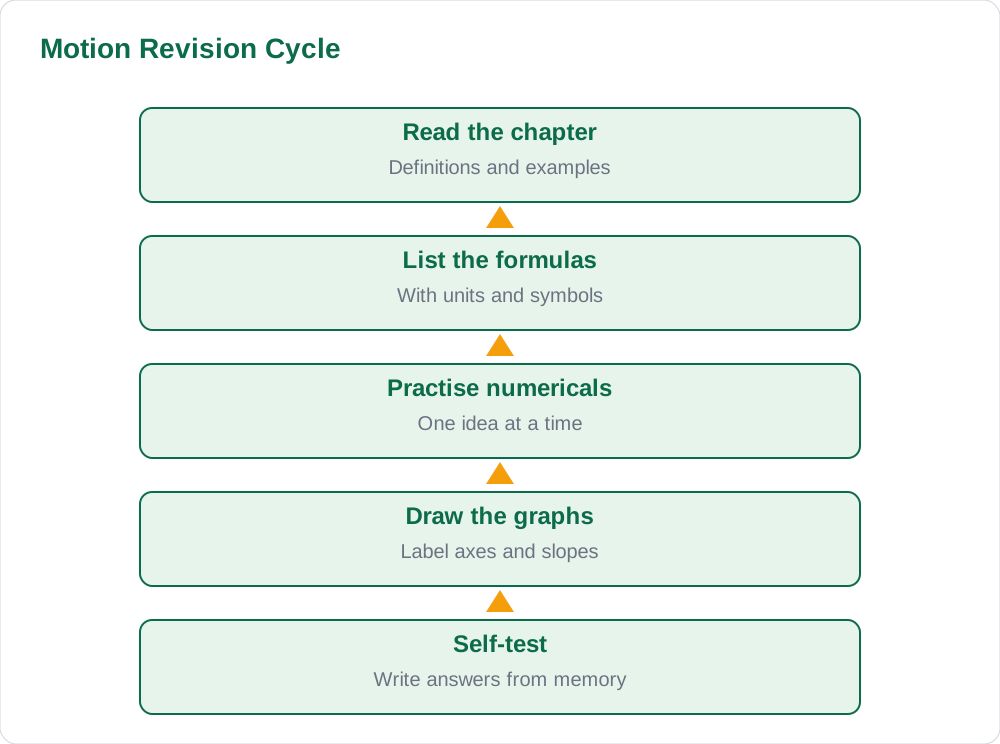
Start by dividing your remaining study time into three parts: definitions and short questions, numericals, and diagrams with reasoning questions. Definitions and short questions usually come from every chapter, so they are the safest marks in the paper, while numericals reward students who practise the same formula in three or four different forms. Diagrams appear less often but carry strong marks because they test understanding at a glance, and a labelled diagram with a short explanation often earns full credit even when the written answer is brief. Work through this guide chapter by chapter, writing each definition in your own words first and then checking it against the book, because a definition you can reproduce from memory is one you actually own.
For every chapter, keep a one-page summary sheet with the formulas, the SI units, and the two or three questions your teacher repeated most in class. Teachers commonly emphasise the questions they asked in class tests and homework, so your own notebook is a better predictor of emphasis than any outside list. When you practise numericals, always write the formula, substitute values with units, and give the answer with its unit, since examiners deduct marks for missing steps even when the final number is right. Visit the blog for more study guides, and revise one chapter fully before moving to the next instead of skimming all chapters at once.
- Make a formula sheet for each chapter and revise it daily in the last two weeks.
- Practise every numerical with formula, substitution, unit and final answer shown.
- Write definitions from memory first, then correct them against the textbook.
Motion, Measurement and Kinematics
The opening chapters on measurement and motion are high-weight because they set up the language of the whole subject: physical quantities, units, speed, velocity, acceleration, and graphical representation of motion. Expect short questions on the difference between scalar and vector quantities, between speed and velocity, and between distance and displacement, since these pairs are easy to confuse and therefore easy to examine. Graphical questions are also common: reading a distance-time graph or a velocity-time graph, finding slope and area, and explaining what each tells you about the motion. Practise describing a graph in two or three sentences, because a clear description earns marks even if one value is slightly off.
Numericals in this area usually test one idea at a time, such as average speed, acceleration from rest, or distance covered under uniform acceleration using the equations of motion. Write down what is given, what is asked, and which equation connects them before calculating anything, and check that your answer makes physical sense. For example, a speed larger than any reasonable everyday speed should make you recheck your units. Vernier callipers and screw gauge questions also appear as short questions, so learn the least count of each instrument and the zero-error correction. Keep your solved notes nearby while practising, and confirm every definition in your STBB books.
Forces, Energy and Pressure
Forces and energy form the conceptual heart of Class 9 Physics, and questions here often combine a definition with a reason: why friction opposes motion, why a moving object keeps moving, or how energy changes form without being created or destroyed. Short questions on Newton's laws are frequent, and the best answers state the law in one clean sentence and then give one everyday example that proves it. Energy questions commonly ask for the difference between kinetic and potential energy, for examples of energy transformation, and for simple calculations of work, power, or efficiency. Learn the conditions under which work is done and when it is zero, because that distinction appears again and again.
Pressure questions reward students who connect the formula to daily life: why a sharp knife cuts better, why dams are thicker at the bottom, or how a hydraulic press multiplies force. Density and pressure numericals are usually short, but they punish unit mistakes, so convert centimetres to metres and grams to kilograms before substituting. If a question asks for a reason rather than a number, answer in two parts: state the principle, then apply it to the situation given. This structure keeps your answer focused and makes it easy for the examiner to award marks. Revisit these chapters in the blog guides on exam technique as well.
- State each law in one sentence, then add one everyday example.
- For reason questions, give the principle first and the application second.
- Convert all units to SI before substituting into any formula.
Heat, Sound and Waves
Heat chapters usually produce short questions on temperature scales, thermal expansion, and methods of heat transfer, with conduction, convection and radiation distinguished by clear examples. Students often lose marks by giving the same example for two different methods, so learn one distinct example for each: a metal rod for conduction, boiling water for convection, and sunlight for radiation. Questions on specific heat capacity and latent heat may include simple numericals, and the key is to identify which quantity the question is actually asking for before choosing a formula. Thermometer questions, including fixed points and scale conversion, are also regular short-question material.
Sound and waves bring definitions such as frequency, wavelength, amplitude and time period, plus the relationship between speed, frequency and wavelength. Expect questions on why sound needs a medium, how echo is used to measure distance, and the difference between longitudinal and transverse waves. Diagrams of a wave with labelled wavelength and amplitude are common, so practise drawing one clean wave and labelling it without clutter. When a question asks for a comparison, present it as two clear points of difference rather than a paragraph that mixes both sides together, and always include the unit of frequency, the hertz, in numerical answers.
Electricity, Magnetism and Light
Electricity chapters are among the most numerical in the paper, with questions on current, voltage, resistance, Ohm's law, and series and parallel circuits. Circuit diagrams are frequently asked, so practise drawing a simple circuit with a cell, switch, ammeter and resistor, and learn to calculate equivalent resistance in both series and parallel combinations. Short questions often test the difference between conductors and insulators, the function of a fuse, and why parallel wiring is used in homes. Magnetism questions are usually shorter, covering magnetic fields, electromagnets, and everyday uses, and a labelled diagram of field lines around a bar magnet is a reliable mark-earner.
Light chapters combine ray diagrams with definitions: reflection, refraction, mirrors, lenses, and the laws that govern them. Ray diagrams for concave and convex mirrors and lenses appear regularly, and the rule is simple: draw with a ruler, label the focus and centre of curvature, and mark the direction of every ray with an arrow. Short questions on real versus virtual images, and on why the sky appears blue or why a pencil looks bent in water, test whether you understand the concept rather than memorised text. Revise light last if time is short, but never skip its diagrams, because one good diagram can carry several marks on its own.
AI Help: Muse AI
Muse AI is Meta's personal AI assistant, and it can help you turn a physics chapter into a set of self-test questions on motion, forces and electricity. Ask it to explain one formula in simple words, then try the numerical yourself before checking the steps. Join Muse with invite code LTGSWD — in the Muse app, go to Settings > Redeem token and enter the code. Disclosure: LTGSWD is the author's Muse invite code. Muse AI does not give official STBB answers — always verify against your STBB book and your teacher. Always verify against your Sindh Textbook Board book and your teacher before using anything in classwork.
5 key points you must know
- Motion and measurement chapters carry the highest early weight: definitions, graphs and one-formula numericals.
- Forces and energy questions combine a law with a reason and one everyday example.
- Electricity and light reward clean labelled diagrams drawn with a ruler.
- Every numerical needs formula, substitution, unit and a sensible final answer.
- Your own class notebook is the best guide to which questions your teacher emphasises.
Frequently asked questions
Which Class 9 Physics chapters should I revise first?
Start with motion and measurement, then forces and energy, then electricity, because these chapters produce the most definitions, numericals and diagrams. Revise heat, sound and light next, and finish with magnetism. This order covers the heaviest question types early, so even if your time runs short you have already secured the most reliable marks.
How should I practise physics numericals for the exam?
For each numerical, write the given values, the quantity asked, the formula, the substitution with units, and the final answer with its unit. Practise the same formula in different forms, such as finding speed, then distance, then time, so you are not caught by a rearranged question. Always check that your answer is physically sensible before moving on.
Are diagrams really important in physics exams?
Yes, diagrams often carry several marks because they show understanding at a glance. A labelled ray diagram, wave diagram or circuit diagram with clear labels and arrows can earn full marks even when the written explanation is short. Practise each diagram twice: once slowly for accuracy, and once under time pressure so you can reproduce it in the exam hall.
How do I remember the difference between similar definitions?
Learn each pair together, such as speed and velocity or distance and displacement, and write one sentence that states exactly how they differ. Add one example for each term, because examples anchor the difference in memory. Self-test by writing both definitions from memory, then correct any mistake immediately against your textbook.
Is this guide a guess paper for the exam?
No, this is a general revision guide based on the question types teachers commonly emphasise, such as definitions, numericals and diagrams. It does not predict or leak any exam paper, and no specific question is claimed to appear. Use it to organise your revision, and always prepare from your own textbook and class notes.
Solved notes — preview free
These guides work best with the solved exercises. Preview the solved notes free on this website — 119 solved notes for Classes 6–10 in Sindhi, Urdu, English and Arabic medium. Or browse the full solved notes catalogue for your class and medium. New solved notes are added regularly — check the catalogue for coming-soon books.