Important Questions: Class 9 Islamiat (Chapter-wise)
Important questions class 9 islamiat revision deserves a calm, respectful method, because the subject tests both knowledge and understanding: short questions on beliefs and practices, study of selected ahadith, and long questions on Seerat, Islamic history and the Quranic message. Teachers commonly emphasise the chapters that shape a student's understanding of faith and conduct, and the questions that return most often are those that ask for a clear definition, a reason, or a lesson for daily life. This guide organises the subject by chapter type and question type, so you can revise systematically without rushing. It is general revision guidance only, not a leaked paper, and it does not reproduce textbook answers; every answer you write should be learned from your own textbook, your teacher, and the [solved notes](/solved.html) on this site, together with your [STBB books](/books.html).
How to Revise Islamiat Well
Revise Islamiat in short, focused sessions rather than long reading stretches, because the subject rewards precise wording and clear understanding. For each chapter, write three things from memory: the main idea in one sentence, two or three key points, and one lesson for daily life. Then check your notes against the textbook and correct any mistake immediately, because an error corrected at once is rarely repeated. Short questions come from every chapter, so cover the whole book steadily instead of perfecting two chapters and ignoring the rest. Read each question carefully in the exam, since Islamiat questions often ask for a reason or a lesson alongside a fact.
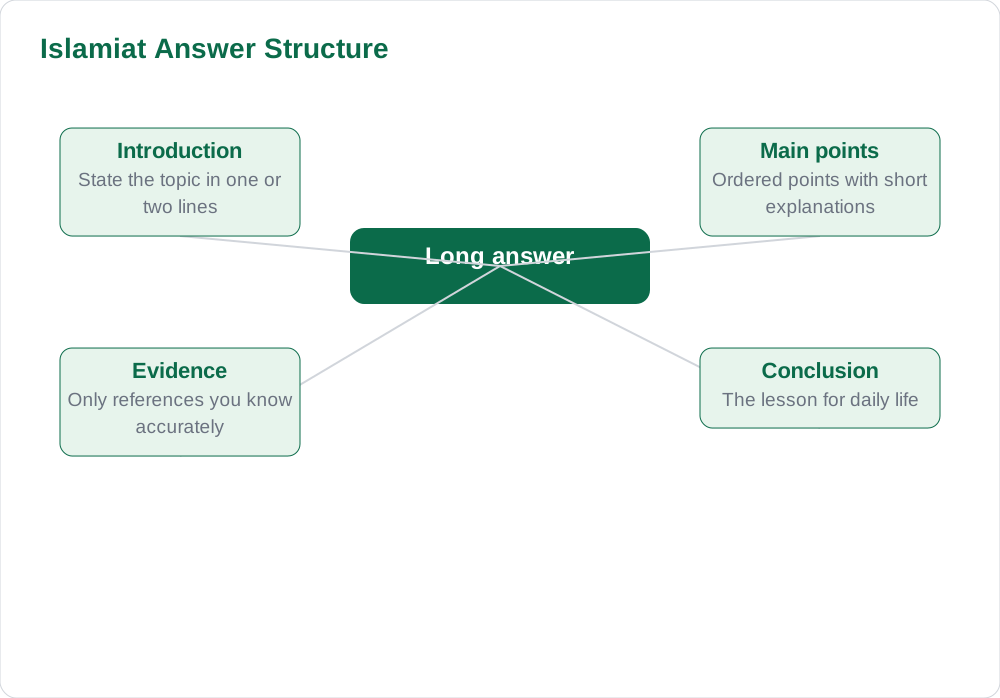
For long questions, structure matters as much as content: begin with a brief introduction, present your points in order with short explanations, and end with a conclusion that states the lesson or message. Avoid adding material you are unsure about, because an incorrect statement in Islamiat answers costs more than a missing point. Where Arabic terms or references are required, write them carefully and exactly as taught, and do not guess at a reference you cannot recall. The blog guides on this site explain the same structured-answer method for other subjects, and your teacher's class notes remain the best guide to emphasis.
- For each chapter, write the main idea, key points and one daily-life lesson from memory.
- Structure long answers as introduction, ordered points, and a concluding lesson.
- Never guess at a reference you cannot recall; write only what you know accurately.
Beliefs, Worship and Short Questions
The chapters on beliefs and worship produce the largest number of short questions, because they test the foundations: the articles of faith, the pillars of Islam, and the meaning and purpose of each act of worship. Prepare these as exact, short definitions first, then add one reason or benefit for each, since examiners often ask why a belief or practice matters rather than only what it is. Questions on prayer, fasting, Zakat and Hajj commonly ask for conditions, benefits, or the difference between similar concepts, so learn each topic as definition plus purpose plus one practical point. Keep your answers respectful and precise, using the terms exactly as your textbook teaches them.
Short questions also test distinctions that students commonly confuse, such as the difference between similar acts of worship or between related terms in Islamic terminology. Learn such pairs together, stating the difference in one sentence, and practise writing both definitions side by side. Revision cards work well here: write the question on one side and the exact answer on the other, and test yourself daily in small sets. Cover every chapter's short questions, because a two-mark question from a short chapter counts the same as one from a long chapter, and steady coverage beats selective cramming.
Hadith Study: Method and Marks
Hadith study questions usually ask for the translation, the explanation, and the lesson of a selected hadith, and the marks are divided across all three parts, so answer all three even if one part is shorter. Learn the translation in clear, simple wording first, because an accurate translation anchors the explanation that follows. The explanation should connect the hadith's words to their meaning in plain language, avoiding extra material that the hadith does not say. The lesson, or message for daily life, should be one practical point you can state in a sentence, such as honesty, patience, or kindness in dealings, expressed in your own words.
Common mistakes in hadith questions include writing a long general essay instead of answering the hadith itself, and adding references or details that are not part of the selected text. Stay close to the hadith: translation, explanation, lesson, in that order. Practise by writing each selected hadith's three parts from memory, then checking them against your textbook and correcting errors at once. Revise the ahadith in small sets across several days rather than all at once, because spaced revision protects exact wording far better than a single long session.
Seerat, History and Long Questions
Seerat and Islamic history chapters produce the longest questions in the paper, and they reward students who can tell events in order with their causes and results. Revise these chapters as timelines: what happened, why it happened, and what followed, because a question that asks for an event usually also rewards the reason and the outcome. Learn the major events in sequence rather than as isolated facts, and be able to explain the significance of each event in one or two sentences. Character and conduct questions, such as the qualities shown in an event, are answered best by linking a quality to a specific action, not by listing qualities alone.
Long questions on Islamic history and civilisation often ask for contributions, causes of rise or decline, or lessons for today, and the strongest answers organise points under clear headings in the mind, even if headings are not written. Write your points in logical order, give a short explanation for each, and end with a conclusion that states the lesson. Avoid exaggeration and uncertain claims, since accuracy matters more than length in these answers. If a question offers a choice, choose the topic you can answer most completely, not the one that merely looks familiar, and manage your time so the long questions are never rushed.
- Revise history as timelines: event, cause, result, significance.
- Link every quality to a specific action, not to a list of adjectives.
- Choose the optional question you can answer most completely.
Quranic Message and Exam Technique
Chapters on the Quranic message usually ask for the theme of a passage, its guidance for believers, and its application to daily life, and the best answers stay close to the text rather than drifting into general writing. Learn the central message of each selected passage in one sentence, then two supporting points that explain it, then one practical application. Questions on rights and duties, moral conduct, and social responsibility appear here too, and they are answered best by stating the principle first and then giving one example of it in daily life. Keep your language respectful and your claims within what your textbook teaches.
On exam day, attempt short questions first to secure steady marks, then move to the long questions with the time that remains. Read every question twice, underline the key instruction word, such as explain, describe, or discuss, and match your answer's length to it. Leave a few minutes to reread your answers for spelling of key terms and for any statement you are unsure about, and correct or remove uncertain claims. A complete, accurate, well-structured paper is worth far more than a long paper with errors, and calm, steady writing reflects the subject itself.
AI Help: Muse AI
Muse AI is Meta's personal AI assistant, and it can help you revise Islamiat by turning a chapter into simple self-test questions on beliefs, worship and Seerat. Ask it to explain a concept in plain words, then check your answer against your textbook before writing it down. Join Muse with invite code LTGSWD — in the Muse app, go to Settings > Redeem token and enter the code. Disclosure: LTGSWD is the author's Muse invite code. Muse AI does not give official STBB answers — always verify against your STBB book and your teacher. Always verify against your Sindh Textbook Board book and your teacher before using anything in classwork.
5 key points you must know
- Beliefs and worship chapters give the most short questions: definition plus purpose plus one point.
- Hadith answers need three parts: translation, explanation, and one practical lesson.
- Seerat revision works as timelines: event, cause, result and significance.
- Long answers follow introduction, ordered points, and a concluding lesson.
- Never guess at a reference; write only what you know accurately.
Frequently asked questions
How should I prepare short questions in Islamiat?
Learn each short question as an exact, short definition plus one reason or benefit, and test yourself with revision cards in small daily sets. Cover every chapter, because short questions come from the whole book and a two-mark question from a short chapter counts the same as one from a long chapter. Correct mistakes immediately against your textbook so errors do not become habits.
What is the best structure for a hadith question?
Answer in three parts in order: translation in clear wording, explanation in plain language, and one practical lesson for daily life. Stay close to the hadith itself and avoid long general writing or details that are not part of the selected text. Practise writing all three parts from memory for each selected hadith, then check them against your textbook.
How do I revise Seerat and Islamic history?
Revise as timelines: what happened, why it happened, and what followed, with the significance of each event in one or two sentences. Link qualities to specific actions rather than listing adjectives alone. Practise writing one event's full account from memory, then correct it against the textbook, so your answers stay accurate and ordered.
Should I write long answers in Islamiat?
Length alone does not earn marks; accuracy, order and a clear lesson do. Structure each long answer as introduction, ordered points with short explanations, and a conclusion stating the lesson. Avoid uncertain claims and extra material you cannot verify, because an incorrect statement costs more than a missing point in this subject.
Is this guide a guess paper?
No, it describes the question types and chapters teachers commonly emphasise, such as short questions on beliefs, hadith study, and Seerat long questions. It does not predict or leak any exam paper, and it does not reproduce textbook answers. Prepare from your own textbook and teacher's notes, and use this guide to organise that preparation.
Solved notes — preview free
These guides work best with the solved exercises. Preview the solved notes free on this website — 119 solved notes for Classes 6–10 in Sindhi, Urdu, English and Arabic medium. Or browse the full solved notes catalogue for your class and medium. New solved notes are added regularly — check the catalogue for coming-soon books.