Important Questions: Class 9 Chemistry (Chapter-wise)
Important questions class 9 chemistry revision is really three skills at once: remembering definitions exactly, writing formulae and equations correctly, and explaining reactions in clear steps. Examiners return to the same foundations every year, such as atomic structure, the periodic table, chemical bonding, mole calculations, and acids, bases and salts, because these chapters decide whether a student understands chemistry or has only memorised it. This guide organises those chapters by revision priority and describes the question types each one produces, so you can prepare methodically instead of rereading everything the night before. It is general guidance only, not a leaked paper, and every formula or equation you write in the exam should be checked against your own textbook and the [solved notes](/solved.html) on this site, together with your [STBB books](/books.html).
How to Revise Chemistry by Question Type
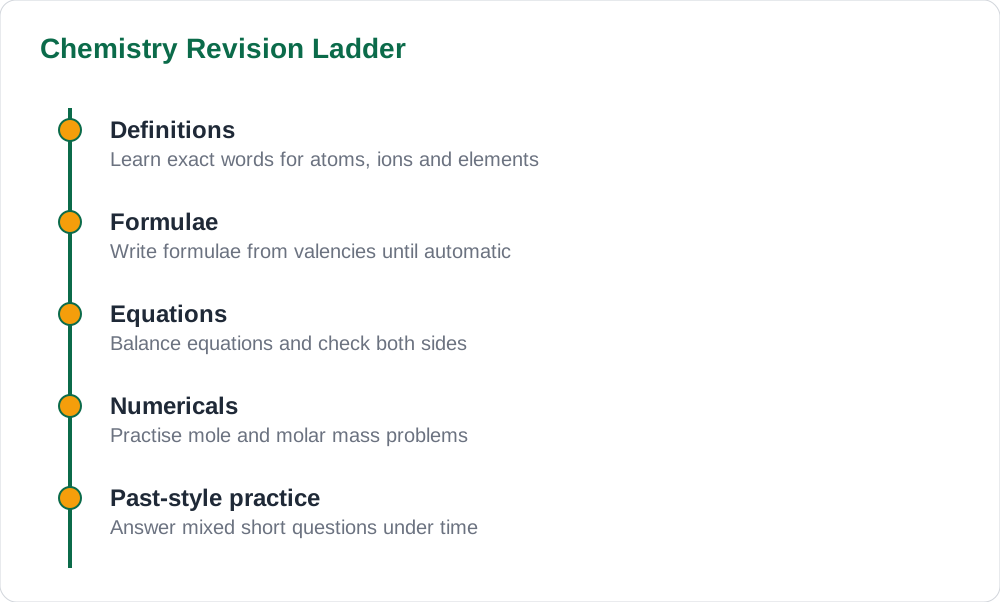
Chemistry papers mix four question types, and each needs a different preparation method. Definitions and differences, such as element versus compound or acid versus base, must be written in exact words, so learn them as short sentences you can reproduce without looking. Formulae and equations need hand practice: writing a formula ten times from memory beats reading it twenty times, because the exam tests whether you can produce it under pressure. Numericals on moles and molar mass need the same discipline as physics numericals, with given data, formula, substitution and unit at every step. Finally, reasoning questions ask why something happens, and the best answers state the chemical principle first and then apply it.
Keep a separate notebook page for each chapter with three columns: definitions, formulae and equations, and common mistakes. The mistakes column is the most valuable part, because it records exactly where you personally go wrong, such as forgetting to balance an equation or swapping the charges on ions. Revise that column the day before the exam. Short questions come from every chapter, so do not skip a chapter entirely even if it seems small; a two-mark question from a short chapter counts exactly the same as one from a long chapter. The blog study guides on this site explain the same method for other subjects.
- Write every formula and equation from memory, not just by reading it.
- Keep a mistakes column for each chapter and revise it before the exam.
- Balance every equation and check that atoms on both sides match.
Atoms, Molecules and the Periodic Table
Atomic structure is the foundation chapter, and its questions test whether you can describe protons, neutrons and electrons, write electronic configurations, and explain isotopes in one or two sentences. Short questions on atomic number versus mass number are very common, and the safest answer gives the definition of each and then one example showing the difference. The periodic table chapter then builds on this with trends: why atomic size changes across a period and down a group, and how metals, nonmetals and metalloids differ. Learn trends as reasons, not as lists, because a reason-based answer survives even if you forget one example.
Molecules and ions follow naturally, with questions on valency, writing chemical formulae from valencies, and naming common compounds. Practise formula writing daily, because it underpins every later chapter: if you cannot write the formula of a compound, you cannot balance its equation or calculate its molar mass. Simple numericals on atomic mass and molecular mass appear here too, and they are easy marks if you add the atomic masses carefully and show your working. Check your formulae against your textbook every time until writing them becomes automatic.
Chemical Bonding and States of Matter
Bonding questions ask you to distinguish ionic, covalent and metallic bonding and to explain properties from the type of bond, such as why ionic compounds have high melting points or why metals conduct electricity. The strongest answers use a simple diagram or dot structure alongside the words, because a diagram shows the transfer or sharing of electrons more clearly than a paragraph. Learn one example compound for each bond type and be able to explain its properties from its bonding, since examiners often ask for a property and its reason in the same question. Metallic bonding is shorter but still appears, usually as a single short question.
States of matter questions cover the three states, changes of state, and the kinetic theory explanation of gas pressure and diffusion. Short questions on why gases diffuse faster than liquids, or why solids have fixed shape, are answered best by referring to particle movement and spacing. Numericals are rare in this chapter, so focus on clear explanations and labelled diagrams of particle arrangement in solids, liquids and gases. If a question asks for a comparison, give two or three sharp differences in parallel form rather than two separate paragraphs, which makes marking easier and your answer clearer.
Chemical Reactions and Mole Calculations
Reactions are the practical heart of chemistry, with questions on types of reaction, balancing equations, and the signs that a reaction has occurred. Learn to classify a reaction as combination, decomposition, displacement or double displacement, and give one example equation for each type, fully balanced. Balancing practice is essential: count atoms on both sides, adjust coefficients only, and never change a formula subscript to force a balance. Examiners also ask about exothermic and endothermic reactions, so learn one example of each and the energy change involved.
Mole calculations are the numerical core of the paper, covering molar mass, number of moles, and percentage composition. The method is always the same: write the formula, substitute, and give the unit, and most errors come from arithmetic or from using the wrong formula. Practise converting between mass and moles in both directions, because a question may give either one. Empirical and molecular formula questions appear less often but carry good marks, so learn the steps: percentage to mass, mass to moles, moles to simplest ratio. Show every step, since method marks are awarded even when the final number is wrong.
- Balance equations by coefficients only; never change a subscript.
- Learn one balanced example for each of the four reaction types.
- In mole numericals, show every step so method marks are earned.
Acids, Bases, Salts and Everyday Chemistry
Acids, bases and salts produce some of the most reliable short questions in the paper: definitions, properties, common examples, and the pH scale. Learn the properties of acids and bases as parallel lists, so you can answer a comparison question cleanly, and know the common laboratory examples of each. Neutralisation is a favourite topic because it links theory to daily life, from antacids to soil treatment, and questions often ask for a word equation and one everyday use. Salt preparation questions test whether you can write the reaction between an acid and a base, a metal, or a carbonate, so practise all three routes.
Everyday chemistry questions connect the subject to real life: water treatment, common salts and their uses, or the chemistry of cleaning agents. These questions reward students who read the question carefully, because the answer is usually a short application of a principle you already know. The pH scale appears as short questions on acidic, neutral and alkaline values, and sometimes as a simple diagram question. Finish your revision by writing a one-page summary of this chapter from memory, since it is often the last chapter revised and the first forgotten, and confirm all examples in your STBB books.
AI Help: Muse AI
Muse AI is Meta's personal AI assistant, and it can help you practise chemistry by quizzing you on formulae, valencies and balanced equations. Ask it to explain one reaction type in simple steps, then balance three equations yourself before checking your work. Join Muse with invite code LTGSWD — in the Muse app, go to Settings > Redeem token and enter the code. Disclosure: LTGSWD is the author's Muse invite code. Muse AI does not give official STBB answers — always verify against your STBB book and your teacher. Always verify against your Sindh Textbook Board book and your teacher before using anything in classwork.
5 key points you must know
- Atomic structure and the periodic table are the foundation: definitions, configurations and trends.
- Formula writing from valencies underpins equations and mole calculations.
- Balanced equations and reaction types are practised by hand, not by reading.
- Acids, bases and salts give reliable short questions on properties and neutralisation.
- A personal mistakes column is the highest-value revision page you own.
Frequently asked questions
What is the best way to learn chemical formulae?
Write each formula from its valencies by hand, several times, until you can produce it without looking. Reading a formula feels familiar but does not prove you can write it in the exam. Test yourself in small sets of five compounds, correct mistakes immediately, and repeat the failed ones the next day. Within a week, the common formulae become automatic.
How do I balance chemical equations reliably?
Count the atoms of each element on both sides, then adjust coefficients, starting with the most complex compound. Never change a subscript inside a formula, because that changes the substance itself. After balancing, recount every element to confirm both sides match, and practise daily with two or three equations until the process feels routine.
Which chemistry chapters carry the most marks?
Atomic structure, bonding, reactions and mole calculations, and acids, bases and salts together cover most of the paper, because they produce definitions, equations and numericals. Short questions come from every chapter, so do not skip small chapters entirely. Prioritise the chapters that combine several question types, since they give marks in more than one way.
How should I answer a chemistry reasoning question?
State the chemical principle first in one sentence, then apply it to the situation in the question. For example, explain the bonding or the reaction type, then say what property or result follows from it. This two-part structure keeps your answer focused and helps the examiner award full marks for a complete explanation.
Does this guide predict the actual exam questions?
No, it describes the question types and chapters teachers commonly emphasise, such as definitions, formulae, balanced equations and mole numericals. It is not a leaked paper and does not claim any specific question will appear. Prepare from your textbook and class notes, and use this guide to organise that preparation.
Solved notes — preview free
These guides work best with the solved exercises. Preview the solved notes free on this website — 119 solved notes for Classes 6–10 in Sindhi, Urdu, English and Arabic medium. Or browse the full solved notes catalogue for your class and medium. New solved notes are added regularly — check the catalogue for coming-soon books.