Important Questions: Class 9 Biology (Chapter-wise)

Important questions class 9 biology revision rewards students who think in diagrams and processes, because the subject asks how living things work, not only what they are called. Every major chapter, from cells and tissues to nutrition, transport, respiration and reproduction, produces the same three question types: labelled diagrams, definitions with functions, and processes explained in order. Teachers commonly emphasise the processes that link structure to function, such as how the heart pumps blood or how leaves make food, because those questions separate understanding from memorisation. This guide organises the chapters by revision priority and explains how to prepare each type. It is general revision guidance only, not a leaked paper, and every diagram and definition should be checked against your textbook and the [solved notes](/solved.html) on this site, together with your [STBB books](/books.html).
How to Revise Biology by Process
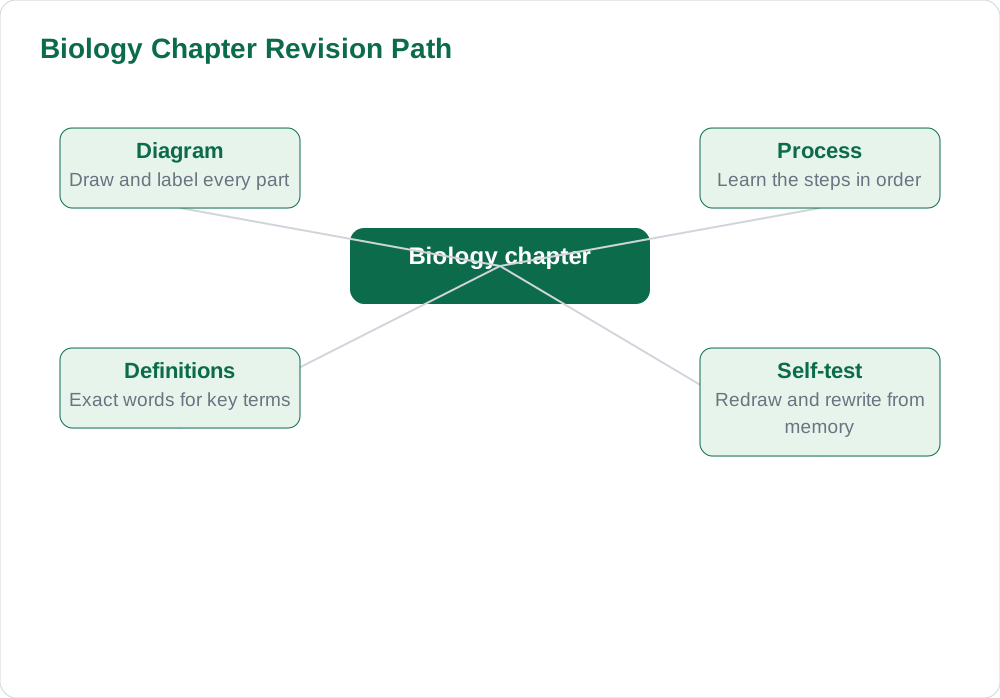
Revise each biology chapter as a process with a diagram, not as a list of facts. Start with the diagram: draw it, label its parts, and write one function sentence for each part, because the diagram question and the short questions of a chapter usually come from the same figure. Then learn the process as numbered steps in order, such as the stages of digestion or the path of blood through the heart, since process questions are marked step by step. Finally, learn the definitions of the chapter's key terms in exact words, because a definition question tests one core idea and vague wording loses the mark. This diagram-process-definition order works for nearly every chapter in the book.
Keep a biology notebook with one page per chapter: the diagram at the top, the process steps below it, and the definitions at the bottom, so the whole chapter is visible at a glance. Test yourself by covering the labels and redrawing the diagram, and by writing the process steps from memory before checking them. Short questions come from every chapter, so do not skip a chapter because it seems small; a two-mark question from a short chapter counts the same as one from a long chapter. The blog guides on this site explain the same method for Class 8 Science, and your class practical notebook shows which diagrams your teacher emphasises.
- One page per chapter: diagram, process steps, definitions.
- Draw and label diagrams from memory; cover labels to test yourself.
- Learn processes as numbered steps, since they are marked step by step.
Cells, Tissues and Organisation
Cell chapters are the foundation of the subject, and their questions test the structure and function of cell parts, the difference between plant and animal cells, and levels of organisation from cell to organism. The labelled diagram of a cell is a classic question, so practise drawing it with all parts labelled and spelled correctly, and learn one function for each part. Comparison questions between plant and animal cells are answered best as parallel points, such as cell wall, chloroplasts and vacuole size, rather than two separate paragraphs. Tissue questions follow the same pattern: name the tissue, state where it is found, and give its function.
Microscopy and cell theory questions appear as short questions, testing the discovery of cells, the parts of a microscope, and the statements of cell theory. Learn cell theory as three clear statements, and be able to label a simple microscope diagram if your syllabus includes it. Organisation questions ask for the sequence from cell to tissue to organ to system, and they are easy marks if you learn the sequence with one example at each level. Do not rush this chapter in revision, because its terms, such as organelle, tissue and organ, are used in every later chapter, and confusion here spreads everywhere.
Nutrition, Photosynthesis and Digestion
Nutrition chapters produce some of the most reliable questions in the paper, beginning with photosynthesis: its word equation, the conditions needed, and the leaf structure that supports it. Learn the photosynthesis equation in words and symbols, and be able to explain the role of light, chlorophyll and carbon dioxide, since examiners often ask for one factor and its effect. The leaf diagram, showing the parts involved in photosynthesis, is a frequent diagram question, so practise it with labels and one function per part. Questions on factors affecting the rate of photosynthesis are answered best by stating the factor, the effect, and the reason in one short paragraph each.
Digestion chapters follow the same structure: the organs in order, the function of each, and the enzymes involved where taught. Learn the human digestive system as a sequence, naming each organ and its role, and practise the labelled diagram until you can reproduce it without the book. Short questions on enzymes, absorption and the difference between ingestion and digestion test precise terms, so learn each term's definition separately rather than as a group. Nutrition in plants and animals may also be compared, and a parallel comparison of autotrophic and heterotrophic nutrition is a clean, mark-friendly answer format.
Transport, Respiration and Excretion
Transport chapters centre on the heart and blood circulation, and the heart diagram is one of the most asked diagrams in Class 9 Biology. Practise drawing the heart with its four chambers, major vessels and valves labelled, and learn the path of blood through it as a numbered sequence, because the sequence question and the diagram question often appear together. Blood components questions ask for the parts of blood and the function of each, so learn plasma, red cells, white cells and platelets as four points with one function each. Plant transport questions, covering xylem and phloem, are answered best as a comparison of structure and function.
Respiration chapters test the difference between breathing and cellular respiration, the word equation for aerobic respiration, and the structure of the breathing system. Learn aerobic and anaerobic respiration as a comparison, including the equation and the energy released, since comparison questions are common here. The breathing system diagram, with trachea, bronchi and alveoli labelled, is another reliable diagram question, and the alveolus is often asked as a short question on adaptation for gas exchange. Excretion questions cover the kidney and its function, usually as a short question or a simple labelled diagram, so learn the kidney's structure and the process of filtration in outline.
- Learn the heart diagram with the blood path as a numbered sequence.
- Compare aerobic and anaerobic respiration by equation and energy.
- State one function per blood component and per breathing-system part.
Coordination, Reproduction and Health
Coordination chapters cover the nervous system and hormones, and their questions test structure, function and comparison: the parts of a neurone, the path of a nerve impulse, and the difference between nervous and hormonal control. The neurone diagram is a standard question, so practise it with dendrites, cell body, axon and synapse labelled, and learn the reflex arc as a sequence of five steps. Endocrine questions usually ask for glands and their hormones with one function each, so learn them as a small table and test yourself by covering one column. Plant coordination, where included, tests tropisms with one example each, such as phototropism and geotropism.
Reproduction chapters test life cycles and labelled diagrams of reproductive systems or flower parts, depending on the syllabus, and the same diagram-process method applies: draw, label, state functions, then learn the process in order. Health and disease questions close the book with causes, transmission and prevention of common diseases, learned as cause-plus-prevention pairs. On exam day, attempt diagrams early while your hand is fresh, write definitions in exact words, and explain processes as numbered steps, since this format matches how examiners award marks. Leave time to check spellings of scientific terms, because a misspelt term can lose its mark.
AI Help: Muse AI
Muse AI is Meta's personal AI assistant, and it can help you revise Class 9 Biology by explaining a life process in simple ordered steps. Ask it to describe blood circulation or photosynthesis step by step, then draw the diagram yourself and label it from memory. Join Muse with invite code LTGSWD — in the Muse app, go to Settings > Redeem token and enter the code. Disclosure: LTGSWD is the author's Muse invite code. Muse AI does not give official STBB answers — always verify against your STBB book and your teacher. Always verify against your Sindh Textbook Board book and your teacher before using anything in classwork.
5 key points you must know
- Revise every chapter as diagram, process steps, then definitions, in that order.
- The heart, cell, leaf and breathing-system diagrams are the most asked figures.
- Processes are marked step by step: learn sequences, not lists of facts.
- Comparisons work best as parallel points with one example each side.
- Check spellings of scientific terms, since a misspelt term can lose its mark.
Frequently asked questions
Which biology diagrams should I practise most?
Practise the cell, leaf, heart, breathing system and neurone diagrams most, because these figures appear again and again in papers and class tests. Draw each one with all parts labelled and spelled correctly, and learn one function sentence per part. Redraw each diagram from memory on three separate days, since spaced redrawing fixes it far better than copying it repeatedly in one session.
How do I learn a biological process for the exam?
Learn the process as numbered steps in order, such as the path of blood through the heart or the stages of digestion, and write the steps from memory before checking them. Process questions are marked step by step, so an ordered answer earns marks even if one step is brief. Link each step to the diagram, since the diagram and the process question usually come from the same figure.
How should I answer a comparison question in biology?
Write parallel points, one for each side, rather than two separate paragraphs. For example, compare plant and animal cells point by point: cell wall, chloroplasts, vacuole and shape. Parallel structure makes your answer easy to mark and shows the examiner exactly where each difference lies, which protects your marks.
What is the best way to remember biological terms?
Learn each term with its definition and one example or function on the same line, because the example anchors the meaning. Test yourself with short cards in small daily sets, and correct mistakes immediately against your textbook. Group related terms together, such as the parts of blood, so you recall them as a set rather than as isolated words.
Is this guide a guess paper?
No, it describes the question types and chapters teachers commonly emphasise, such as labelled diagrams, life processes and short questions on cells and systems. It does not predict or leak any exam paper, and no specific question is claimed to appear. Prepare from your textbook and class notes, and use this guide to organise that preparation.
Solved notes — preview free
These guides work best with the solved exercises. Preview the solved notes free on this website — 119 solved notes for Classes 6–10 in Sindhi, Urdu, English and Arabic medium. Or browse the full solved notes catalogue for your class and medium. New solved notes are added regularly — check the catalogue for coming-soon books.