Important Questions: Class 8 Science (Chapter-wise)

Important questions class 8 science revision is built on four skills that appear in every chapter: defining a term exactly, drawing and labelling a diagram, describing an experiment in steps, and explaining an everyday observation with science. Class 8 is the bridge year, where topics from primary science grow into the physics, chemistry and biology of Class 9, so examiners test whether you understand ideas rather than only remember words. This guide organises the subject by chapter type, from living things and materials to forces, energy and the environment, and explains the question types each chapter produces. It is general revision guidance only, not a leaked paper, and every definition and diagram should be checked against your textbook and the [solved notes](/solved.html) on this site, together with your [STBB books](/books.html).
Four Skills for Every Science Chapter
For each chapter, prepare four things: the definitions, the diagrams, the experiments, and the everyday examples. Definitions must be learned in exact words, because a definition question has one correct core idea and vague wording loses marks. Diagrams must be practised by hand until you can draw and label them without the book, since a diagram question cannot be answered by memory of words alone. Experiments must be learned as steps in order, with the apparatus, the method, and the observation or result, because examiners often ask for one missing step. Everyday examples connect the chapter to life, and they are the material of reasoning questions, which ask why something happens.
Keep a science notebook with one page per chapter, divided into those four sections, and revise it in short daily sessions rather than one long session before the exam. When you meet a new term, write its definition and one example on the same line, because the example fixes the meaning. When you practise a diagram, label every part and then cover the labels and test yourself, since labelling from memory is the real skill. The blog guides on this site explain the same four-skill method for other science subjects, and your class practical notebook is a strong guide to which experiments your teacher emphasises.
- One notebook page per chapter: definitions, diagrams, experiments, examples.
- Practise diagrams by drawing and labelling from memory, not by copying.
- Learn experiments as apparatus, method in order, and observation.
Living Things, Plants and the Human Body
Life science chapters produce many diagram and definition questions, from plant parts and photosynthesis to human body systems and food chains. Learn each diagram with its labels in a fixed order, so you never miss a part under pressure, and be able to state the function of each labelled part in one sentence. Photosynthesis and respiration are commonly asked as comparisons, so learn them as parallel points: what goes in, what comes out, and where the process happens. Questions on nutrition, digestion and breathing follow the same pattern: name the parts in order, state each part's function, and explain the process as a sequence.
Food chains, food webs and ecosystems appear as short questions and sometimes as diagram questions, where the skill is placing organisms in the correct order and identifying producers, consumers and decomposers. Health and disease questions test causes, prevention and the difference between communicable and non-communicable conditions, so learn them as cause plus prevention pairs. Reproduction and growth chapters, where taught, are revised best by diagrams with labelled stages in order. Always answer life science questions with the scientific term first and the explanation after, because the term itself often carries a mark.
Materials, Matter and Chemical Changes
Materials chapters test classification and properties: metals versus nonmetals, acids versus bases, and physical versus chemical changes, usually as comparison questions. Learn each comparison as two or three sharp differences, and give one example for each side, because examples prove you understand the difference rather than memorised it. Questions on solutions, mixtures and separation methods ask for the method that fits a given mixture, so learn each method with the property it exploits, such as filtration for insoluble solids or evaporation for dissolved salts. Simple experiments on acids and bases, including indicators and their colour changes, are regular short-question material.
Chemical change questions often ask for signs of a reaction, such as colour change, gas formation, or heat change, and for one example equation in words. Rusting, burning and digestion are favourite examples because they connect chemistry to daily life, and questions may ask for a cause and a prevention method together. Keep your answers short and ordered: state the change, give the sign or evidence, and name the example. If a question asks for a difference between physical and chemical change, give differences of kind, not just two examples, since examiners award marks for the distinguishing feature.
Forces, Energy and Simple Machines
Physics chapters in Class 8 centre on forces, pressure, energy and simple machines, and their questions mix definitions with everyday reasoning. Force questions test types of force, friction and its advantages and disadvantages, and the effect of force on motion, so learn each type with one example. Pressure questions use daily-life situations, such as why a tractor has wide tyres or why a sharp pin pierces easily, and the answer structure is always principle first, then application. Energy questions ask for forms of energy, transformations, and sources, including renewable and non-renewable sources with one advantage and disadvantage each.
Simple machines, including levers, pulleys and inclined planes, appear as diagram and short questions: identify the machine, name its parts, and state its use or advantage. Learn the three classes of lever with one example each, and be able to label a pulley or lever diagram correctly. Numericals at this level are simple, usually one formula, so write the formula and substitute carefully with units. Electricity and magnetism chapters, where included, test circuits, conductors and insulators, and magnetic properties, and a clean circuit diagram with labelled parts is a reliable mark-earner.
- Answer pressure and friction questions as principle first, then application.
- Learn lever classes and machine diagrams with one example each.
- Write the formula before substituting in every simple numerical.
Earth, Environment and Exam Technique
Earth and environment chapters cover the solar system, weather, seasons, water cycle, and pollution, and their questions reward labelled diagrams and ordered explanations. The water cycle is a classic diagram question, so practise drawing it with arrows showing evaporation, condensation and precipitation, and label each stage. Seasons and day-night questions test understanding of Earth's rotation and revolution, so learn the difference between the two motions and the effect of each. Pollution questions ask for causes, effects and control measures, and the best answers give one point under each heading rather than a mixed paragraph.
On exam day, read each science question and decide which of the four skills it tests: definition, diagram, experiment or reasoning, and answer in that skill's format. A diagram question needs a diagram, not a paragraph; an experiment question needs steps in order, not a conclusion alone. Attempt the questions you know best first, keep diagrams neat with a pencil and ruler, and leave time to check spellings of scientific terms, since a misspelt term can lose the mark. Finish by rereading every answer once for a missing label, unit or step, because small omissions are the most common lost marks in science.
AI Help: Muse AI
Muse AI is Meta's personal AI assistant, and it can help you revise Class 8 Science by explaining a diagram or experiment in simple steps. Ask it to describe photosynthesis or the water cycle in plain words, then draw and label the diagram yourself from memory. Join Muse with invite code LTGSWD — in the Muse app, go to Settings > Redeem token and enter the code. Disclosure: LTGSWD is the author's Muse invite code. Muse AI does not give official STBB answers — always verify against your STBB book and your teacher. Always verify against your Sindh Textbook Board book and your teacher before using anything in classwork.
5 key points you must know
- Four skills carry every chapter: definitions, diagrams, experiments and everyday examples.
- Life science diagrams need labels in a fixed order plus one function per part.
- Materials questions are comparisons: sharp differences with one example each side.
- Forces and pressure answers follow principle first, then application.
- Answer each question in its own format: diagram, steps, or reason as asked.
Frequently asked questions
How do I learn science diagrams for the exam?
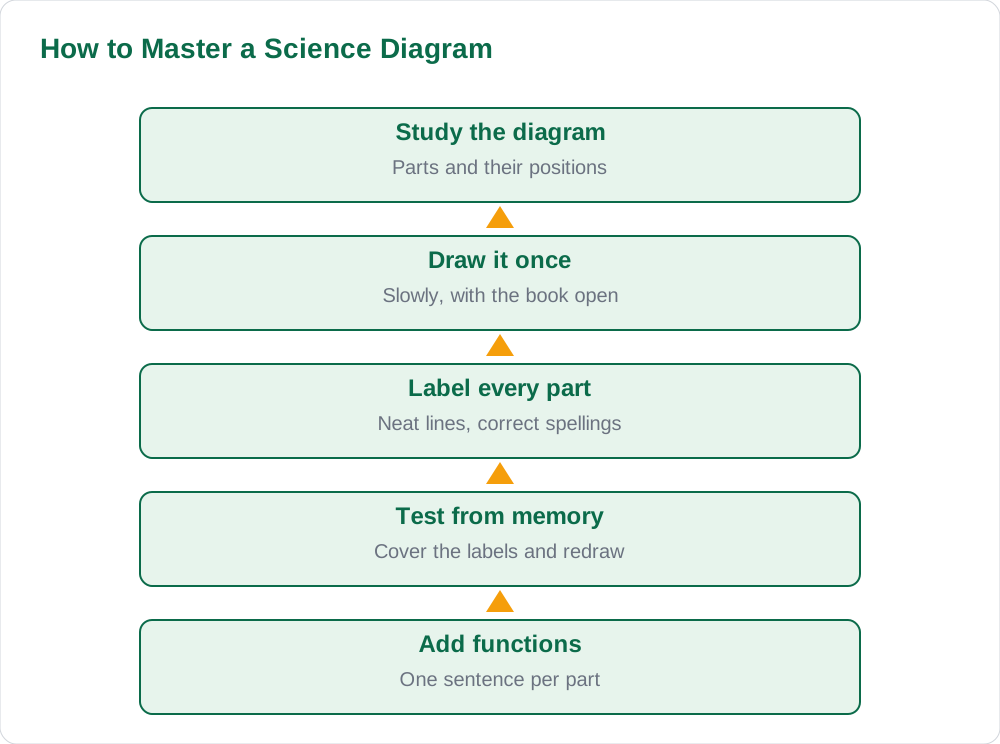
Study the diagram, draw it once with the book open, then cover the labels and redraw it from memory. Label every part with neat lines and correct spellings, and learn one function sentence for each part. Repeat the diagram on three separate days, because spaced redrawing fixes it far better than copying it ten times in one sitting.
How should I describe an experiment in an answer?
Give the apparatus, the method as numbered steps in order, and the observation or result. Examiners often ask for one missing step, so learn the sequence, not just the conclusion. Keep the steps short and in order, and state what you observed rather than what you expected, since observations are what experiments actually test.
Which Class 8 Science chapters matter most?
Living things and body systems, materials and chemical changes, forces and energy, and Earth and environment all produce definitions, diagrams and reasoning questions, so none should be skipped. Prioritise the chapters with diagrams and experiments, because those question types carry concentrated marks, but keep short-question coverage across every chapter.
How do I answer a why question in science?
State the scientific principle first in one sentence, then apply it to the situation in the question. For example, name the force or process involved, then explain what it does in this case. This two-part structure keeps your answer focused and earns marks for both the principle and its application, even if one part is brief.
Is this guide a guess paper?
No, it describes the question types and chapters teachers commonly emphasise, such as diagrams, definitions, experiments and everyday reasoning questions. It does not predict or leak any exam paper, and no specific question is claimed to appear. Prepare from your textbook and class notes, and use this guide to organise that preparation.
Solved notes — preview free
These guides work best with the solved exercises. Preview the solved notes free on this website — 119 solved notes for Classes 6–10 in Sindhi, Urdu, English and Arabic medium. Or browse the full solved notes catalogue for your class and medium. New solved notes are added regularly — check the catalogue for coming-soon books.