Important Questions: Class 10 Maths (Chapter-wise)
Important questions class 10 maths preparation is less about memorising solutions and more about recognising question patterns: the same theorems, the same types of equations, and the same standard constructions return every year in new numbers. Students who practise by type, rather than by page order, finish the paper faster and with fewer careless errors, because each question reminds them of a method they have already drilled. This guide organises Class 10 Maths by chapter weight and question type, from algebra and quadratic equations through geometry and trigonometry to statistics, and explains how to prepare each type. It is general revision guidance only, not a leaked paper, and every method should be checked against your textbook and the [solved notes](/solved.html) on this site, together with your [STBB books](/books.html).
A Method for Maths Revision
Revise maths in three passes per chapter. The first pass is understanding: read the solved examples slowly and make sure you can explain each step in words, not just copy it. The second pass is drilling: solve five to ten unsolved questions of each type without looking at the answers, because fluency comes from producing solutions, not recognising them. The third pass is testing: solve a mixed set under time, mark it honestly, and record every error in a mistakes notebook with the correct method written beside it. This three-pass method is slower than rereading, but it is the only method that reliably raises marks.
In the exam itself, read the whole question before writing, underline what is given and what is asked, and choose your method before calculating. Show every step, because method marks are awarded for correct working even when the final answer slips, and a skipped step can cost marks you had already earned. Keep rough work tidy and in one place so you can check it, and always verify an answer where possible, for example by substituting a root back into the original equation. The blog guides on this site cover the same exam technique for science subjects.
- Three passes per chapter: understand, drill by type, then test under time.
- Show every step; method marks survive a wrong final answer.
- Keep a mistakes notebook and revise it before every test.
Algebra: Equations and Polynomials
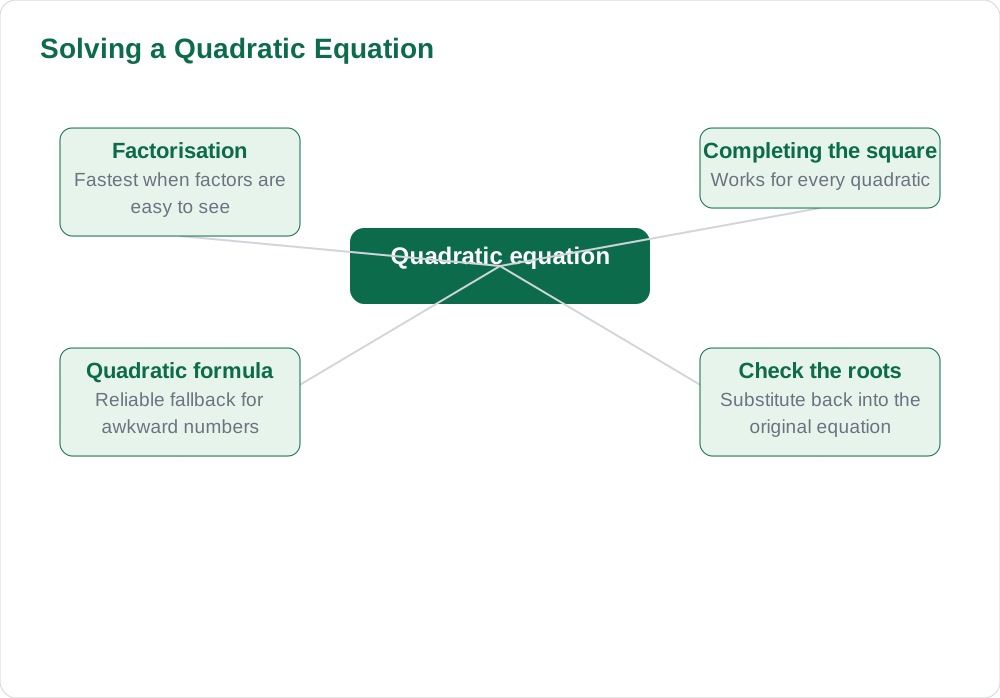
Algebra chapters produce the most predictable questions in the paper, beginning with quadratic equations solved by factorisation, completing the square, and the quadratic formula. Practise all three methods on the same equation at least once, so you can choose the fastest method in the exam rather than defaulting to one. Questions on the nature of roots using the discriminant are common short questions, and they are easy marks if you remember the three cases: positive, zero and negative discriminant. Simultaneous equations and word problems based on them also appear regularly, and the skill is translating words into equations correctly before solving.
Polynomial questions test factorisation, remainder and factor theorems, and the relationship between roots and coefficients. Learn to state the factor theorem precisely and to apply it in two directions: testing whether a value is a root, and finding an unknown coefficient. Surds and indices questions are usually short and reward careful simplification, so practise rationalising denominators and applying index laws until they are automatic. Algebraic fractions and partial fractions, where taught, appear as longer questions, and the safest approach is to work slowly and check each line before moving on.
Geometry: Theorems and Constructions
Geometry questions divide into theorem proofs, riders based on theorems, and constructions, and each needs different preparation. Theorem proofs must be learned in exact logical order: statement, given, construction if any, proof step by step, and conclusion. Do not memorise proofs word for word without understanding them, because a rider question will ask you to apply the same theorem to a new figure. Circle theorems are especially high-weight, including angle in a semicircle, angles in the same segment, and tangent properties, so learn each theorem with its diagram drawn beside it.
Constructions require instruments and practice, not reading: draw each standard construction at least three times with compass and ruler until your arcs are clean and your lines are accurate. Common constructions include bisecting angles and lines, constructing triangles from given data, and drawing tangents to a circle. In the exam, leave construction arcs visible, because the examiner needs to see how you constructed the figure. Coordinate geometry questions, where included, test distance, midpoint and gradient formulas, and they are reliable marks if you substitute carefully and simplify step by step.
Trigonometry and Mensuration
Trigonometry questions usually begin with ratios in a right-angled triangle, then move to standard angles, identities, and heights and distances problems. Learn the values for 30, 45 and 60 degrees by heart, and practise proving simple identities by working from one side only, usually the more complex side. Heights and distances problems are word problems in disguise: draw the diagram first, mark the angle of elevation or depression, label the known and unknown sides, and only then choose the ratio. A diagram drawn before any calculation prevents most errors in this topic.
Mensuration covers areas and volumes of standard shapes, and the questions reward students who write the correct formula before substituting. Learn the formulas for circles, sectors, cylinders, cones and spheres as a single sheet, and practise problems that combine two shapes, such as a cylinder with hemispherical ends. Unit conversion is the main trap: convert all lengths to the same unit before calculating, and give area answers in square units and volume answers in cubic units. If a question gives a diameter, halve it before using the radius formula, a small step that is easy to forget under pressure.
- Draw the diagram first in every heights and distances problem.
- Learn standard angle values and prove identities from one side only.
- Convert all lengths to one unit before any mensuration calculation.
Statistics, Probability and Exam Strategy
Statistics questions are among the most scoring in the paper because their methods are fixed: mean, median and mode for grouped data, cumulative frequency curves, and sometimes standard deviation where taught. Practise one full grouped-data question of each type until the table layout is automatic, because most lost marks come from table errors, not from the final calculation. Probability questions test basic rules: listing the sample space, counting favourable outcomes, and applying addition and multiplication rules where needed. Write the sample space explicitly before calculating any probability, since an incomplete sample space undermines everything that follows.
On exam day, attempt the questions you are most confident about first, and leave the hardest question for the end, because early marks build confidence and protect your time. Spend the last ten minutes checking: substitute roots back into equations, verify that constructions have visible arcs, and confirm that every answer carries its unit where one is needed. If a question resists you after two attempts, move on and return to it later with fresh eyes. A calm, methodical paper beats a rushed one, and the marks you secure early are the marks that carry your grade.
AI Help: Muse AI
Muse AI is Meta's personal AI assistant, and it can help you practise Class 10 Maths by explaining one theorem or method in simple steps. Ask it to break a hard question into smaller steps, then solve each step yourself before checking the working. Join Muse with invite code LTGSWD — in the Muse app, go to Settings > Redeem token and enter the code. Disclosure: LTGSWD is the author's Muse invite code. Muse AI does not give official STBB answers — always verify against your STBB book and your teacher. Always verify against your Sindh Textbook Board book and your teacher before using anything in classwork.
5 key points you must know
- Algebra is the most predictable section: quadratics by three methods and the discriminant cases.
- Geometry proofs must be learned in logical order, with the diagram drawn beside each theorem.
- Trigonometry heights and distances problems start with a diagram, not a calculation.
- Statistics methods are fixed and scoring; table accuracy matters more than speed.
- Show every step and verify answers where possible to protect method marks.
Frequently asked questions
Which Class 10 Maths chapters should I prioritise?
Prioritise algebra, especially quadratic equations, then geometry theorems and circle properties, then trigonometry and statistics. These chapters combine long questions with short questions, so they offer marks in several places. Do not skip any chapter entirely, because short questions come from everywhere, but give the heaviest chapters the most drill time.
How do I prepare for geometry theorem questions?
Learn each theorem as statement, given, construction, proof and conclusion, with its diagram drawn beside it. Then practise riders that apply the same theorem to a new figure, because riders test understanding rather than memory. Redraw the diagram yourself for every proof you revise, since drawing fixes the logic in a way reading never does.
What is the best way to avoid careless errors in maths?
Work one line at a time and check each line before writing the next, especially signs and unit conversions. After finishing a question, verify the answer where possible, such as substituting a root back into the equation. Keep rough work tidy in one place, and reserve the last ten minutes of the paper for checking rather than starting new questions.
How many questions should I practise per chapter?
Aim for five to ten unsolved questions of each type per chapter, solved without looking at answers, rather than fifty questions skimmed with solutions open. Quality beats quantity: one question solved independently teaches more than five copied from a solution. Record every error in a mistakes notebook and revisit it before the next test.
Is this article a guess paper?
No, it is a general revision guide describing the question types and chapters teachers commonly emphasise, such as quadratics, circle theorems and grouped-data statistics. It does not leak or predict any exam paper, and no specific question is claimed to appear. Use it to organise your practice from your own textbook.
Solved notes — preview free
These guides work best with the solved exercises. Preview the solved notes free on this website — 119 solved notes for Classes 6–10 in Sindhi, Urdu, English and Arabic medium. Or browse the full solved notes catalogue for your class and medium. New solved notes are added regularly — check the catalogue for coming-soon books.