Important Questions: Class 10 English (Chapter-wise)
Important questions class 10 english preparation covers more ground than any other subject, because one paper tests reading, writing, grammar and literature together. The students who score well are rarely the ones with the largest vocabulary; they are the ones who know the format of each question type, plan before writing, and leave time to check. Essays, letters, stories and comprehension passages each have a structure that examiners reward, and grammar questions test a small set of rules that can be drilled until they are automatic. This guide walks through the paper section by section, describing the question types teachers commonly emphasise and how to prepare each one. It is general revision guidance only, not a leaked paper, and all practice should be checked against your textbook and the [solved notes](/solved.html) on this site, together with your [STBB books](/books.html).
Understanding the English Paper
Begin by learning the paper's structure: which sections carry which marks, how much time each section deserves, and what the examiner looks for in each answer. Comprehension passages reward careful reading and answers written in your own words, while writing tasks reward planning, paragraphing and relevance. Grammar questions are usually the quickest marks in the paper, so answer them early and carefully, because a single rule learned well can earn marks in several questions. Literature questions test whether you understood the lesson's theme and characters, not whether you memorised summaries, so revise lessons by theme and message rather than by plot alone.
Time management decides many English results. Allocate time in proportion to marks, start with the sections you find easiest to build confidence, and always leave ten minutes at the end for checking spelling, punctuation and unfinished sentences. Read every question twice before answering, because English questions often contain two instructions, such as summarise and give your opinion, and missing the second half costs half the marks. Practise at least one full paper under timed conditions before the exam, since writing speed and stamina are skills that only timed practice builds. The blog guides on this site cover timed practice for other subjects too.
- Allocate time in proportion to marks and reserve ten minutes for checking.
- Read each question twice; many carry two instructions, not one.
- Practise one full paper under timed conditions before the exam.
Essays and Composition Writing
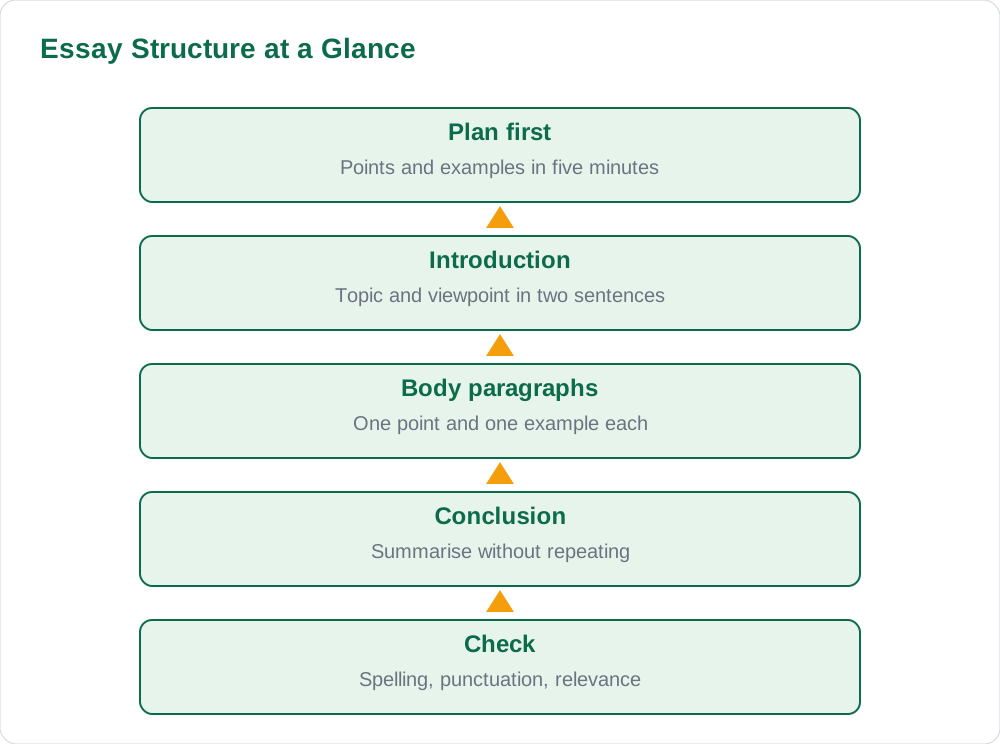
Essays are the highest-mark writing task, and they are marked on relevance, organisation, vocabulary and accuracy, in that order. A strong essay begins with a clear introduction that states the topic and your viewpoint, continues with three or four paragraphs each making one point with an example, and ends with a conclusion that summarises without repeating the introduction word for word. Before writing, spend five minutes planning: jot down your points, order them logically, and choose one example for each. Students who plan write better essays in less time than students who start writing immediately, because planning prevents repetition and wandering.
Common essay themes in Class 10 include the value of education, science in daily life, environmental protection, the role of media, and problems of student life, but the theme matters less than the treatment. Whatever the topic, connect it to real examples from your own experience or reading, and avoid memorised essays that do not answer the exact title given. A memorised essay on a slightly different topic loses relevance marks quickly. Practise writing one essay per week, have your teacher mark it, and keep a list of your repeated errors, such as article mistakes or run-on sentences, so you can correct them deliberately.
Letters, Applications and Stories
Letters and applications are format questions, and format marks are free marks for students who learn them. A formal letter needs the sender's address, date, receiver's address, salutation, subject, body in three paragraphs, and a proper closing, while an informal letter to a friend follows a warmer, simpler pattern. Learn one format for each type perfectly, including punctuation of addresses and dates, because examiners deduct for format errors even when the content is good. Applications to the principal follow the same discipline: state your purpose in the first line, give the reason briefly, and close politely with a clear request.
Story writing tests imagination plus control: a good story has a clear beginning that sets the scene, a middle that builds one problem or event, and an ending that resolves it, all within the word limit. Avoid introducing five characters and three problems, because a short story cannot develop them all, and the result is confusion rather than richness. Use dialogue sparingly and punctuate it correctly, vary your sentence lengths, and choose a title that fits the story's message. Practise completing a story from a given opening line, since that is a common exam format, and always reread your story once for sense before submitting it.
Comprehension and Literature Lessons
Comprehension passages are best approached in three steps: read the passage once for general sense, read the questions, then read the passage again slowly to locate each answer. Answer in your own words wherever the question allows, because copying whole sentences from the passage earns fewer marks and sometimes none. For vocabulary questions, guess the meaning from context before checking the dictionary, since context clues are part of what is being tested. If a question asks for your opinion, give a short reason with it, because an unsupported opinion reads as a guess rather than an answer.
Literature lessons should be revised by theme, character and message, not by memorising summaries line by line. For each lesson, be able to answer three questions: what happens, what does it mean, and what would you learn from it. Short questions usually test facts and meanings, while long questions test theme and character, so prepare both levels. Learn the meanings of difficult words from each lesson, since vocabulary questions often come from the lessons themselves. When quoting from a lesson, keep quotations short and accurate, and explain them in your own words afterwards, which shows understanding rather than memory alone.
- Read the passage, read the questions, then reread to locate answers.
- Answer in your own words and support opinions with a short reason.
- Revise each lesson by theme, character and message, not by plot alone.
Grammar: The Rules That Repeat
Grammar sections test a small set of rules again and again: tenses, active and passive voice, direct and indirect speech, prepositions, articles, and sentence correction. Each rule can be mastered by drilling twenty examples, because the exam varies the sentences but not the rules. Tense questions usually ask you to correct a verb form or complete a sentence, and the key is identifying the time reference in the sentence before choosing the form. Voice and narration questions follow fixed transformation steps, so learn the steps as a checklist and apply them mechanically, checking each change against the original sentence.
Prepositions and articles are learned by usage rather than by rule alone, so keep a notebook of phrases you get wrong and revise them weekly. Sentence correction questions often hide one error of subject-verb agreement, one of tense, and one of article or preposition, so read each sentence slowly and test each part separately. In the exam, grammar questions are quick marks, so do not rush them: a careless grammar answer loses marks you had already earned by learning the rule. Confirm tricky usages in your textbook and in the solved notes before the exam, and practise grammar daily in short bursts rather than in one long session.
AI Help: Muse AI
Muse AI is Meta's personal AI assistant, and it can help you improve English writing by reviewing a draft essay or letter for clarity and mistakes. Ask it to suggest a stronger opening sentence or a better example, then rewrite the paragraph yourself in your own words. Join Muse with invite code LTGSWD — in the Muse app, go to Settings > Redeem token and enter the code. Disclosure: LTGSWD is the author's Muse invite code. Muse AI does not give official STBB answers — always verify against your STBB book and your teacher. Always verify against your Sindh Textbook Board book and your teacher before using anything in classwork.
5 key points you must know
- Essays are marked on relevance and organisation first: plan for five minutes before writing.
- Letters and applications give free format marks to students who learn the format exactly.
- Comprehension answers should be in your own words, with opinions supported by a reason.
- Literature revision works by theme, character and message, not by memorised summaries.
- Grammar rules are few and fixed: drill tenses, voice, narration and prepositions until automatic.
Frequently asked questions
How long should I spend planning an essay?
Spend about five minutes planning before you write. List your main points, order them logically, and choose one example for each point. Planning feels slow but saves time overall, because it prevents repetition, wandering and blank moments mid-essay. Students who plan consistently write clearer, better-organised essays and finish within the time limit more often.
Should I memorise essays before the exam?
No, memorised essays rarely match the exact title given, and examiners deduct relevance marks when an essay answers a different question. Instead, learn essay structure and practise writing on different topics, so you can adapt to any title. Keep a bank of examples and quotations you can use flexibly, rather than whole essays you must reproduce.
How do I improve my grammar marks quickly?
Drill one rule at a time with twenty examples each: tenses first, then voice, narration, prepositions and articles. Keep a notebook of your own errors and revise it weekly, because your repeated mistakes are the fastest marks to recover. In the exam, read each grammar sentence slowly and test each part separately before choosing your answer.
How should I answer comprehension questions?
Read the passage for general sense, read the questions, then reread slowly to locate each answer. Write answers in your own words where allowed, and support any opinion with a short reason. For vocabulary questions, use context clues to guess the meaning first. Always check that your answer matches exactly what the question asked, not just the passage topic.
Is this guide a guess paper for English?
No, it describes the writing formats, grammar rules and lesson themes teachers commonly emphasise, such as essay structure, letter format and narration rules. It does not predict or leak any exam paper, and no specific question is claimed to appear. Prepare from your textbook and class notes, and use this guide to organise that preparation.
Solved notes — preview free
These guides work best with the solved exercises. Preview the solved notes free on this website — 119 solved notes for Classes 6–10 in Sindhi, Urdu, English and Arabic medium. Or browse the full solved notes catalogue for your class and medium. New solved notes are added regularly — check the catalogue for coming-soon books.