How to Solve Science Exercises Using Diagrams
Some science questions are answered better with a picture than with a paragraph. A labelled diagram can show parts, processes, and relationships in seconds, while words alone take a paragraph and still leave room for confusion. Examiners know this, which is why many science questions explicitly ask for diagrams, and why a good diagram often earns marks that a paragraph cannot. This article teaches when to choose a diagram, how to draw and label it properly, and how to combine it with a short explanation for full credit.
When a Diagram Beats a Paragraph
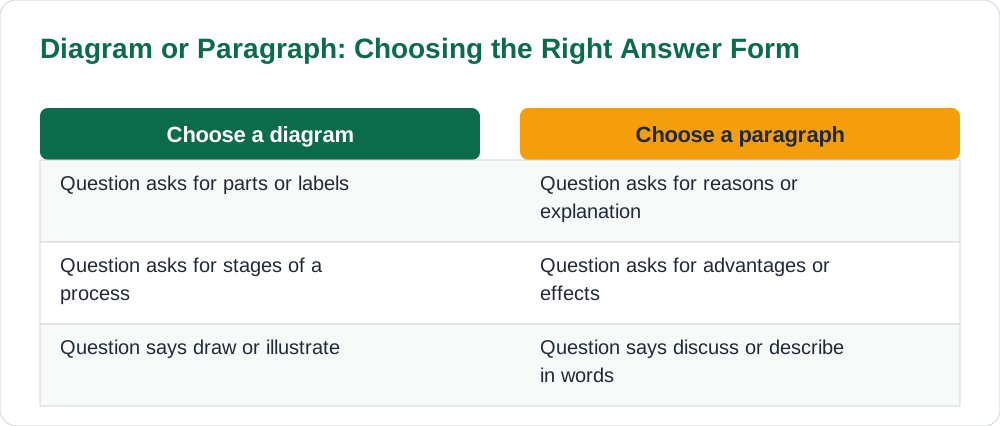
A diagram is the right choice when the question asks about parts, positions, sequences, or relationships. Questions that ask for the parts of something, the stages of a process, or how two things compare are all diagram-friendly, because a picture shows structure directly. A paragraph describing the same structure must list parts in words and hope the reader reconstructs the picture, which is slower and more error-prone. When the question says draw, label, or illustrate, a diagram is not optional; it is the answer.
Even when a diagram is not explicitly requested, adding a small one can strengthen an explanation answer, provided it is neat and relevant. A diagram of a process beside a written explanation shows understanding in two forms, which examiners reward. The rule is relevance: the diagram must illustrate the question's topic, not a neighbouring topic, and it must be drawn carefully enough to be read. A messy or irrelevant diagram hurts an answer, while a clear, labelled one helps it.
Drawing a Diagram That Earns Marks
A mark-earning diagram follows four rules. First, it is large enough to label clearly; a tiny diagram in a corner cannot be read or credited. Second, it is drawn with clean lines, using a ruler for straight edges where appropriate, because neatness signals care and makes labels legible. Third, every part the question asks about is labelled, with label lines that do not cross each other. Fourth, it carries a short title or caption naming what it shows, so the examiner knows at once what they are looking at.
Labels deserve special attention. Each label should use the textbook's term, spelled correctly, since a misspelled label can lose the mark for that part. Label lines should point precisely to the part they name, not vaguely toward it. Pupils should draw the diagram first in rough, check the labels against the textbook, and only then draw the fair version. This two-stage approach prevents the common problem of a nearly correct diagram spoiled by one wrong label.
Pairing the Diagram with a Short Explanation
A diagram rarely stands alone. Most science answers need a short written explanation beside or below the diagram, explaining what it shows and why it matters. The explanation should be brief: two to four sentences that walk through the diagram's main points in order, using the same terms as the labels. This pairing works because the diagram shows structure while the words explain function, and together they cover everything the question asks.
The explanation should not repeat every label in sentence form, which wastes time and adds nothing. Instead, it should explain the process or relationship the diagram illustrates, for example how one stage leads to the next, or how the parts work together. Pupils should write the explanation after drawing the diagram, so the words follow the picture's logic rather than competing with it. A diagram plus a focused explanation is one of the strongest answer forms in science.
Diagrams for Processes and Comparisons
Process questions suit flow diagrams: boxes for stages, arrows showing order, and short labels for each stage. The stages must be complete and in the right order, because a missing or misordered stage loses marks even when the rest is correct. Comparison questions suit two-column or side-by-side diagrams, where each side shows one thing being compared and matching features line up. Both forms should be checked against the textbook before fair-copying, since a process diagram with a wrong order teaches the wrong process during revision.
For topics where the textbook itself contains a diagram, the pupil's diagram should follow the book's version closely in structure, while being drawn by the pupil rather than traced. Following the book ensures the labels and parts match what the examiner expects. Pupils who invent their own structure risk omitting a part the question requires. The textbook is the model; the pupil's drawing is the demonstration of understanding it.
- Process diagrams: boxes for stages, arrows for order, no missing stage.
- Comparison diagrams: side-by-side layout with matching features aligned.
- Textbook diagrams: follow the book's structure and labels closely.
- Always check labels and order against the book before fair-copying.
Practising Diagrams Before Exams
Diagrams improve with practice, and exercise time is the right time to practise. Pupils should draw the diagram for every diagram-friendly exercise question, even when the question does not demand one, because each drawing builds speed and accuracy. Timed practice helps too: drawing a familiar diagram from memory in a few minutes, then checking it against the book, reveals which labels are weak before an exam does. A pupil who can draw and label the key diagrams of a chapter from memory has mastered that chapter's structure.
Keep practised diagrams in the solved-notes folder, one per page where possible, so they can be revised visually. A folder of labelled diagrams is an excellent pre-exam review tool, because a single page can recall a whole topic. Organise them by chapter using How to Organise a Solved-Notes Folder by Subject and Chapter, and check every diagram with the routine in How to Check Your Answers Against the Textbook. More science study methods are available on the solved notes page.
AI Help: Muse AI
Muse AI is Meta's personal AI assistant, and it can help with science diagrams in a practical way. A pupil can ask Muse to list the parts of a diagram in order, or to explain a process step by step, which makes drawing and labelling the diagram much easier.
Join Muse with invite code LTGSWD — in the Muse app, go to Settings > Redeem token and enter the code.
Disclosure: LTGSWD is the author's Muse invite code.
Muse AI does not give official STBB answers — always verify against your Sindh Textbook Board book and your teacher.
5 key points you must know
- Choose a diagram for parts, sequences, and comparisons; use words for reasons.
- Draw large, clean, and fully labelled, with a title naming the diagram.
- Use textbook terms for labels, spelled correctly and pointing precisely.
- Pair every diagram with a short explanation of what it shows.
- Practise key diagrams from memory, then check them against the book.
Frequently asked questions
Should I draw a diagram if the question does not ask for one?
Yes, when it is relevant and neat: a small diagram beside an explanation answer can strengthen it. Do not add diagrams that are irrelevant or messy, since those weaken an answer. The diagram must illustrate the question's topic.
What if I cannot remember all the labels?
Draw what you remember, then check the missing labels in the textbook and add them. Practise the diagram again from memory after checking. Repeated draw-and-check cycles are the fastest way to learn labels.
Is a diagram alone enough for full marks?
Usually not. Most questions need a short explanation with the diagram, explaining the process or relationship it shows. Check the question's wording: if it asks for explanation as well as a diagram, both are required.
How large should a diagram be?
Large enough for every label to be written clearly with non-crossing label lines, typically a quarter to a third of a page for a main diagram. A diagram too small to label is too small to earn marks.
Solved notes — preview free
These guides work best with the solved exercises. Preview the solved notes free on this website — 119 solved notes for Classes 6–10 in Sindhi, Urdu, English and Arabic medium. Or browse the full solved notes catalogue for your class and medium. New solved notes are added regularly — check the catalogue for coming-soon books.