Fatima Jinnah: Her Role in Pakistan's Story
Fatima Jinnah is honoured as Madar-e-Millat, the Mother of the Nation. She is often introduced as the sister of Quaid-e-Azam, but her own story is much larger. She was a trained dentist, a political worker, a voice for women, and a leader in her own right. During the Pakistan Movement she travelled, spoke, organised women, and stood beside her brother in difficult times. After independence she continued to serve the nation, especially women and refugees. For students, her life teaches courage, education, service, and the important role of women in national history.
Education and Early Independence
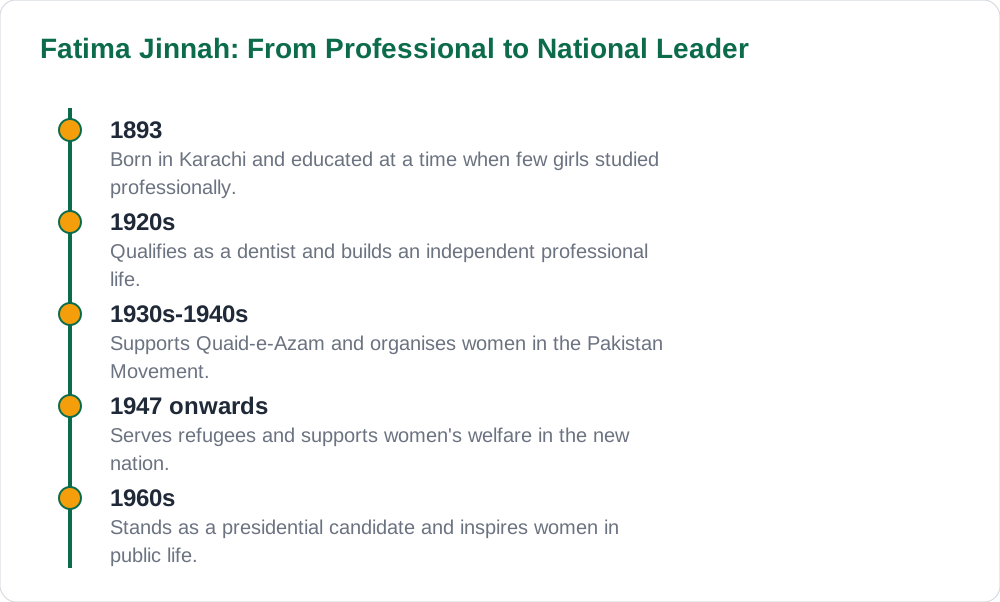
Fatima Jinnah was born in Karachi in 1893. She received a good education at a time when few girls in the subcontinent were encouraged to study professionally. She trained as a dentist and practised her profession, which gave her financial independence and public confidence. This matters for students today because it shows that education is not only about exams. It is about gaining a skill that lets you stand on your own feet and serve others.
Her early life also shows the value of family support and personal discipline. She managed her home, her profession, and later her political work with care. Girls and boys alike can learn from this balance. Study well, learn a useful skill, and use it honestly. A person who can support themselves can also help others without depending on favour or charity. That independence gave Fatima Jinnah the strength to speak publicly at a time when women's voices were often ignored.
Companion and Strength to Quaid-e-Azam
After the death of Quaid-e-Azam's wife, Fatima Jinnah became his closest companion and support. She managed his household, looked after his health, and travelled with him during the long and tiring struggle for Pakistan. Those who knew them describe her as calm, organised, and loyal. Leadership is often shown in public speeches, but it is also built in private care: looking after health, keeping schedules, and giving honest advice. Fatima Jinnah performed that quiet work with dedication.
Students can learn an important lesson here. Supporting others is not a small role. Helping a sick family member, managing home tasks so a parent can work, or supporting a classmate before an exam are acts of real service. A family, a class, and a nation all run on such quiet support. Fatima Jinnah reminds us that strength is not always loud. Sometimes strength is steady care, day after day, without seeking praise. You can read more study material on the solved notes page.
Organising Women in the Pakistan Movement
Fatima Jinnah played a major role in bringing women into the Pakistan Movement. She addressed women's gatherings, encouraged them to join the Muslim League, and helped organise support for the cause. At that time, many women faced social restrictions on public activity. Her example showed that women could take part in national life while keeping their dignity and values. She proved that the freedom struggle belonged to the whole nation, not to men alone.
For students, this teaches equality in practice. In class, girls and boys should both get chances to speak, lead groups, and present work. Teachers and students should respect every voice. When girls are encouraged to study, speak, and lead, the whole class becomes stronger. Fatima Jinnah's work also teaches organisation: change happens when people meet, plan, share tasks, and work together. One speech does not build a movement. Steady, organised effort does.
- Give girls and boys equal chances to speak and lead in class.
- Organise group work with clear tasks for every member.
- Respect every voice instead of only listening to the loudest student.
Service After Independence
After Pakistan came into being in 1947, Fatima Jinnah continued her public service. She worked for refugees who had arrived with little more than their lives, and she supported women's education and welfare. The early years of Pakistan were full of hardship: shortages, administrative problems, and the grief of partition. In that difficult time, her calm presence and welfare work gave comfort to many people. She did not retire from public life after independence. She believed that freedom brought responsibility, not rest.
Students can apply this lesson after success. Passing an exam, winning a competition, or finishing a project is not the end. It is the start of a new responsibility to help others. A student who does well should help classmates, share notes, and guide younger students. Service after success is what turns a good result into good character. That spirit kept Fatima Jinnah respected long after the independence struggle ended. Find class-wise books on the books page.
A Leader in Her Own Right
Later in life, Fatima Jinnah entered electoral politics and stood as a candidate in the presidential election of the 1960s. Although she did not win, her campaign was historic because it showed that a woman could lead a national political movement and challenge powerful rulers. Her courage inspired many women to enter public life, education, and professional work. She passed away in Karachi in 1967, but her title Madar-e-Millat keeps her memory alive as a mother figure of the nation.
Her final lesson for students is courage with dignity. She disagreed with rulers, but she argued her case publicly and peacefully. She did not use abuse or violence. Students can practise the same courage: speaking the truth politely, standing up for a classmate who is treated unfairly, and refusing to join in bullying or cheating. Courage is not shouting. It is standing firm for what is right, calmly and consistently. That is the leadership Fatima Jinnah modelled for every Pakistani student. More guidance is available on the blog home.
AI Help: Muse AI
Muse AI is Meta's personal AI assistant. It can explain history in simple words, summarise a lesson, and make practice questions for revision. For this article, you can ask Muse AI to summarise Fatima Jinnah's role in three short points for class revision. Join Muse with invite code LTGSWD — in the Muse app, go to Settings > Redeem token and enter the code. Disclosure: LTGSWD is the author's Muse invite code. Muse AI does not give official Sindh Textbook Board answers — always verify against your Sindh Textbook Board book and your teacher.
4 key points you must know
- Fatima Jinnah was a trained dentist before she became a national leader.
- She organised women and supported Quaid-e-Azam during the Pakistan Movement.
- After 1947 she served refugees and supported women's welfare.
- Her later political campaign showed women's leadership in public life.
Frequently asked questions
Why is Fatima Jinnah called Madar-e-Millat?
She is called Mother of the Nation because of her lifelong service to Pakistan, her support for Quaid-e-Azam, and her care for women, refugees, and the people.
What profession did Fatima Jinnah practise?
She trained and practised as a dentist, which gave her professional independence and public confidence before her political work.
How did she help women in the Pakistan Movement?
She addressed women's gatherings, encouraged them to join the movement, and helped organise their political participation at a time of social restrictions.
What lesson can students learn from her life?
Education brings independence, quiet support is real service, and courage with dignity means standing for what is right calmly and peacefully.
Solved notes — preview free
These guides work best with the solved exercises. Preview the solved notes free on this website — 119 solved notes for Classes 6–10 in Sindhi, Urdu, English and Arabic medium. Or browse the full solved notes catalogue for your class and medium. New solved notes are added regularly — check the catalogue for coming-soon books.