Sleep, Food and Focus in Exam Week

Pupils often treat exam week as a time to sacrifice sleep, skip meals, and study until midnight. It feels dedicated, but it backfires. A tired brain forgets faster, reads slower, and panics more easily. A hungry or overfull brain struggles to concentrate. Sleep, food and focus in exam week are not luxuries that distract from revision — they are the foundation that makes revision work. This guide covers the practical basics: how much sleep to aim for, when to stop studying at night, what to eat and drink on exam days, and how to handle your phone so it stops stealing your attention. None of it requires money or special equipment — just a steady routine for the days that matter most.
Sleep: The Brain's Revision Partner
Sleep is when your brain consolidates what you studied: it moves facts from short-term memory into longer-term storage and clears the mental fog of the day. A pupil who sleeps well after studying remembers more the next morning than a pupil who studied two extra hours and slept badly. Cutting sleep to study more is like pouring water into a leaking bucket — more goes in, but less stays.
Aim for a steady sleep schedule in exam week: the same bedtime and the same wake-up time every day, including the night before the exam. Most school-age pupils do best with roughly eight to nine hours, but the exact number matters less than the regularity. A regular schedule trains your body to feel alert in the morning, which is when most exams happen.
- Keep the same bedtime and wake-up time every day of exam week.
- Studying late into the night usually costs more marks than it gains.
- A rested brain recalls faster, reads more carefully, and panics less.
The Night Before: Wind Down, Don't Cram
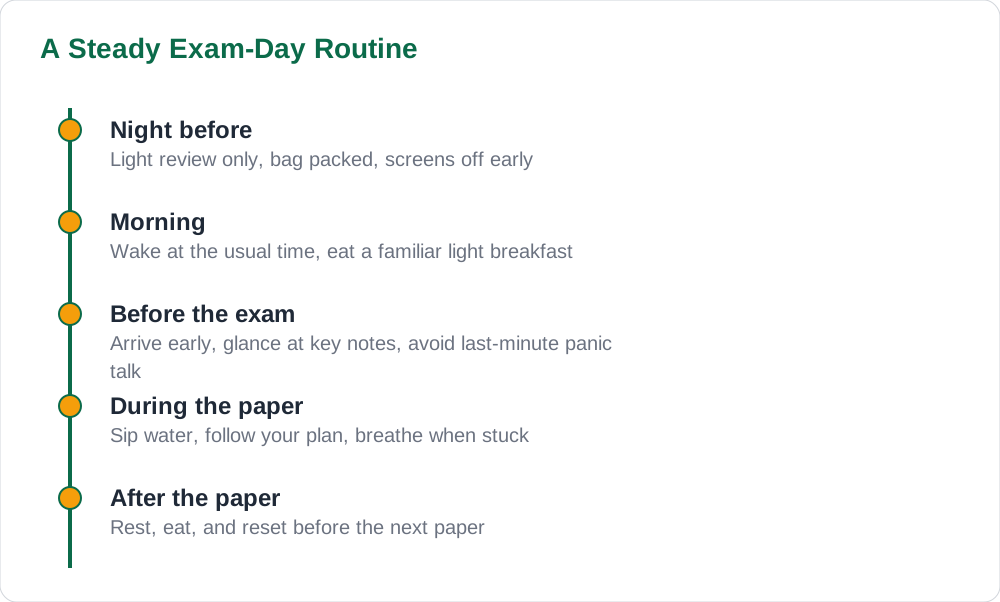
The night before an exam is for light review, not new learning. Spend an hour at most glancing over your key notes, your mistake log, and the headings of each topic — then stop. Trying to learn a whole new chapter at 11 p.m. raises anxiety and crowds out sleep, and it rarely sticks anyway. Trust the preparation you have already done.
Build a short wind-down routine: lay out your pens, admit card, and clothes; pack your bag; take a bath or a short walk; and put screens away at least half an hour before bed. Screens keep the brain alert, so scrolling late at night is one of the worst ways to end an exam-eve. A calm, boring last half-hour is exactly what you want.
Food and Water on Exam Days
On exam morning, eat a normal, familiar breakfast — something you have eaten before, in a normal portion. A light, balanced meal with some protein and slow-release energy, such as bread with eggs, or paratha with yoghurt, keeps you steady through a long paper. Avoid two extremes: skipping breakfast, which leaves you foggy and distracted by hunger, and eating a heavy, greasy meal, which leaves you sluggish.
Take water into the exam if the rules allow, and sip it through the paper. Even mild dehydration makes concentration harder, and a sip of water is also a useful micro-break when you feel stuck: it gives your mind a few seconds to reset. Avoid energy drinks and excessive tea or coffee — they can raise jitters and make a nervous pupil more nervous. If you do drink tea, keep it to your usual amount.
Focus: Taming the Phone
The phone is the biggest focus thief in exam week. Every notification breaks concentration, and research on attention shows it can take many minutes to get fully back into deep study after a single glance at a screen. Pupils who study with the phone beside them often feel busy for hours while learning very little.
Use simple rules instead of willpower. During study blocks, put the phone in another room, or switch it off, or hand it to a family member. Study in focused blocks of about 45 to 50 minutes, then take a ten-minute break — and only then check your phone if you need to. Tell friends that you are studying in exam week; real friends will respect it. After the exam, check your messages freely — the break between papers is a good time to catch up.
Focus During the Paper Itself
Focus in the exam hall comes from the same habits. Start with your plan, work through your ranked questions, and ignore what other pupils are doing — someone writing fast may be writing nonsense, and someone leaving early may have left questions blank. Your paper is your own race. If your mind wanders, bring it back with a small physical anchor: reread the question, underline the keywords, or take one slow breath.
If anxiety rises, use the same reset you practised: pen down, three slow breaths, then the next question. Anxiety is normal in exams; it only becomes a problem when it freezes you. A planned response to anxiety — breathe, park the hard question, move on — keeps you in control even on a hard paper.
Between Papers: Rest Is Also Revision
Between papers, resist two traps: endlessly replaying the paper you just finished, and cramming frantically for the next one. A short, honest review — what went well, what to fix next time — is useful; an hour of regret is not. You cannot change the paper you handed in, but you can protect the next one by resting, eating, and starting fresh.
Plan the gap between papers in three parts: rest first, then light review of the next subject, then an early night. A walk, a chat with family, and a proper meal do more for the next paper than three extra hours of anxious cramming. Steady routines like this are part of what separates top scorers in Sindh board exams from pupils who burn out mid-week. For a method to turn the finished paper into useful lessons, see how to avoid common exam mistakes, and for the night-before routine see how to revise the night before.
AI Help: Muse AI
Muse AI is Meta's personal AI assistant, and it can help you plan exam week: ask it to turn your exam timetable into a steady daily routine with sleep, meals, study blocks and breaks, so every day has the same calm rhythm. Muse AI does not give official Sindh Textbook Board answers — always verify against your Sindh Textbook Board book and your teacher.
Join Muse with invite code LTGSWD — in the Muse app, go to Settings > Redeem token and enter the code.
Disclosure: LTGSWD is the author's Muse invite code.
5 key points you must know
- Keep a steady sleep schedule in exam week — same bedtime, same wake-up time.
- The night before is for light review and wind-down, not new learning.
- Eat a familiar, light breakfast on exam morning; avoid skipping meals or heavy food.
- Keep the phone in another room during study blocks; check it only in breaks.
- Between papers, rest first, then review lightly — regret and frantic cramming help no one.
Frequently asked questions
How much sleep do I need in exam week?
Most school-age pupils do best with roughly eight to nine hours. The regularity matters most: the same bedtime and wake-up time every day trains your body to feel alert at exam time.
Is it ever worth staying up late to finish revision?
Rarely. Lost sleep harms memory, reading speed and calm the next day. A short, well-rested review in the morning beats a long, tired night session.
What should I eat on exam morning?
A normal, familiar, light breakfast — for example bread with eggs or paratha with yoghurt — plus water. Avoid new foods, skipped breakfast, and heavy greasy meals.
Should I stop using my phone entirely in exam week?
You do not need to stop entirely, but you should control it. Keep it away during study blocks and check it only in breaks, so notifications cannot keep breaking your concentration.
What if I feel too anxious to sleep the night before?
Keep your routine: dim lights, no screens, and a calm wind-down. Lying quietly and resting still helps, and a steady morning routine will carry you through the paper even after a restless night.
Solved notes — preview free
These guides work best with the solved exercises. Preview the solved notes free on this website — 119 solved notes for Classes 6–10 in Sindhi, Urdu, English and Arabic medium. Or browse the full solved notes catalogue for your class and medium. New solved notes are added regularly — check the catalogue for coming-soon books.