Earn Partial Marks: How to Attempt Every Question
A blank answer earns zero marks — always, without exception. A partial answer, even one you are unsure about, can earn something. This simple fact is one of the most useful things a pupil can learn about exams. Examiners give marks for each correct point, definition, step or example in your answer, so an answer that is half right usually earns about half the marks. A blank page earns nothing at all. This guide shows you how to attempt every question, even the ones that scare you. You will learn a simple three-part structure — definition, point, example — that turns shaky knowledge into scorable answers, and a set of safe moves for questions where you genuinely cannot remember the full answer. The rule is simple: if a question is on your paper, it deserves an attempt.
Why Blank Answers Are the Costliest Mistake
Pupils leave questions blank for two reasons: they think they know nothing, or they run out of time. Both are fixable. The first reason is almost always wrong — you usually know something relevant: a definition, a related fact, a first step, an example. Even a single correct sentence can earn a mark, and one mark can be the difference between grades. The second reason is a time problem, covered by planning your paper so every question gets at least a few minutes.
Think of marks as points you collect, not a pass-or-fail verdict on each question. A paper with five half-attempted questions can outscore a paper with three perfect answers and two blanks. Attempting everything also keeps you calm: a paper full of attempts feels like a finished job, while blanks sit in your mind and grow into regret.
The Three-Part Attempt: Definition, Point, Example
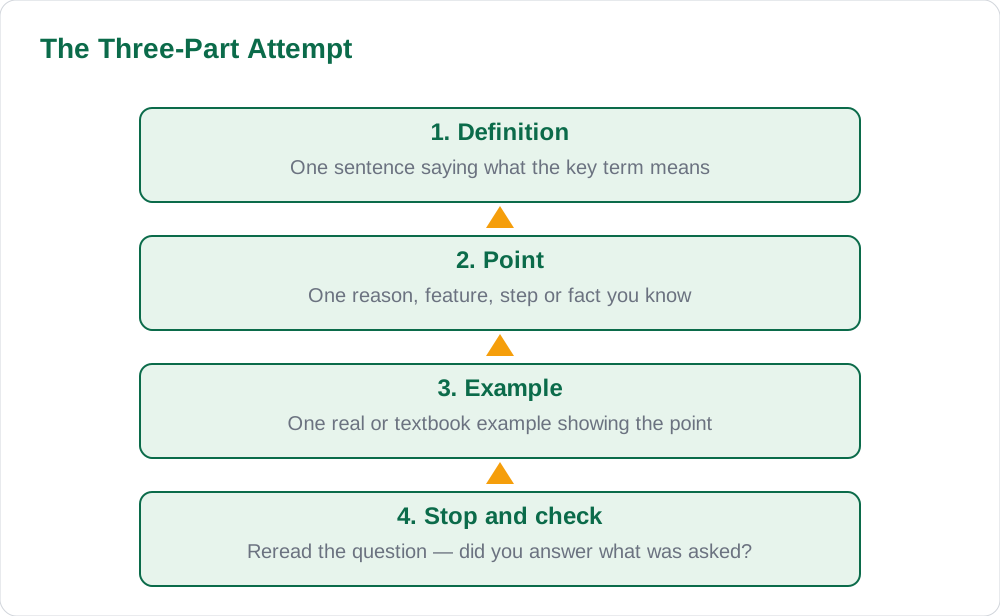
When you are unsure, build your answer from three blocks. First, a definition: write one sentence saying what the key term means. Definitions are often worth marks on their own, and they warm up your memory for the rest. Second, a point: write one thing you know about the topic — a reason, a feature, a step, or a fact. Third, an example: give one real or textbook example that shows the point. Three blocks, three chances to earn marks.
This structure also keeps weak answers organised. An examiner reading a neat definition-point-example answer can award marks quickly, while a long confused paragraph makes marks hard to find. Even if your point is only partly right, the structure itself helps the examiner see what you meant. Keep each block short and label nothing fancy — just write the sentences in order.
Safe Moves When You Cannot Remember the Full Answer
If your memory goes blank, do not freeze. Start with what you do know, even if it feels small. Write the definition of the main term. Write a related fact. Draw and label a simple diagram if the topic suits one — a labelled diagram can earn marks in science and geography even with little written text. Write the first step of a solution in mathematics, because method marks are often awarded for correct steps even when the final answer is missing.
Another safe move is to reason from what you know. If you cannot remember a list, explain one item well. If you cannot remember a name, describe the idea. If you are torn between two answers in a short question, write your best choice with a short reason — a reasoned attempt beats a guess, and a guess beats a blank. Never write I do not know in place of an answer; use the space to show what you do know.
- Write the definition of the main term — it often earns marks on its own.
- Draw and label a simple diagram where the topic allows it.
- In mathematics, write the correct first steps to earn method marks.
- If torn between answers, pick your best choice and add a short reason.
Partial Marks in Different Subjects
Partial marks work a little differently across subjects, but the principle is the same. In science, each correct fact, label, or step earns marks, so a labelled diagram plus two correct sentences can earn well. In mathematics, showing your working matters enormously — a correct formula and substitution earn marks even if the arithmetic slips. In Islamiat and social studies, a correct definition, one clear point, and one example form a solid short answer.
In language papers, writing something relevant and well organised earns marks for content and expression even if you cannot produce the perfect answer. An essay with a clear opening, two developed points, and a closing sentence will outscore a blank page or a single rushed paragraph. In every subject, the examiner is looking for what you got right, not only for what you got wrong.
Time for Attempts: Save Minutes for the Hard Ones
Attempting every question requires time discipline. If you spend all your time perfecting the questions you know, the hard ones get nothing. Instead, answer your confident questions first, but keep them tight, and reserve time at the end for the questions you find hard. Even five minutes per hard question is enough for a definition, a point, and an example.
A useful habit is to mark hard questions during your first scan of the paper and promise yourself you will return to them. When you return, you will often find that your mind has been working on them in the background while you answered other questions — ideas that were missing at minute five sometimes appear at minute forty. Read more about planning your paper in the five-minute plan and about avoiding common exam mistakes.
If you truly run out of time, write short bullet attempts for the remaining questions rather than full paragraphs. Three short correct points in bullet form can earn nearly as much as a long answer, and they take a fraction of the time.
What Never to Do in an Attempt
A good attempt is honest and relevant. Do not invent facts, dates, or quotations and present them as certain — an examiner can spot invented details, and they earn nothing. If you are unsure of a detail, write what you are confident about and leave the uncertain part general. Do not copy a neighbour's work or write a long unrelated essay hoping something will match; both waste time and the second can look like you did not read the question.
Do not write a joke, a plea for marks, or a complaint on the answer sheet. Examiners mark answers, not messages. And never leave a question blank because you think a weak attempt will hurt you — it cannot. The worst an attempt can earn is zero, which is exactly what a blank earns. For answer structure that makes attempts scorable, see how to write a perfect answer.
AI Help: Muse AI
Muse AI is Meta's personal AI assistant, and it can help you practise structured attempts: give it a topic and ask it to show you a definition, one key point and one example, then try writing the same structure yourself from memory. Muse AI does not give official Sindh Textbook Board answers — always verify against your Sindh Textbook Board book and your teacher.
Join Muse with invite code LTGSWD — in the Muse app, go to Settings > Redeem token and enter the code.
Disclosure: LTGSWD is the author's Muse invite code.
5 key points you must know
- A blank answer always earns zero; a partial answer can earn real marks.
- Build unsure answers from definition, one point, and one example.
- Show your working in mathematics — method steps earn marks even without the final answer.
- Reserve time at the end for hard questions instead of perfecting easy ones.
- Never invent facts or write messages to the examiner — attempt honestly and stay relevant.
Frequently asked questions
Can a wrong answer still earn marks?
Yes, if part of it is right. Examiners award marks point by point, so a correct definition or one correct step can earn marks even if another part of the answer is wrong.
What if I know absolutely nothing about a question?
Write the definition of the main term, one related fact, or a labelled diagram. You almost always know something connected to the topic, and that something can earn a mark.
Should I guess on short-answer questions?
Yes, if you have attempted to reason first. A reasoned best choice beats a blank. Never leave a question empty because you are unsure.
How much time should I save for hard questions?
Aim to leave at least a few minutes per hard question. Answer confident questions tightly so the hard ones still get a fair attempt.
Does writing bullets instead of paragraphs lose marks?
Not when the question asks for points or when time is short. Clear, correct bullet points can earn the same marks as paragraphs for many short-answer questions.
Solved notes — preview free
These guides work best with the solved exercises. Preview the solved notes free on this website — 119 solved notes for Classes 6–10 in Sindhi, Urdu, English and Arabic medium. Or browse the full solved notes catalogue for your class and medium. New solved notes are added regularly — check the catalogue for coming-soon books.