English Essay: Science in Daily Life
The english essay science daily life topic is easy to write well, because science surrounds you from the moment you wake up until you sleep. The alarm clock, the electric light, the gas stove, the mobile phone and the medicine in your home are all gifts of science. This article gives you an outline, a full model essay and exam tips, so that you can turn everyday examples into a strong, well-organised essay. You can find more study material on the [Solved Notes](/solved.html) page and in the [books](/books.html) section.
Science Is Not Only in the Laboratory
Many students think science lives only in textbooks and laboratories, but in truth science lives in every room of the house. When you switch on a fan, you use electricity; when you cook food on a stove, you use heat energy; when you keep milk fresh in a refrigerator, you use the science of cooling. Even the soap that cleans your hands and the toothpaste that protects your teeth are products of chemistry. Once you notice these examples, you will never run out of ideas for this essay.
Science has also changed travel, communication and medicine beyond recognition. A journey that once took weeks now takes hours by aeroplane, and a message that once took days now reaches another country in seconds through a mobile phone. Doctors use X-rays, vaccinations and modern medicines to cure diseases that once killed thousands of people. At the same time, science must be used wisely, because the same knowledge that makes electricity can also make weapons, and the same factories that make goods can pollute the air if they are careless.
- Morning: alarm, light, toothpaste, breakfast
- Kitchen: stove, refrigerator, clean water
- Communication: mobile phone, television, internet
- Health: medicines, vaccination, hospitals
- Travel: bus, train, aeroplane
Essay Outline: Science in Daily Life
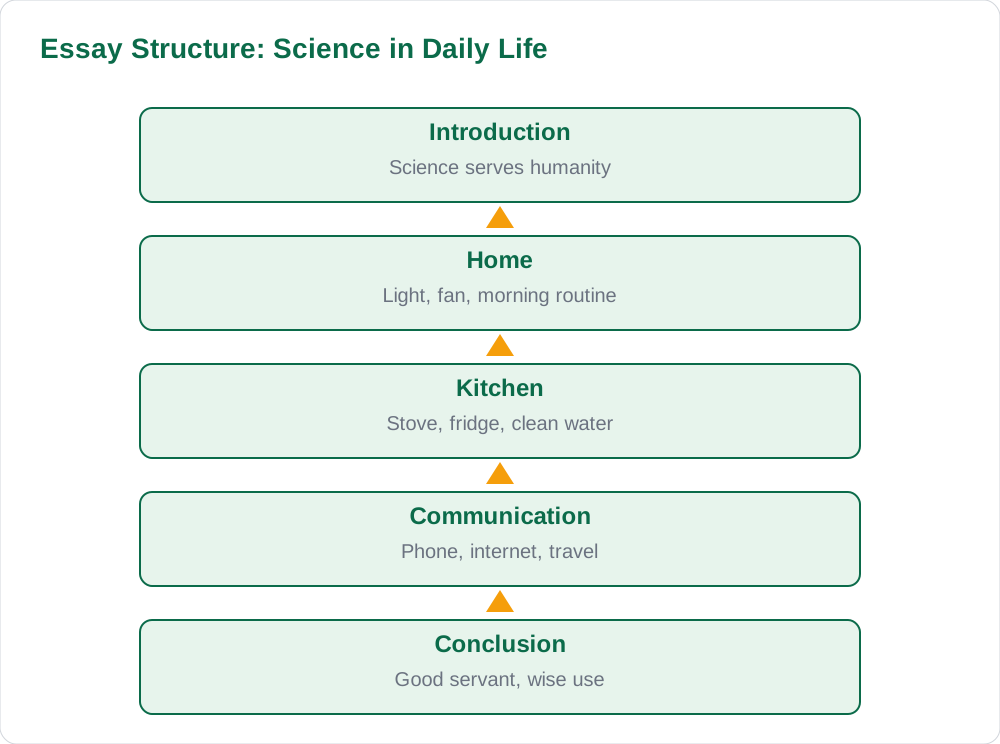
The best structure for this essay follows your own day: morning, kitchen, communication, health and travel, ending with a balanced conclusion. This day-order structure is natural, easy to remember and full of examples, so you will not need to memorise abstract points. Start with a general introduction about science as a servant of humanity, then walk through the day giving one or two examples in each paragraph. End by saying that science is a good servant but a bad master, and must be used for peace and human welfare.
Make sure every example is real and from daily life, not from a science fiction film. Examiners reward the student who writes about a refrigerator and a mobile phone more than the student who writes vaguely about wonderful inventions. Name the object, say what it does, and say how life would be difficult without it. That three-step pattern — object, use, benefit — makes every paragraph strong.
- Introduction: science as a servant of humanity
- Body 1: morning and home
- Body 2: kitchen and food
- Body 3: communication and travel
- Body 4: health and medicine
- Conclusion: use science wisely for welfare
Model Essay: Science in Daily Life
Science plays a very important part in our daily life, and it is difficult to imagine even a single day without its blessings. In the morning, the alarm clock wakes us, the electric bulb removes darkness, and the tap gives us clean water for washing and drinking. At breakfast, science helps us again: the stove cooks our food quickly, the refrigerator keeps milk and vegetables fresh, and the toaster prepares bread in minutes. Without science, our mornings would be slow, dark and full of hard labour, but with science they are easy, comfortable and pleasant.
Science has also made communication and travel wonderfully easy. Through the mobile phone we can talk to a relative in another city or country in seconds, and through television and the internet we learn the news of the whole world while sitting at home. Buses, trains and aeroplanes carry us quickly and safely over long distances, and students can now study from books, videos and online lessons that were unknown to their grandparents. In the field of health, science has given us medicines, vaccinations, X-rays and modern hospitals, so diseases that once caused great fear can now be treated and often cured completely.
Model Essay: Conclusion and Useful Vocabulary
However, we must remember that science is a good servant but a bad master, and it must be used with wisdom and care. The same science that produces electricity and medicines can also produce harmful weapons and pollution if people use it selfishly. Factories must control their smoke, drivers must avoid unnecessary horns and smoke, and students must use mobile phones for learning rather than wasting hours on useless games. In conclusion, science has made our life comfortable, healthy and fast, and if we use it honestly for the welfare of humanity, it will continue to be our greatest blessing.
Useful vocabulary includes: invention for a new device or method, blessing for a great benefit, vaccination for protection against disease, and welfare for the health and happiness of people. Use verbs actively: science cooks, preserves, connects and cures. Avoid writing science has made our life easy in every paragraph; vary your sentences by giving a new example each time, so the essay stays fresh from beginning to end.
- invention — a new device or method
- blessing — a great benefit or gift
- vaccination — protection against a disease
- welfare — health, happiness and safety
- labour — hard physical work
Exam Technique for This Essay
Good essays are planned before they are written, and this topic is no exception. Spend the first five minutes making a short outline on the rough-work page: introduction, three or four body points in a sensible order, and a conclusion. This small habit prevents repetition, keeps your ideas in order, and helps you finish on time. In the examination hall, write neatly, leave a clear space between paragraphs, and check your spelling at the end if time allows. A clean, well-organised answer always scores better than a longer, confused one, even when both students know the same facts.
Practise by writing this essay once at home without looking at your notes, then compare your draft with the outline in this article and improve the weak paragraphs. Learn five or six useful words for this topic and use them naturally, not forced into every sentence. Avoid copying long sentences you do not understand, because examiners reward clear, original English. Read your essay aloud once before submitting it in practice: if a sentence sounds strange when spoken, rewrite it in simpler words. With one careful practice essay a week, your speed, confidence and marks will all improve steadily.
- Follow your day: morning, kitchen, communication, health
- Use the pattern: object, use, benefit
- Give real examples, not science fiction
- Add a balanced warning: use science wisely
- Vary examples so no paragraph repeats the last
AI Help: Muse AI
Muse AI is Meta's personal AI assistant, and it can help you learn in simple, clear language. For example, ask Muse AI to list five science examples from your own kitchen or to simplify a difficult sentence in your draft.
Join Muse with invite code LTGSWD — in the Muse app, go to Settings > Redeem token and enter the code. Disclosure: LTGSWD is the author's Muse invite code. Muse AI does not give official STBB answers — always verify against your STBB book and your teacher. Always verify against your Sindh Textbook Board book and your teacher before using anything in classwork.
5 key points you must know
- Science is present in every room of the house.
- Daily examples beat vague praise of inventions.
- Communication, travel and medicine show science's power.
- Science must be used wisely, not selfishly.
- A balanced conclusion scores higher than one-sided praise.
Frequently asked questions
How do I get enough examples for this essay?
Walk through your own day in your mind: waking, washing, eating, travelling, studying and sleeping. Every step gives you an example, from the alarm clock to the electric bulb. Write down ten examples first, then choose the best six for your essay.
Should I mention the harms of science too?
Yes, briefly, in the conclusion or the last body paragraph. A short balanced note about pollution or misuse shows maturity. Keep it short, so the essay remains mainly about the benefits of science in daily life.
How long should this essay be in the examination?
For Classes 9 and 10, about 250 to 300 words is a safe length. That is usually five to seven paragraphs: one introduction, three or four body paragraphs and one conclusion. Quality matters more than length, so do not pad your essay with repeated sentences just to make it longer.
Can I change the model essay in my own words?
Yes, and you should. Use the model essay as a guide for structure and ideas, then rewrite it in your own simple English. Examiners reward original writing, so keep the outline, change the examples where you can, and add one personal observation from your own life. You can find more study guides on the blog page.
Solved notes — preview free
These guides work best with the solved exercises. Preview the solved notes free on this website — 119 solved notes for Classes 6–10 in Sindhi, Urdu, English and Arabic medium. Or browse the full solved notes catalogue for your class and medium. New solved notes are added regularly — check the catalogue for coming-soon books.