English Essay: Quaid-e-Azam Muhammad Ali Jinnah

The english essay quaid e azam topic is one of the most respected essay topics in Pakistan, because the Founder of the Nation is a model of honesty, hard work and determination. Muhammad Ali Jinnah was born on 25 December 1876 in Karachi, became a great lawyer and leader, and led the Muslims of the subcontinent to the creation of Pakistan on 14 August 1947. This article gives you an outline, a full model essay and exam tips, so that you can write about his life with respect and accuracy. Related notes are available on the [Solved Notes](/solved.html) page and in the [books](/books.html) collection.
Why the Quaid-e-Azam Still Inspires Us
Great leaders are remembered not for wealth or power, but for character, and the Quaid-e-Azam possessed character in the highest degree. He was honest in his dealings, punctual in his habits, firm in his principles and fearless in speaking the truth. He never accepted a bribe, never broke his word and never changed his stand for personal gain. Students can learn from him that success comes from discipline and hard work, not from shortcuts, and that a single honest person can change the history of a whole nation.
His greatest achievement was Pakistan, a separate homeland where Muslims could live according to their faith, laws and culture. He achieved this not by violence, but by constitutional struggle, powerful speeches and unshakable unity of the Muslim League. His guiding motto, Faith, Unity and Discipline, remains the best advice for every Pakistani student today. Faith gives courage, unity gives strength, and discipline gives success, and any student who practises these three qualities can achieve great things in life.
- Born 25 December 1876 in Karachi
- Became a brilliant lawyer and leader
- Led the struggle for Pakistan
- Pakistan came into being on 14 August 1947
- Motto: Faith, Unity and Discipline
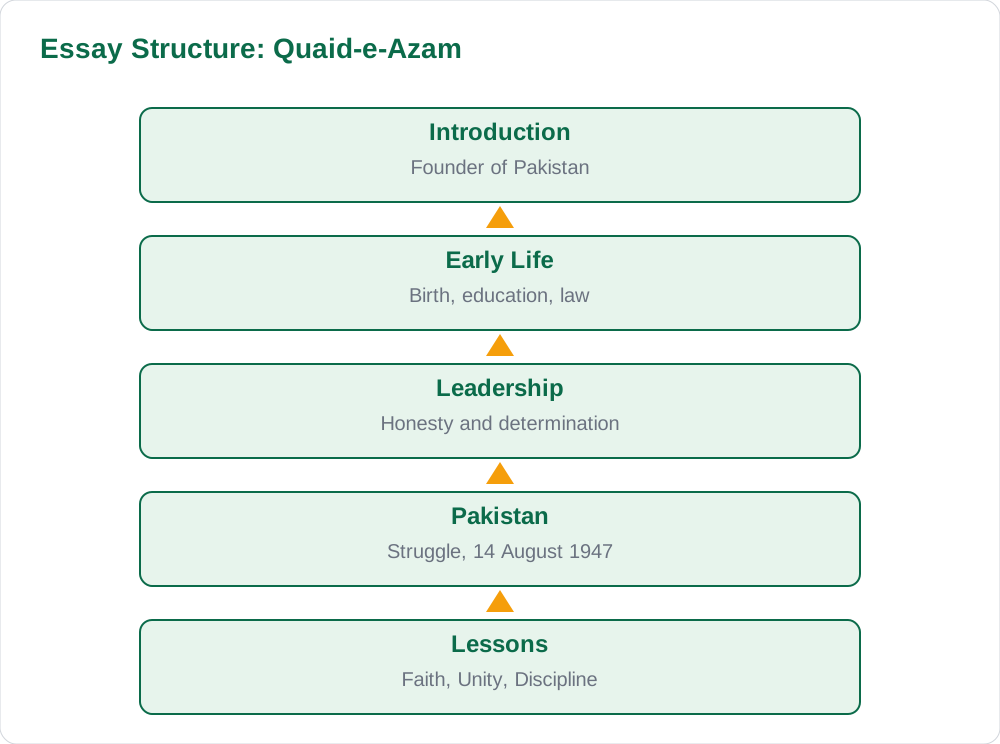
Essay Outline: Quaid-e-Azam
Arrange this essay in time order: birth and early life, education and legal career, political struggle, achievement of Pakistan, and lessons for students. Time order is easy to follow and prevents confusion, which is important when an essay covers a whole life. Keep dates short and only those you are sure of: birth year 1876 and independence year 1947 are the two essential dates. Do not guess at other dates or events; a wrong date in a history essay damages your credibility.
The conclusion should not repeat the biography; it should explain what we must learn. Write about honesty, hard work, unity and discipline, and end with a promise to follow his example in student life. This turns a simple life story into a meaningful essay with a message, which is exactly what examiners look for in a personality essay.
- Introduction: the Founder of Pakistan
- Body 1: early life and education
- Body 2: legal career and leadership
- Body 3: struggle and creation of Pakistan
- Conclusion: lessons for students today
Model Essay: Quaid-e-Azam Muhammad Ali Jinnah
Quaid-e-Azam Muhammad Ali Jinnah is the Founder of Pakistan, and every Pakistani remembers him with love, respect and gratitude. He was born on 25 December 1876 in Karachi, and from his childhood he was serious, hardworking and fond of reading. After completing his early education, he went to England to study law, and on his return he became one of the most brilliant lawyers of Bombay. His honesty was famous: he never took a case he believed to be unjust, and even his opponents admired his truthfulness and dignity.
In politics, the Quaid first worked for Hindu-Muslim unity, but when he saw that Muslims would not get justice and freedom in a united India, he led the demand for a separate homeland. With wisdom, patience and powerful arguments, he united the Muslims of the subcontinent under the flag of the Muslim League. He faced opposition, illness and great difficulties, yet he never lost courage and never compromised on principles. At last, on 14 August 1947, his dream came true and Pakistan appeared on the map of the world, and the nation gave him the title of Quaid-e-Azam, the Great Leader.
Model Essay: Conclusion and Useful Vocabulary
The Quaid-e-Azam died on 11 September 1948, only a year after independence, but his work and his message live on. He gave us the motto of Faith, Unity and Discipline, and this motto is a complete guide for national life. Faith means trust in our cause and in ourselves; unity means standing together beyond province, language and sect; discipline means obeying laws and doing our duty honestly. If students follow this motto, they will succeed in examinations and in life, and Pakistan will progress towards the bright future its Founder dreamed of.
Useful vocabulary for this essay includes: founder for the person who establishes something, determination for firm decision, constitutional for done through law and peaceful methods, and gratitude for thankfulness. Use the title Quaid-e-Azam with respect and spell Muhammad Ali Jinnah correctly, as examiners notice errors in famous names. Avoid exaggeration: the Quaid's real life is inspiring enough without invented stories, so write only facts you know.
- founder — a person who establishes a country or organisation
- determination — firmness of purpose
- constitutional — through law, not violence
- opponent — a person who disagrees or competes
- gratitude — deep thankfulness
Exam Technique for This Essay
Good essays are planned before they are written, and this topic is no exception. Spend the first five minutes making a short outline on the rough-work page: introduction, three or four body points in a sensible order, and a conclusion. This small habit prevents repetition, keeps your ideas in order, and helps you finish on time. In the examination hall, write neatly, leave a clear space between paragraphs, and check your spelling at the end if time allows. A clean, well-organised answer always scores better than a longer, confused one, even when both students know the same facts.
Practise by writing this essay once at home without looking at your notes, then compare your draft with the outline in this article and improve the weak paragraphs. Learn five or six useful words for this topic and use them naturally, not forced into every sentence. Avoid copying long sentences you do not understand, because examiners reward clear, original English. Read your essay aloud once before submitting it in practice: if a sentence sounds strange when spoken, rewrite it in simpler words. With one careful practice essay a week, your speed, confidence and marks will all improve steadily.
- Use time order: birth, career, struggle, Pakistan, lessons
- Use only dates you are certain about
- Spell names correctly: Muhammad Ali Jinnah
- End with lessons, not a repeated biography
- Keep the tone respectful throughout
AI Help: Muse AI
Muse AI is Meta's personal AI assistant, and it can help you learn in simple, clear language. For example, ask Muse AI to explain Faith, Unity and Discipline in simple words or to quiz you on the two key dates in this essay.
Join Muse with invite code LTGSWD — in the Muse app, go to Settings > Redeem token and enter the code. Disclosure: LTGSWD is the author's Muse invite code. Muse AI does not give official STBB answers — always verify against your STBB book and your teacher. Always verify against your Sindh Textbook Board book and your teacher before using anything in classwork.
5 key points you must know
- Quaid-e-Azam combined honesty, hard work and firm principles.
- He achieved Pakistan through constitutional struggle, not violence.
- Faith, Unity and Discipline is his lasting motto.
- Only certain dates should be written in a history essay.
- Students can follow his example in daily student life.
Frequently asked questions
What are the two most important dates for this essay?
25 December 1876, the birth of the Quaid-e-Azam, and 14 August 1947, the creation of Pakistan. Learn these two dates by heart and spell them correctly. Add 11 September 1948, the date of his death, only if you remember it confidently.
How do I write a good conclusion for a personality essay?
Do not repeat the life story. Instead, name two or three qualities, such as honesty and discipline, and explain how students can practise them today. End with a short sentence of gratitude or a promise to follow the example.
How long should this essay be in the examination?
For Classes 9 and 10, about 250 to 300 words is a safe length. That is usually five to seven paragraphs: one introduction, three or four body paragraphs and one conclusion. Quality matters more than length, so do not pad your essay with repeated sentences just to make it longer.
Can I change the model essay in my own words?
Yes, and you should. Use the model essay as a guide for structure and ideas, then rewrite it in your own simple English. Examiners reward original writing, so keep the outline, change the examples where you can, and add one personal observation from your own life. You can find more study guides on the blog page.
Solved notes — preview free
These guides work best with the solved exercises. Preview the solved notes free on this website — 119 solved notes for Classes 6–10 in Sindhi, Urdu, English and Arabic medium. Or browse the full solved notes catalogue for your class and medium. New solved notes are added regularly — check the catalogue for coming-soon books.