English Essay: Pollution and Its Solution
The english essay pollution topic matters to every student in Pakistan, because polluted air, dirty water and littered streets affect our health every day. Pollution means adding harmful substances to the environment, and its solution begins with understanding its three main kinds: air, water and land pollution. This article gives you an outline, a full model essay and exam tips. You can also find study material on the [Solved Notes](/solved.html) page and in the [books](/books.html) section.
Three Kinds of Pollution
Air pollution comes from smoke of vehicles, factories and burning rubbish, and it causes cough, asthma and other chest diseases, especially in crowded cities. Water pollution comes from sewage, factory waste and plastic thrown into rivers and canals, and it spreads stomach diseases and kills fish and plants. Land pollution comes from plastic bags, garbage and chemicals dumped on open ground, which spoil soil, block drains and breed flies and mosquitoes. When you understand these three kinds separately, your essay becomes organised and easy to follow.
The causes of pollution are mostly human activities, which is good news, because human activities can also be changed. People burn rubbish instead of disposing of it properly, factories release smoke without filters, and shoppers use plastic bags for every small purchase. Floods worsen when drains are blocked by plastic, and dirty water spreads disease when sewage mixes with drinking water. Every cause in your essay should be paired with a solution, because an essay that only complains, without suggesting fixes, feels incomplete to an examiner.
- Air: vehicle and factory smoke
- Water: sewage, factory waste, plastic
- Land: garbage, plastic bags, chemicals
- Effects: cough, stomach disease, blocked drains
- Solutions: trees, filters, clean habits
Essay Outline: Pollution and Its Solution
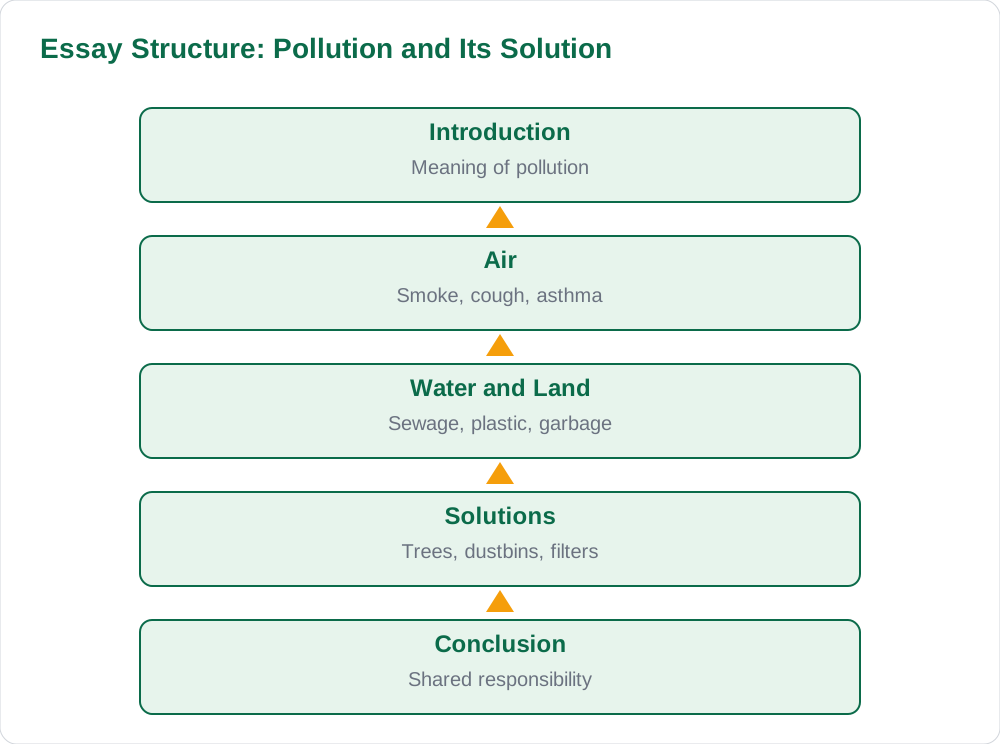
Use a clear problem-and-solution structure: introduction, air pollution, water and land pollution, solutions, and conclusion. Give each kind of pollution its own paragraph with causes and effects, then devote a full paragraph to practical solutions that students and families can actually follow. Practical solutions score higher than grand promises: planting trees, using dustbins, avoiding plastic bags, saving water and keeping streets clean are all actions a student can describe honestly.
End with a shared responsibility message: government, factories and citizens must all play their part. Government can enforce laws and provide dustbins and clean water, factories can install filters, and citizens can stop littering and plant trees. When all three work together, the environment improves quickly. Avoid blaming one group only, and avoid inventing statistics; write about effects you can explain, such as cough from smoke or disease from dirty water.
- Introduction: meaning of pollution
- Body 1: air pollution, causes and effects
- Body 2: water and land pollution
- Body 3: practical solutions for all
- Conclusion: shared responsibility, clean future
Model Essay: Pollution and Its Solution
Pollution is one of the greatest problems of the modern world, and it means making our air, water and land dirty and harmful through human activities. Air pollution is caused by the smoke of vehicles, factories and burning rubbish, and it fills our cities with dust and poisonous gases. People who breathe this polluted air suffer from cough, asthma and other diseases of the chest, and children and old people suffer the most. Water pollution is equally dangerous: sewage, factory waste and plastic are thrown into rivers and canals, so drinking water becomes unsafe and fish and crops are harmed. Land pollution spoils our streets and fields, because garbage and plastic bags block drains, breed mosquitoes and make our surroundings ugly and unhealthy.
The solution to pollution begins with simple habits that every student and family can adopt today. We must plant more trees, because trees clean the air, give shade and make our surroundings beautiful. We must use dustbins instead of throwing rubbish on streets, carry cloth bags instead of plastic bags, and save water instead of wasting it. Factories must install filters to clean their smoke, and the government must enforce laws against dumping waste into rivers and provide proper dustbins and clean drinking water in every area. Schools can help by teaching students about cleanliness and by organising tree-planting and cleanliness campaigns every year.
Model Essay: Conclusion and Useful Vocabulary
In conclusion, pollution is a problem created by human beings, and therefore human beings can solve it if they act together with sincerity. If every citizen stops littering, plants even one tree and uses water carefully, our cities will become cleaner within a few years. A clean environment means healthy children, fresh air, safe water and a beautiful country, and these blessings are worth far more than the small effort they require. Let us promise today to keep our homes, streets and schools clean, because a clean Pakistan is the duty and the pride of every Pakistani.
Useful vocabulary includes: environment for our surroundings, sewage for dirty waste water, filter for a device that cleans smoke or water, and campaign for an organised effort for a cause. Use cause-and-effect language: smoke causes cough, plastic blocks drains, trees clean air. This language makes your essay logical and persuasive, and it shows the examiner that you understand the problem, not merely memorised a paragraph.
- environment — our surroundings: air, water, land
- sewage — dirty waste water from homes
- filter — a device that removes harmful substances
- campaign — an organised effort for a cause
- breed — to produce young, as mosquitoes do
Exam Technique for This Essay
Good essays are planned before they are written, and this topic is no exception. Spend the first five minutes making a short outline on the rough-work page: introduction, three or four body points in a sensible order, and a conclusion. This small habit prevents repetition, keeps your ideas in order, and helps you finish on time. In the examination hall, write neatly, leave a clear space between paragraphs, and check your spelling at the end if time allows. A clean, well-organised answer always scores better than a longer, confused one, even when both students know the same facts.
Practise by writing this essay once at home without looking at your notes, then compare your draft with the outline in this article and improve the weak paragraphs. Learn five or six useful words for this topic and use them naturally, not forced into every sentence. Avoid copying long sentences you do not understand, because examiners reward clear, original English. Read your essay aloud once before submitting it in practice: if a sentence sounds strange when spoken, rewrite it in simpler words. With one careful practice essay a week, your speed, confidence and marks will all improve steadily.
- Pair every cause with a solution
- Cover air, water and land separately
- Give practical solutions students can do
- Avoid invented statistics and figures
- End with shared responsibility, not blame alone
AI Help: Muse AI
Muse AI is Meta's personal AI assistant, and it can help you learn in simple, clear language. For example, ask Muse AI to suggest three practical solutions for pollution in your street or to simplify a paragraph about air pollution.
Join Muse with invite code LTGSWD — in the Muse app, go to Settings > Redeem token and enter the code. Disclosure: LTGSWD is the author's Muse invite code. Muse AI does not give official STBB answers — always verify against your STBB book and your teacher. Always verify against your Sindh Textbook Board book and your teacher before using anything in classwork.
5 key points you must know
- Pollution has three main kinds: air, water and land.
- Human causes can be changed by human action.
- Practical solutions score higher than grand promises.
- Government, factories and citizens share responsibility.
- A clean environment protects health and beauty.
Frequently asked questions
How do I organise a pollution essay without repeating myself?
Give air, water and land each their own paragraph, and keep all solutions together in one paragraph near the end. If a sentence fits in two paragraphs, keep it in the stronger one and delete it from the other.
Can I write about pollution in my own city?
Yes, and it makes your essay stronger. Mention littered streets, smoke from traffic or blocked drains as examples, without naming or blaming any individual. Local examples show observation, which examiners reward.
How long should this essay be in the examination?
For Classes 9 and 10, about 250 to 300 words is a safe length. That is usually five to seven paragraphs: one introduction, three or four body paragraphs and one conclusion. Quality matters more than length, so do not pad your essay with repeated sentences just to make it longer.
Can I change the model essay in my own words?
Yes, and you should. Use the model essay as a guide for structure and ideas, then rewrite it in your own simple English. Examiners reward original writing, so keep the outline, change the examples where you can, and add one personal observation from your own life. You can find more study guides on the blog page.
Solved notes — preview free
These guides work best with the solved exercises. Preview the solved notes free on this website — 119 solved notes for Classes 6–10 in Sindhi, Urdu, English and Arabic medium. Or browse the full solved notes catalogue for your class and medium. New solved notes are added regularly — check the catalogue for coming-soon books.